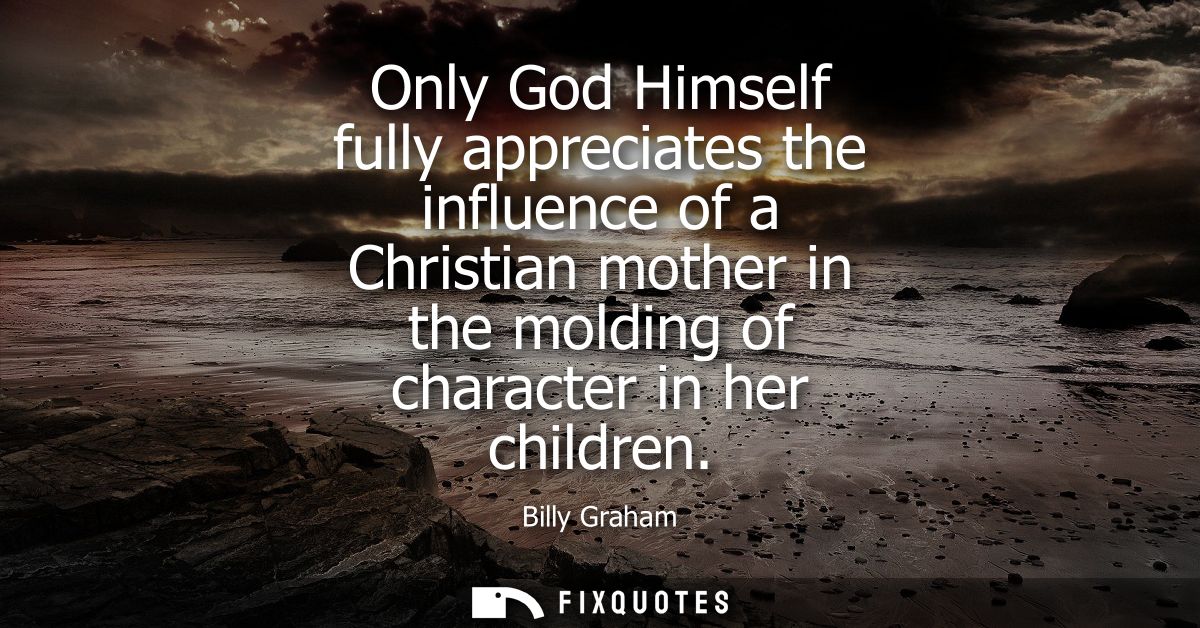
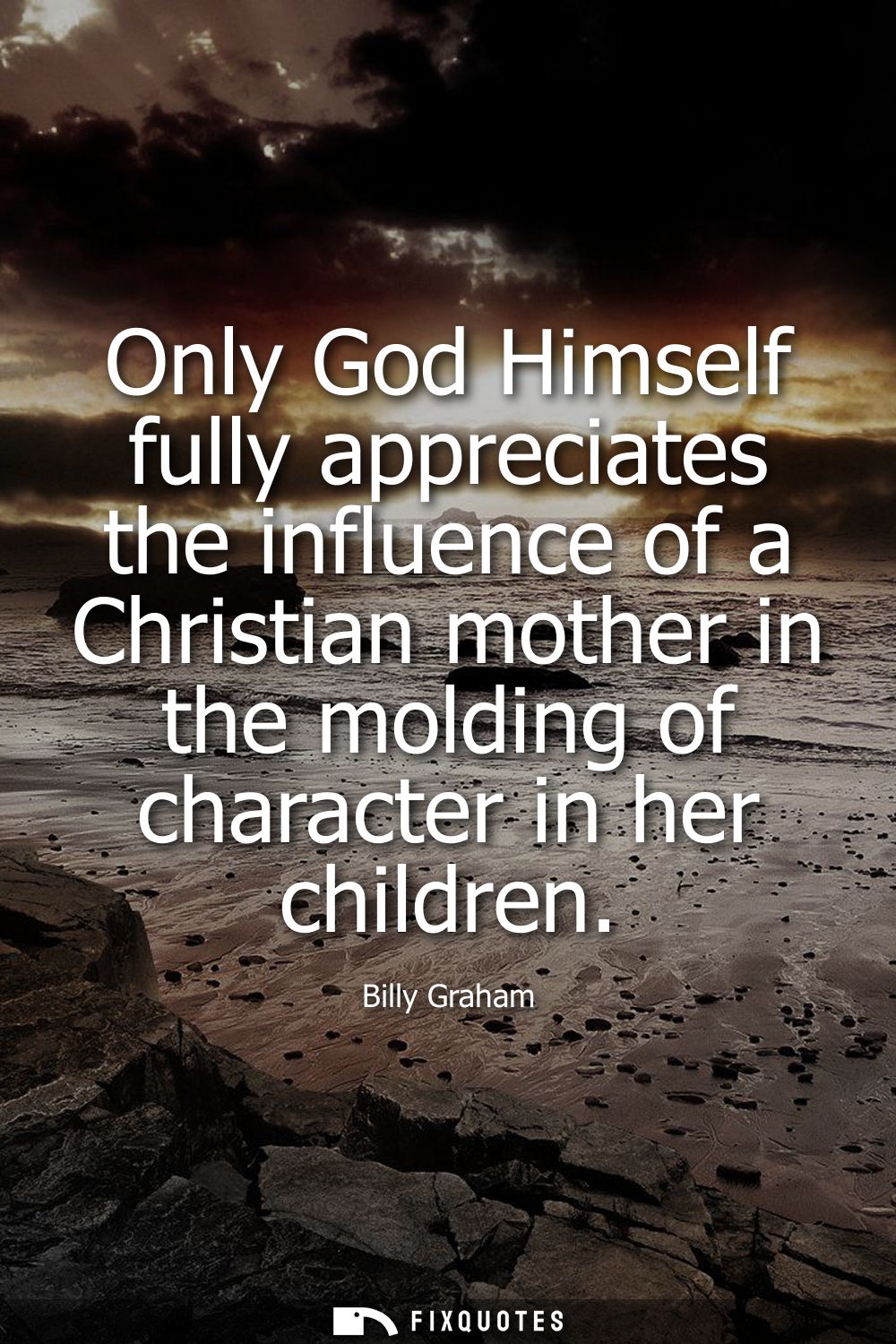
"Only God Himself fully appreciates the influence of a Christian mother in the molding of character in her children"
About this Quote
Graham’s line works like a benediction and a pressure point at the same time: it elevates motherhood to near-sacramental power while quietly removing it from public accounting. “Only God Himself” is the rhetorical masterstroke. It flatters the unseen labor of parenting by placing it beyond human measurement, then makes that very invisibility a virtue. If no one can “fully appreciate” a mother’s influence except God, the mother is promised cosmic recognition even when earthly recognition, resources, or relief never arrive.
The phrase “Christian mother” is doing boundary work. Graham isn’t praising mothers in general; he’s praising a specific moral and religious formation project, one aimed at “molding of character.” That verb turns parenting into craftsmanship: patient, daily pressure shaping a child toward an ideal. It also assumes a hierarchy of influence - the mother as primary moral architect - that aligns with mid-20th-century evangelical family ideals, where feminine authority is potent but domesticated, decisive but largely confined to the home.
Context matters: Graham preached to a postwar America anxious about social change, communism, and declining “values,” and he offered the family as a stabilizing institution. This quote comforts Christian women whose work is repetitive and undervalued, casting it as spiritually consequential. The subtext, though, is an expectation: if children’s “character” is the product, mothers bear the scrutiny when the product fails. It’s praise that can feel like protection, and also like assignment.
The phrase “Christian mother” is doing boundary work. Graham isn’t praising mothers in general; he’s praising a specific moral and religious formation project, one aimed at “molding of character.” That verb turns parenting into craftsmanship: patient, daily pressure shaping a child toward an ideal. It also assumes a hierarchy of influence - the mother as primary moral architect - that aligns with mid-20th-century evangelical family ideals, where feminine authority is potent but domesticated, decisive but largely confined to the home.
Context matters: Graham preached to a postwar America anxious about social change, communism, and declining “values,” and he offered the family as a stabilizing institution. This quote comforts Christian women whose work is repetitive and undervalued, casting it as spiritually consequential. The subtext, though, is an expectation: if children’s “character” is the product, mothers bear the scrutiny when the product fails. It’s praise that can feel like protection, and also like assignment.
Quote Details
| Topic | Mother |
|---|
More Quotes by Billy
Add to List