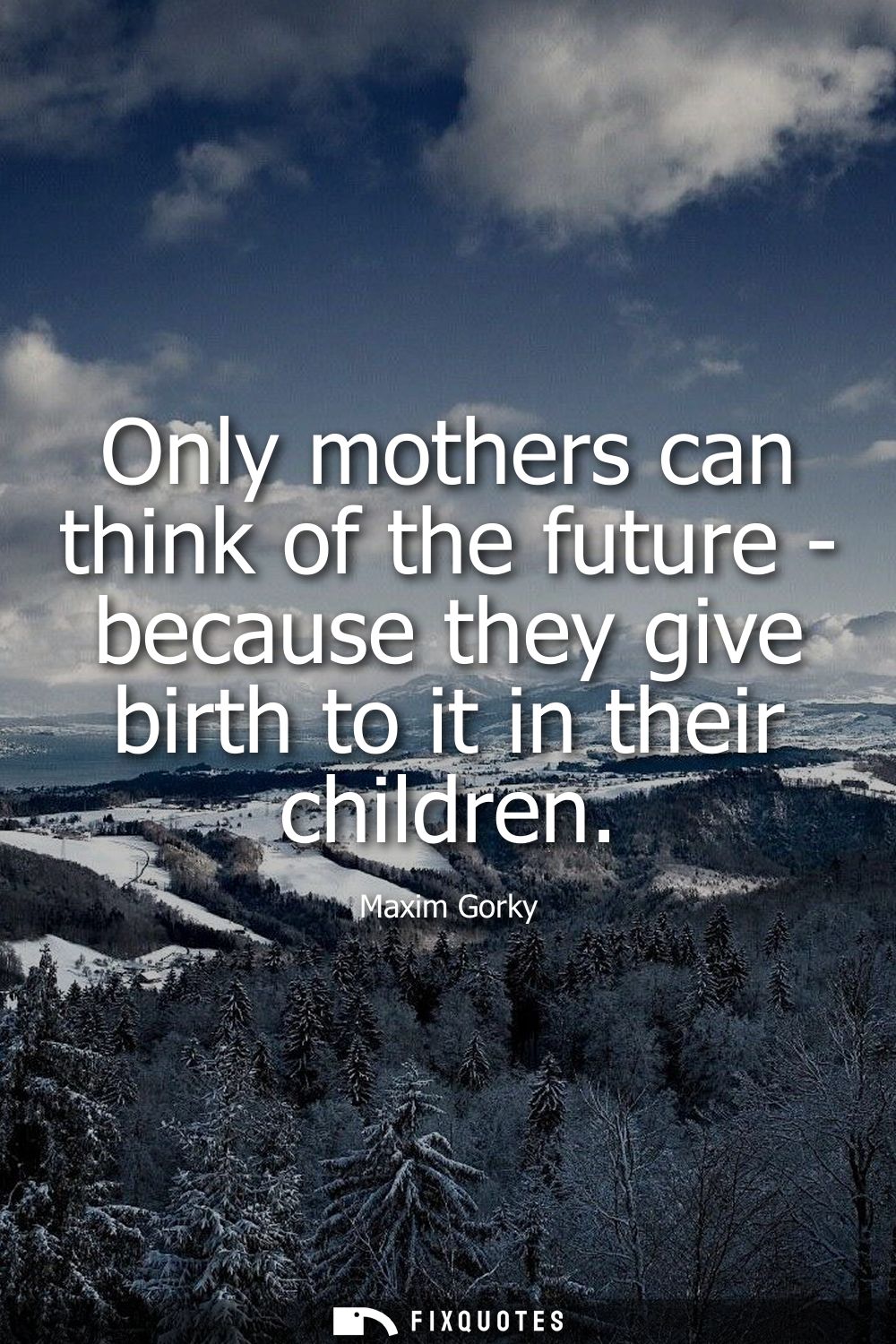
"Only mothers can think of the future - because they give birth to it in their children"
About this Quote
The subtext is sharper than the sentiment suggests. By implying that others can’t truly think ahead, Gorky quietly indicts a society run by men who talk about progress while treating actual lives as expendable. In early 20th-century Russia, “future” was a contested word, claimed by revolutionaries, reformers, and propagandists alike. Gorky, sympathetic to radical change but wary of cruelty dressed up as necessity, often insisted that any promised dawn had to answer for its human cost. Mothers become his ethical check: they can’t afford fantasies that require sacrificing a generation, because that generation is in their arms.
It’s also a strategic sentimentalism. Elevating mothers grants them authority without explicitly demanding power, an old move in cultures that revere maternal sacrifice while limiting women’s autonomy. The quote comforts and conscripts at once: it honors care as foresight, then leverages that care as a mandate to judge the present. In Gorky’s hands, motherhood isn’t merely private virtue; it’s a rebuke to politics that treats the future as a speech, not a child.
Quote Details
| Topic | Mother |
|---|---|
| Source | Later attribution: Humorous Wit (Djamel Ouis, 2020) modern compilationISBN: 9781782225829 · ID: c7zXDwAAQBAJ
Evidence:
... Only mothers can think of the future — because they give birth to it in their children. Maxim Gorky The future is our shirt, while the present is our skin. The future lies in designing and selling computers that people don't realize are ... |
| Cite |
Citation Formats
APA Style (7th ed.)
Gorky, Maxim. (2026, March 10). Only mothers can think of the future - because they give birth to it in their children. FixQuotes. https://fixquotes.com/quotes/only-mothers-can-think-of-the-future-because-7201/
Chicago Style
Gorky, Maxim. "Only mothers can think of the future - because they give birth to it in their children." FixQuotes. March 10, 2026. https://fixquotes.com/quotes/only-mothers-can-think-of-the-future-because-7201/.
MLA Style (9th ed.)
"Only mothers can think of the future - because they give birth to it in their children." FixQuotes, 10 Mar. 2026, https://fixquotes.com/quotes/only-mothers-can-think-of-the-future-because-7201/. Accessed 11 Mar. 2026.