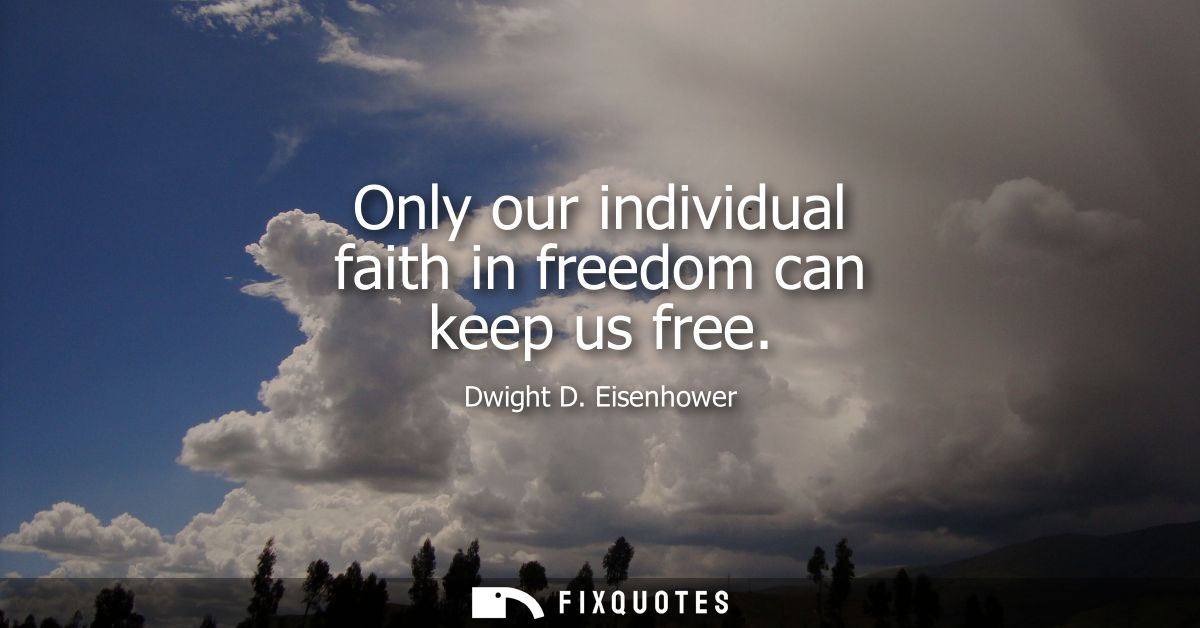
"Only our individual faith in freedom can keep us free"
About this Quote
Freedom, Eisenhower suggests, is less a constitutional arrangement than a daily, private decision. The line sounds reassuring until you notice its quiet pressure: if liberty fails, the first suspect is not Congress or a court, but the citizen who stopped believing in it. That’s a bracing claim from a five-star general turned president, someone who understood how quickly “security” can become a permission slip for control.
The intent is civic hardening. Eisenhower is arguing that laws and institutions are scaffolding; the load-bearing structure is internal. By framing freedom as something maintained by “individual faith,” he borrows the emotional circuitry of religion - devotion, vigilance, even heresy - and applies it to democracy. The subtext: freedom isn’t self-executing. It can be traded away in small, rationalized increments: for comfort, for unity, for the promise that someone else will handle the mess.
The context matters. Eisenhower governed in the Cold War’s moral theater, where the United States sold itself as the opposite of Soviet coercion while wrestling with McCarthyism, loyalty tests, and anxiety about internal enemies. His warning also echoes his broader skepticism about permanent mobilization (the same worldview behind the “military-industrial complex” farewell). The line works because it flatters and indicts at once: it tells Americans they are powerful enough to keep liberty alive, and responsible enough to lose it. Freedom, here, is a habit - and habits die without believers.
The intent is civic hardening. Eisenhower is arguing that laws and institutions are scaffolding; the load-bearing structure is internal. By framing freedom as something maintained by “individual faith,” he borrows the emotional circuitry of religion - devotion, vigilance, even heresy - and applies it to democracy. The subtext: freedom isn’t self-executing. It can be traded away in small, rationalized increments: for comfort, for unity, for the promise that someone else will handle the mess.
The context matters. Eisenhower governed in the Cold War’s moral theater, where the United States sold itself as the opposite of Soviet coercion while wrestling with McCarthyism, loyalty tests, and anxiety about internal enemies. His warning also echoes his broader skepticism about permanent mobilization (the same worldview behind the “military-industrial complex” farewell). The line works because it flatters and indicts at once: it tells Americans they are powerful enough to keep liberty alive, and responsible enough to lose it. Freedom, here, is a habit - and habits die without believers.
Quote Details
| Topic | Freedom |
|---|---|
| Source | Help us find the source |
| Cite |
Citation Formats
APA Style (7th ed.)
Eisenhower, Dwight D. (2026, January 14). Only our individual faith in freedom can keep us free. FixQuotes. https://fixquotes.com/quotes/only-our-individual-faith-in-freedom-can-keep-us-16941/
Chicago Style
Eisenhower, Dwight D. "Only our individual faith in freedom can keep us free." FixQuotes. January 14, 2026. https://fixquotes.com/quotes/only-our-individual-faith-in-freedom-can-keep-us-16941/.
MLA Style (9th ed.)
"Only our individual faith in freedom can keep us free." FixQuotes, 14 Jan. 2026, https://fixquotes.com/quotes/only-our-individual-faith-in-freedom-can-keep-us-16941/. Accessed 1 Apr. 2026.
More Quotes by Dwight
Add to List