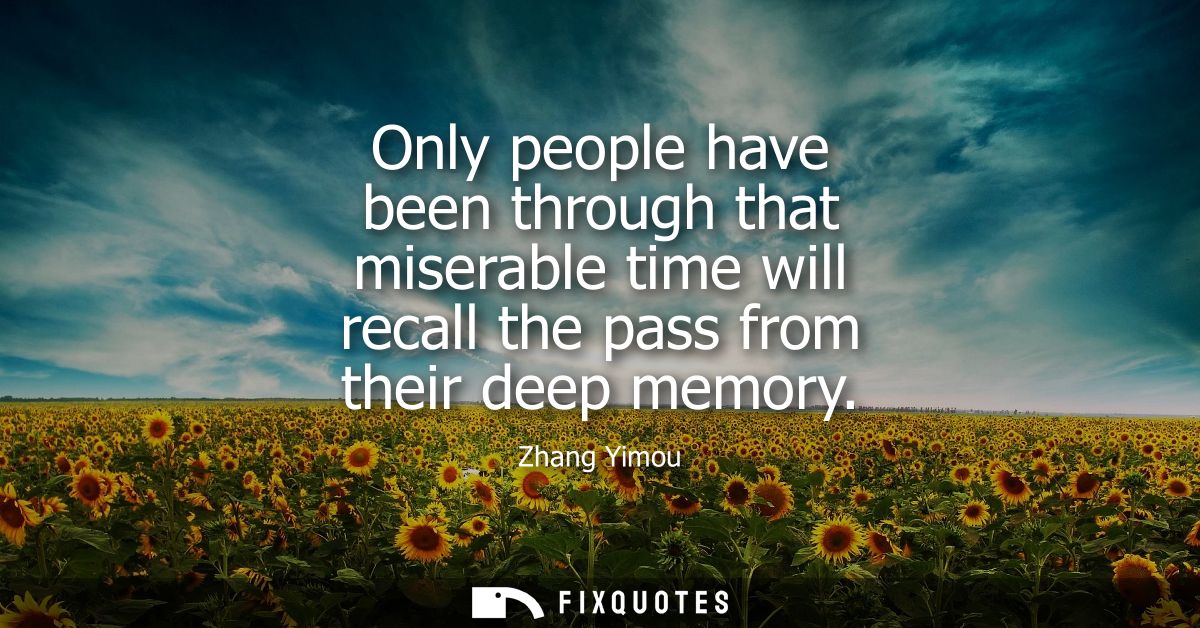
"Only people have been through that miserable time will recall the pass from their deep memory"
About this Quote
Zhang Yimou’s line has the blunt, bruised clarity of someone who knows that history doesn’t live evenly in the public mind. “Only people have been through that miserable time” draws a hard border around remembrance: trauma is not an abstract lesson available on demand, but a bodily credential. The phrasing is slightly ungainly in English, which almost helps; it feels like a thought translated from lived experience rather than polished for comfort.
The key move is “recall the pass from their deep memory.” “Pass” suggests a threshold, a checkpoint, a narrow escape - not a nostalgic era but a corridor you survive. “Deep memory” isn’t the kind you access by reading plaques or watching a tasteful montage. It’s the involuntary archive: smells, hunger, the sound of a door closing, the reflexive flinch when certain slogans return. Zhang’s cinema often circles this tension between collective narratives and private scars, especially in works shaped by the Cultural Revolution’s afterimage, where official history can be both omnipresent and evasive.
Subtextually, the quote challenges audiences who consume suffering as cultural product. It implies that outsiders can sympathize, even admire the craft, but they can’t fully retrieve what that time cost. That’s not gatekeeping for its own sake; it’s an ethical warning about how quickly misery becomes a period piece once the people who carry it are pressured into silence, or into “moving on” for the sake of national storylines. Zhang frames memory as a contested terrain: the past survives not because it’s recorded, but because it’s lodged where politics and aesthetics can’t fully reach.
The key move is “recall the pass from their deep memory.” “Pass” suggests a threshold, a checkpoint, a narrow escape - not a nostalgic era but a corridor you survive. “Deep memory” isn’t the kind you access by reading plaques or watching a tasteful montage. It’s the involuntary archive: smells, hunger, the sound of a door closing, the reflexive flinch when certain slogans return. Zhang’s cinema often circles this tension between collective narratives and private scars, especially in works shaped by the Cultural Revolution’s afterimage, where official history can be both omnipresent and evasive.
Subtextually, the quote challenges audiences who consume suffering as cultural product. It implies that outsiders can sympathize, even admire the craft, but they can’t fully retrieve what that time cost. That’s not gatekeeping for its own sake; it’s an ethical warning about how quickly misery becomes a period piece once the people who carry it are pressured into silence, or into “moving on” for the sake of national storylines. Zhang frames memory as a contested terrain: the past survives not because it’s recorded, but because it’s lodged where politics and aesthetics can’t fully reach.
Quote Details
| Topic | Tough Times |
|---|
More Quotes by Zhang
Add to List