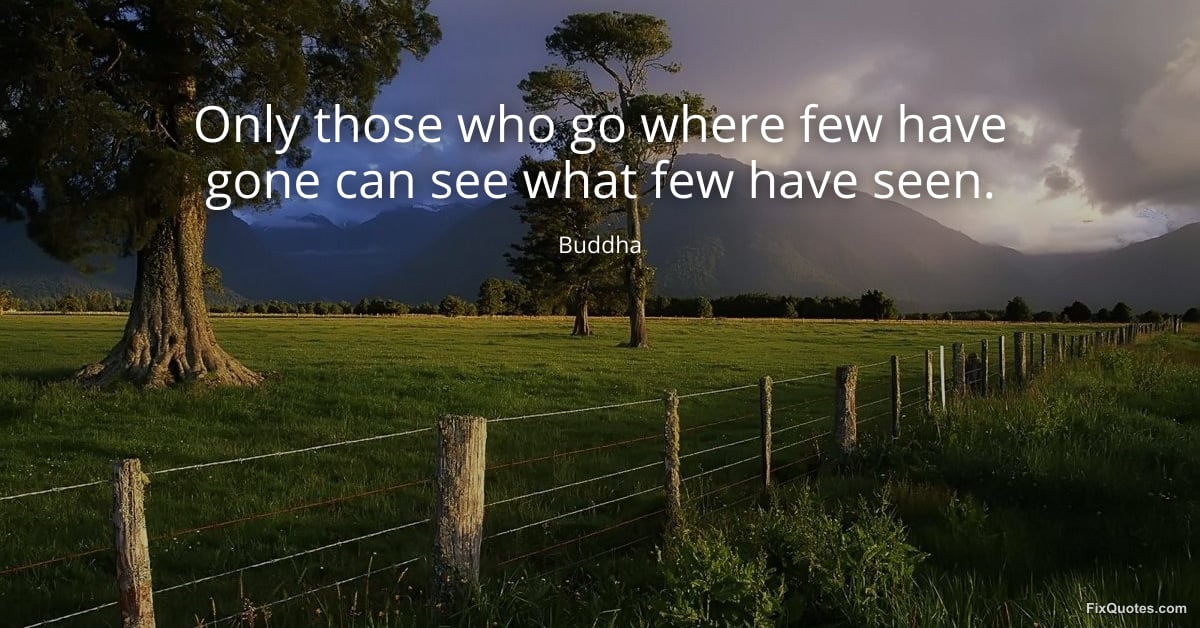
"Only those who go where few have gone can see what few have seen"
About this Quote
The line carries the calm severity of a spiritual challenge. It is not really about geography or adventure; it is about discipline, estrangement, and the price of insight. Attributed to the Buddha, it fits the larger logic of his teaching: awakening is available to human beings, but not on ordinary terms. You do not arrive at clarity by staying inside habit, status, appetite, or inherited belief. You have to step outside the crowded route.
That is why the sentence works. It flatters no one. It offers no democratic reassurance that wisdom comes cheaply or naturally. The repeated "few" creates a sense of narrowing, almost a bottleneck: most people remain enclosed in the familiar, and the familiar keeps reproducing the same illusions. To "go where few have gone" suggests an inner path that is socially unintuitive. Renunciation, meditation, self-scrutiny, detachment from desire; these are not glamorous acts, and they often look irrational to the surrounding world.
In the context of the Buddha's life, the subtext sharpens. Siddhartha leaves privilege, family expectation, and political destiny in order to investigate suffering at its root. That biographical break gives the aphorism its authority. He is not praising novelty for its own sake. He is arguing that transformative knowledge demands a break with consensus reality.
There is also a quiet warning in it. People often want the vision without the departure, the revelation without the exile. The Buddha's point is that uncommon perception is earned by uncommon practice. Insight is not merely discovered; it is made possible by what one is willing to leave behind.
That is why the sentence works. It flatters no one. It offers no democratic reassurance that wisdom comes cheaply or naturally. The repeated "few" creates a sense of narrowing, almost a bottleneck: most people remain enclosed in the familiar, and the familiar keeps reproducing the same illusions. To "go where few have gone" suggests an inner path that is socially unintuitive. Renunciation, meditation, self-scrutiny, detachment from desire; these are not glamorous acts, and they often look irrational to the surrounding world.
In the context of the Buddha's life, the subtext sharpens. Siddhartha leaves privilege, family expectation, and political destiny in order to investigate suffering at its root. That biographical break gives the aphorism its authority. He is not praising novelty for its own sake. He is arguing that transformative knowledge demands a break with consensus reality.
There is also a quiet warning in it. People often want the vision without the departure, the revelation without the exile. The Buddha's point is that uncommon perception is earned by uncommon practice. Insight is not merely discovered; it is made possible by what one is willing to leave behind.
Quote Details
| Topic | Adventure |
|---|---|
| Source | Help us find the source |
| Cite |
Citation Formats
APA Style (7th ed.)
Buddha. (2026, March 10). Only those who go where few have gone can see what few have seen. FixQuotes. https://fixquotes.com/quotes/only-those-who-go-where-few-have-gone-can-see-185878/
Chicago Style
Buddha. "Only those who go where few have gone can see what few have seen." FixQuotes. March 10, 2026. https://fixquotes.com/quotes/only-those-who-go-where-few-have-gone-can-see-185878/.
MLA Style (9th ed.)
"Only those who go where few have gone can see what few have seen." FixQuotes, 10 Mar. 2026, https://fixquotes.com/quotes/only-those-who-go-where-few-have-gone-can-see-185878/. Accessed 3 Apr. 2026.
More Quotes by Buddha
Add to List