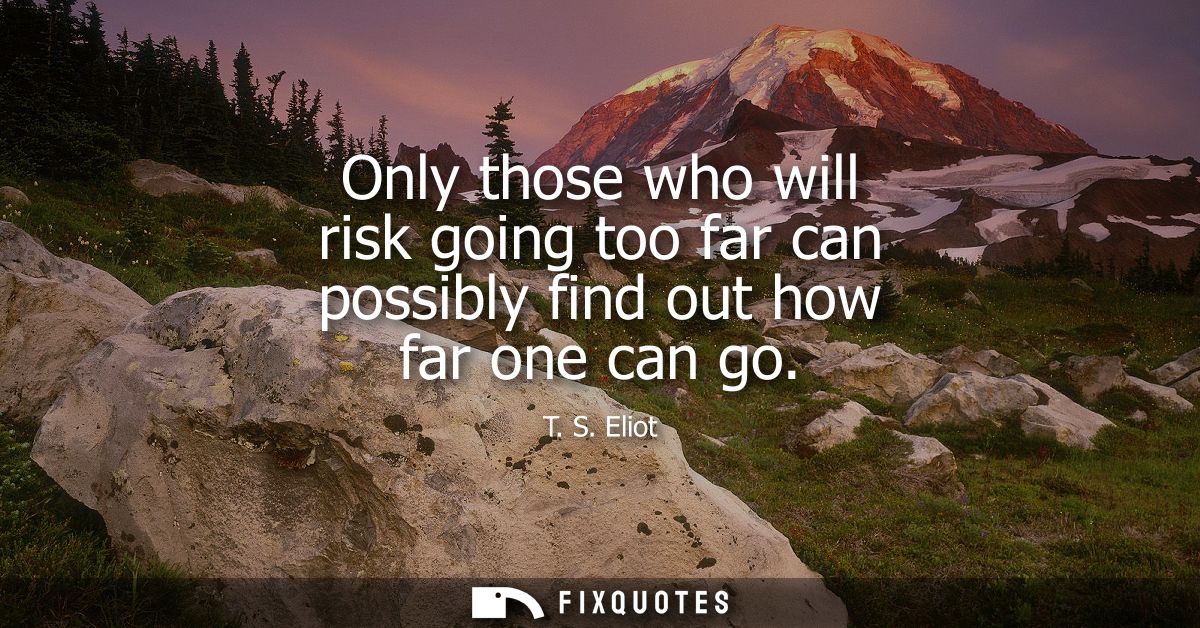
"Only those who will risk going too far can possibly find out how far one can go"
About this Quote
The subtext is modernist to the core. Eliot came of age amid rupture - aesthetic, spiritual, geopolitical - when inherited measures of “how far” one can go (in art, belief, sexuality, politics) were visibly failing. In that climate, restraint can look less like virtue than avoidance. His own work embodies the thesis: The Waste Land doesn’t politely extend tradition; it fractures it, raids multiple languages, and courts opacity. The “too far” is formal as much as existential.
There’s also a quiet ethical provocation. Eliot is not cheering recklessness for its own sake; he’s diagnosing how limits become knowable. You can’t map a boundary from the safe interior. The line reads like a permission slip for experimentation, but it doubles as a critique of audiences and institutions that demand innovation without tolerating the overreach that makes innovation possible.
Quote Details
| Topic | Motivational |
|---|---|
| Source | Help us find the source |
| Cite |
Citation Formats
APA Style (7th ed.)
Eliot, T. S. (2026, January 16). Only those who will risk going too far can possibly find out how far one can go. FixQuotes. https://fixquotes.com/quotes/only-those-who-will-risk-going-too-far-can-137733/
Chicago Style
Eliot, T. S. "Only those who will risk going too far can possibly find out how far one can go." FixQuotes. January 16, 2026. https://fixquotes.com/quotes/only-those-who-will-risk-going-too-far-can-137733/.
MLA Style (9th ed.)
"Only those who will risk going too far can possibly find out how far one can go." FixQuotes, 16 Jan. 2026, https://fixquotes.com/quotes/only-those-who-will-risk-going-too-far-can-137733/. Accessed 27 Mar. 2026.