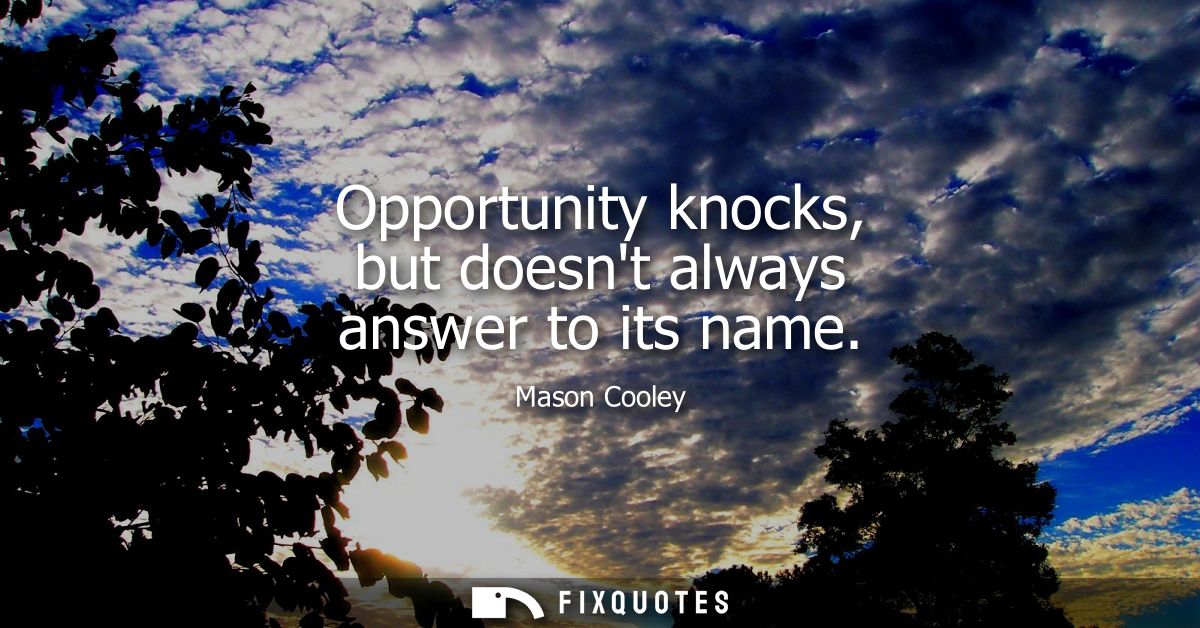
"Opportunity knocks, but doesn't always answer to its name"
About this Quote
Opportunity, in Cooley's hands, is less a cheerful visitor than a prankster with a fake ID. The familiar proverb promises a clean narrative: hear the knock, open the door, seize the moment. Cooley keeps the knock but sabotages the payoff. "Doesn't always answer to its name" is a sly legalistic twist, implying misdirection: the thing that arrives may not identify itself properly, may not be what it claims, may not even be "opportunity" until afterward, when hindsight slaps a label on it.
The intent is to puncture the self-help confidence of that old maxim without lapsing into outright despair. He isn't denying that chances appear; he's arguing that our detection system is flawed. We expect opportunity to look like a promotion, a lucky break, a clear sign. In real life it often arrives as inconvenience, risk, awkward timing, or work that doesn't pay immediately. The subtext is a critique of meritocratic storytelling: if opportunity is recognizable and fair, then missing it is your fault. Cooley suggests the opposite - that the world is noisy, signals are ambiguous, and the "right moment" doesn't come pre-captioned.
As an aphorist, Cooley is writing in the postwar-to-late-century American tradition that distrusts grand assurances. His sentence is compact, almost offhand, but it smuggles in a grimly comic worldview: even when fate knocks, it might not say who it is. The line works because it rewires a cliche with one small pivot, turning comfort into alertness and optimism into skepticism without losing the rhythm that made the proverb memorable.
The intent is to puncture the self-help confidence of that old maxim without lapsing into outright despair. He isn't denying that chances appear; he's arguing that our detection system is flawed. We expect opportunity to look like a promotion, a lucky break, a clear sign. In real life it often arrives as inconvenience, risk, awkward timing, or work that doesn't pay immediately. The subtext is a critique of meritocratic storytelling: if opportunity is recognizable and fair, then missing it is your fault. Cooley suggests the opposite - that the world is noisy, signals are ambiguous, and the "right moment" doesn't come pre-captioned.
As an aphorist, Cooley is writing in the postwar-to-late-century American tradition that distrusts grand assurances. His sentence is compact, almost offhand, but it smuggles in a grimly comic worldview: even when fate knocks, it might not say who it is. The line works because it rewires a cliche with one small pivot, turning comfort into alertness and optimism into skepticism without losing the rhythm that made the proverb memorable.
Quote Details
| Topic | Puns & Wordplay |
|---|---|
| Source | Help us find the source |
| Cite |
Citation Formats
APA Style (7th ed.)
Cooley, Mason. (2026, January 16). Opportunity knocks, but doesn't always answer to its name. FixQuotes. https://fixquotes.com/quotes/opportunity-knocks-but-doesnt-always-answer-to-100317/
Chicago Style
Cooley, Mason. "Opportunity knocks, but doesn't always answer to its name." FixQuotes. January 16, 2026. https://fixquotes.com/quotes/opportunity-knocks-but-doesnt-always-answer-to-100317/.
MLA Style (9th ed.)
"Opportunity knocks, but doesn't always answer to its name." FixQuotes, 16 Jan. 2026, https://fixquotes.com/quotes/opportunity-knocks-but-doesnt-always-answer-to-100317/. Accessed 28 Mar. 2026.
More Quotes by Mason
Add to List