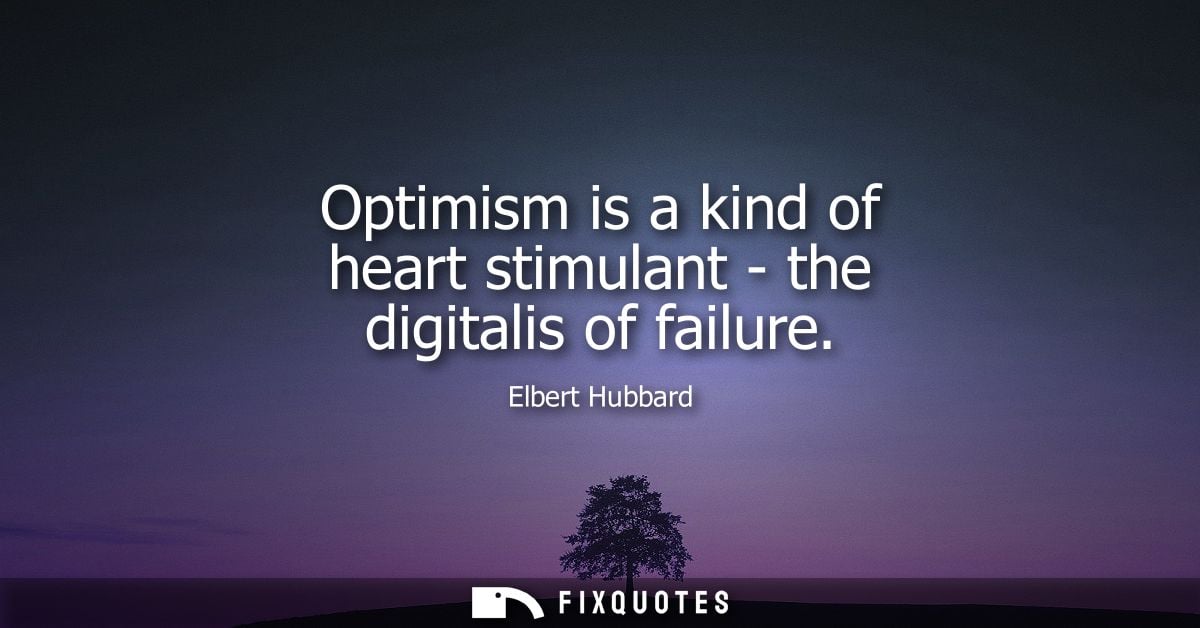
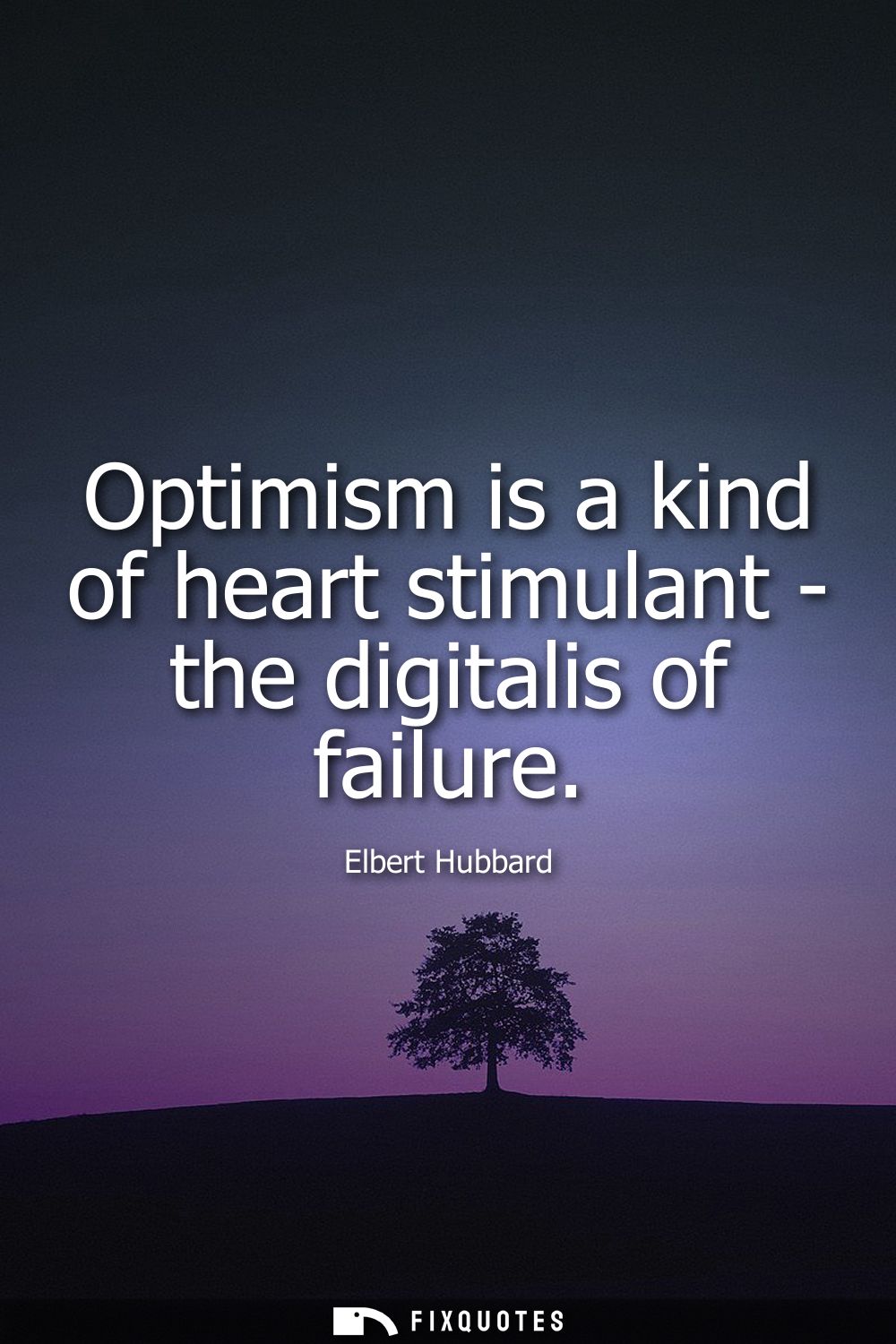
"Optimism is a kind of heart stimulant - the digitalis of failure"
About this Quote
Optimism, in Hubbard's hands, isn't the sunny virtue it gets billed as; it's a drug, administered when the patient is already in trouble. Calling it "a kind of heart stimulant" borrows the language of medicine to make optimism sound less like character and more like chemistry: a quick jolt to keep you upright when your inner circulation has slowed. Then comes the sting in the tail: "the digitalis of failure". Digitalis was a real cardiac medication, powerful and risky, used to strengthen a faltering heart. Hubbard is implying that optimism often arrives not as wisdom but as triage - a controlled dose of hope meant to stop the collapse.
The subtext is faintly accusatory. If your optimism needs to be pharmaceutically strong, it's probably not springing from evidence; it's compensating for bruises. Hubbard, writing in a late-19th/early-20th-century America drunk on self-help and hustle ideology, cuts against the era's boosterism. He doesn't fully dismiss optimism; he reframes it as a coping mechanism, even a survival tactic. But the metaphor also hints at dependence: stimulants can mask symptoms without curing the disease, and digitalis can become dangerous if misused. Optimism, then, is both useful and suspect - it can keep you moving, but it can also prevent you from confronting the structural or personal reasons you keep failing.
What makes the line work is its tonal double-play: it sounds like encouragement until you realize it's a clinical diagnosis. Hubbard's wit doesn't comfort; it pokes, reminding us that relentless positivity may be less about strength than about managing damage.
The subtext is faintly accusatory. If your optimism needs to be pharmaceutically strong, it's probably not springing from evidence; it's compensating for bruises. Hubbard, writing in a late-19th/early-20th-century America drunk on self-help and hustle ideology, cuts against the era's boosterism. He doesn't fully dismiss optimism; he reframes it as a coping mechanism, even a survival tactic. But the metaphor also hints at dependence: stimulants can mask symptoms without curing the disease, and digitalis can become dangerous if misused. Optimism, then, is both useful and suspect - it can keep you moving, but it can also prevent you from confronting the structural or personal reasons you keep failing.
What makes the line work is its tonal double-play: it sounds like encouragement until you realize it's a clinical diagnosis. Hubbard's wit doesn't comfort; it pokes, reminding us that relentless positivity may be less about strength than about managing damage.
Quote Details
| Topic | Optimism |
|---|---|
| Source | Help us find the source |
| Cite |
Citation Formats
APA Style (7th ed.)
Hubbard, Elbert. (2026, January 16). Optimism is a kind of heart stimulant - the digitalis of failure. FixQuotes. https://fixquotes.com/quotes/optimism-is-a-kind-of-heart-stimulant-the-137444/
Chicago Style
Hubbard, Elbert. "Optimism is a kind of heart stimulant - the digitalis of failure." FixQuotes. January 16, 2026. https://fixquotes.com/quotes/optimism-is-a-kind-of-heart-stimulant-the-137444/.
MLA Style (9th ed.)
"Optimism is a kind of heart stimulant - the digitalis of failure." FixQuotes, 16 Jan. 2026, https://fixquotes.com/quotes/optimism-is-a-kind-of-heart-stimulant-the-137444/. Accessed 3 Apr. 2026.
More Quotes by Elbert
Add to List