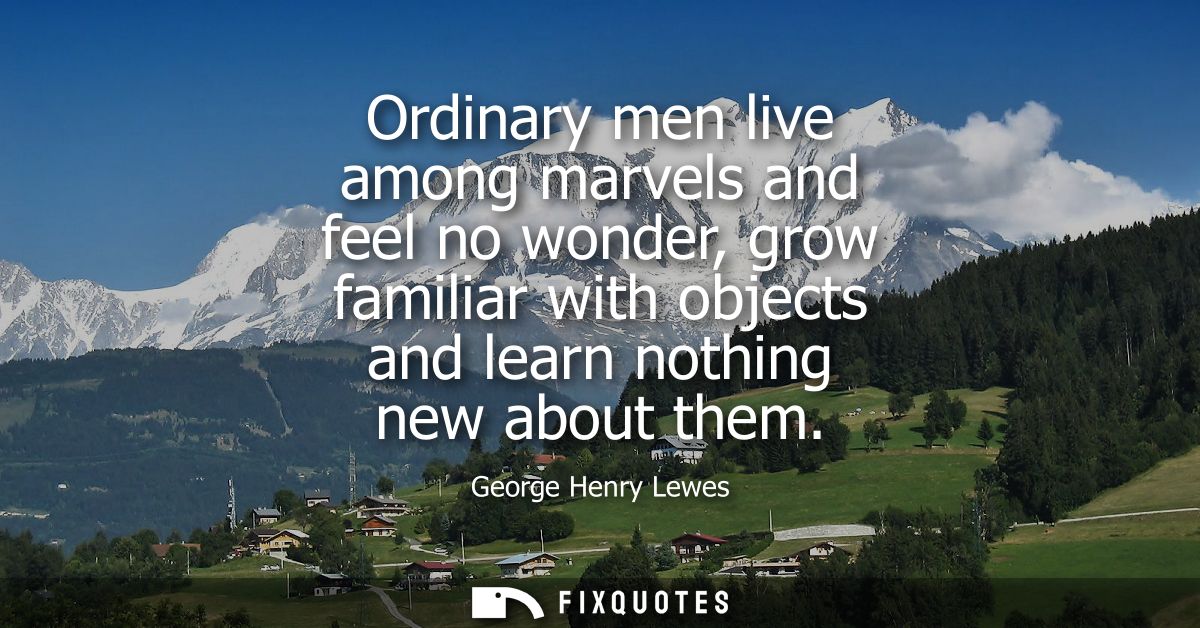
"Ordinary men live among marvels and feel no wonder, grow familiar with objects and learn nothing new about them"
About this Quote
The second clause tightens the screw. Familiarity doesn’t merely reduce awe; it blocks learning. “Grow familiar” is passive, almost organic, as if numbness is the default setting. “Learn nothing new” lands harder because it rejects the comforting idea that time naturally brings insight. Lewes implies the opposite: time can be an anesthetic. The subtext is a critique of complacent empiricism - the mind that thinks it’s being practical while it’s actually refusing to notice.
Contextually, this fits a mid-19th-century intellectual world obsessed with perception: how the mind filters reality, how science and psychology can sharpen attention rather than flatten it. Lewes, close to the Victorian debates around scientific observation and everyday experience, is warning that the true enemy of knowledge isn’t mystery; it’s the routine that turns the astonishing into “just how things are.” That’s why the sentence works: it makes wonder an ethical obligation, not a decorative emotion.
Quote Details
| Topic | Wisdom |
|---|---|
| Source | Help us find the source |
| Cite |
Citation Formats
APA Style (7th ed.)
Lewes, George Henry. (2026, January 18). Ordinary men live among marvels and feel no wonder, grow familiar with objects and learn nothing new about them. FixQuotes. https://fixquotes.com/quotes/ordinary-men-live-among-marvels-and-feel-no-11361/
Chicago Style
Lewes, George Henry. "Ordinary men live among marvels and feel no wonder, grow familiar with objects and learn nothing new about them." FixQuotes. January 18, 2026. https://fixquotes.com/quotes/ordinary-men-live-among-marvels-and-feel-no-11361/.
MLA Style (9th ed.)
"Ordinary men live among marvels and feel no wonder, grow familiar with objects and learn nothing new about them." FixQuotes, 18 Jan. 2026, https://fixquotes.com/quotes/ordinary-men-live-among-marvels-and-feel-no-11361/. Accessed 28 Mar. 2026.