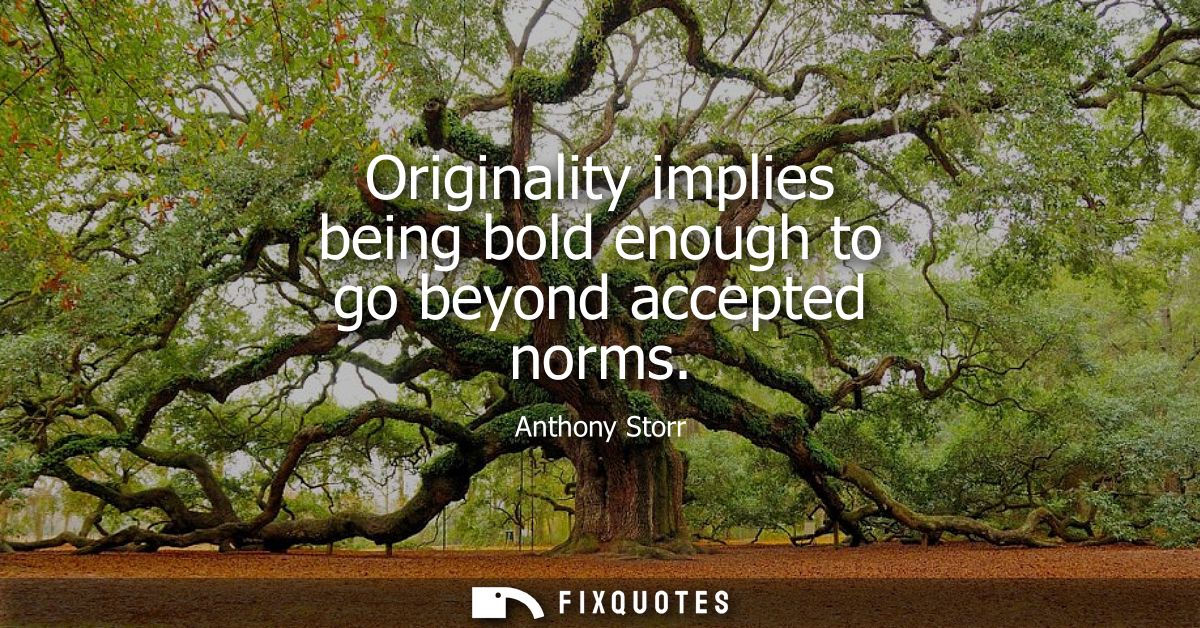
"Originality implies being bold enough to go beyond accepted norms"
About this Quote
Originality, in Storr's framing, isn't a quirky personality trait or a clever remix; it's a moral and social wager. The line turns the romantic myth of the lone genius into something more bracing: to be original is to risk disapproval. "Implies" does a lot of work here, quietly stripping away the possibility of safe, committee-approved novelty. If what you're doing is comfortably legible inside "accepted norms", Storr suggests, it's probably not originality at all - it's sanctioned variation.
The subtext is psychological, which fits Storr's wider preoccupation with creativity and the inner life. Boldness isn't mere swagger; it's the capacity to tolerate isolation, misunderstanding, even ridicule. "Accepted" hints at the real enforcer: not laws, but consensus. Norms are maintained by social reward and punishment, and Storr is pointing to the hidden cost of stepping out of line. Originality becomes less about producing new objects than about sustaining a certain kind of inner independence.
Context matters because Storr wrote in a century that both fetishized originality (modernism, avant-garde art, the cult of innovation) and professionalized conformity (bureaucracies, mass media, institutional gatekeeping). His sentence reads like a corrective to the era's branding of "creative" as a market-friendly identity. He's insisting that the genuinely new doesn't arrive with a press release. It arrives with friction - and the willingness to keep going anyway.
The subtext is psychological, which fits Storr's wider preoccupation with creativity and the inner life. Boldness isn't mere swagger; it's the capacity to tolerate isolation, misunderstanding, even ridicule. "Accepted" hints at the real enforcer: not laws, but consensus. Norms are maintained by social reward and punishment, and Storr is pointing to the hidden cost of stepping out of line. Originality becomes less about producing new objects than about sustaining a certain kind of inner independence.
Context matters because Storr wrote in a century that both fetishized originality (modernism, avant-garde art, the cult of innovation) and professionalized conformity (bureaucracies, mass media, institutional gatekeeping). His sentence reads like a corrective to the era's branding of "creative" as a market-friendly identity. He's insisting that the genuinely new doesn't arrive with a press release. It arrives with friction - and the willingness to keep going anyway.
Quote Details
| Topic | Wisdom |
|---|---|
| Source | Help us find the source |
| Cite |
Citation Formats
APA Style (7th ed.)
Storr, Anthony. (2026, January 15). Originality implies being bold enough to go beyond accepted norms. FixQuotes. https://fixquotes.com/quotes/originality-implies-being-bold-enough-to-go-169848/
Chicago Style
Storr, Anthony. "Originality implies being bold enough to go beyond accepted norms." FixQuotes. January 15, 2026. https://fixquotes.com/quotes/originality-implies-being-bold-enough-to-go-169848/.
MLA Style (9th ed.)
"Originality implies being bold enough to go beyond accepted norms." FixQuotes, 15 Jan. 2026, https://fixquotes.com/quotes/originality-implies-being-bold-enough-to-go-169848/. Accessed 12 Feb. 2026.
More Quotes by Anthony
Add to List