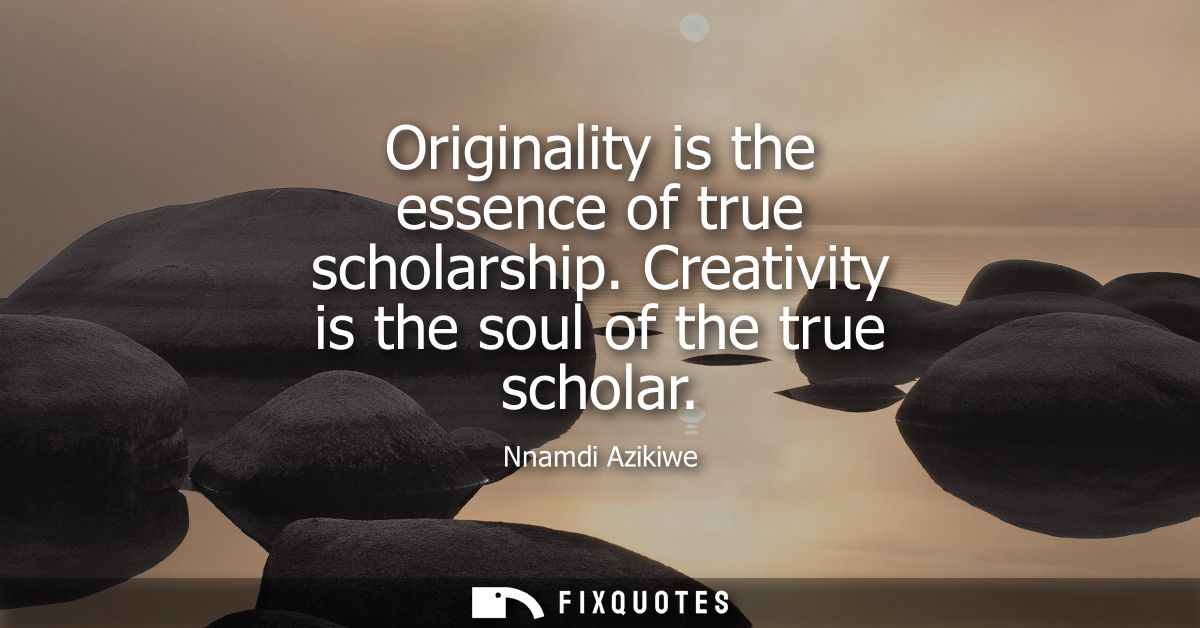
"Originality is the essence of true scholarship. Creativity is the soul of the true scholar"
About this Quote
The pairing matters. “Essence” evokes a standard, almost constitutional: scholarship without originality is missing its core. “Soul” pushes it further, turning the scholar from a credentialed functionary into a living moral agent. He’s arguing that the mind is not a filing cabinet; it’s a generator. That rhetoric fits a statesman who understood how often “expertise” can be conscripted to validate power. In colonized societies, scholarship was frequently rewarded for compliance, not insight. Azikiwe’s formulation is a quiet refusal of that bargain.
There’s also an implied warning to post-independence elites: liberation cannot stop at flag-raising if the intellectual class remains derivative. Originality becomes a civic duty, creativity a form of national infrastructure. He’s sketching a blueprint for nation-building where universities are not prestige factories but laboratories for new institutions, new narratives, new futures. The line works because it flatters and indicts at once: it calls scholars “true” only when they risk making something that wasn’t already permitted.
Quote Details
| Topic | Knowledge |
|---|---|
| Source | Help us find the source |
| Cite |
Citation Formats
APA Style (7th ed.)
Azikiwe, Nnamdi. (2026, January 16). Originality is the essence of true scholarship. Creativity is the soul of the true scholar. FixQuotes. https://fixquotes.com/quotes/originality-is-the-essence-of-true-scholarship-125219/
Chicago Style
Azikiwe, Nnamdi. "Originality is the essence of true scholarship. Creativity is the soul of the true scholar." FixQuotes. January 16, 2026. https://fixquotes.com/quotes/originality-is-the-essence-of-true-scholarship-125219/.
MLA Style (9th ed.)
"Originality is the essence of true scholarship. Creativity is the soul of the true scholar." FixQuotes, 16 Jan. 2026, https://fixquotes.com/quotes/originality-is-the-essence-of-true-scholarship-125219/. Accessed 1 Apr. 2026.