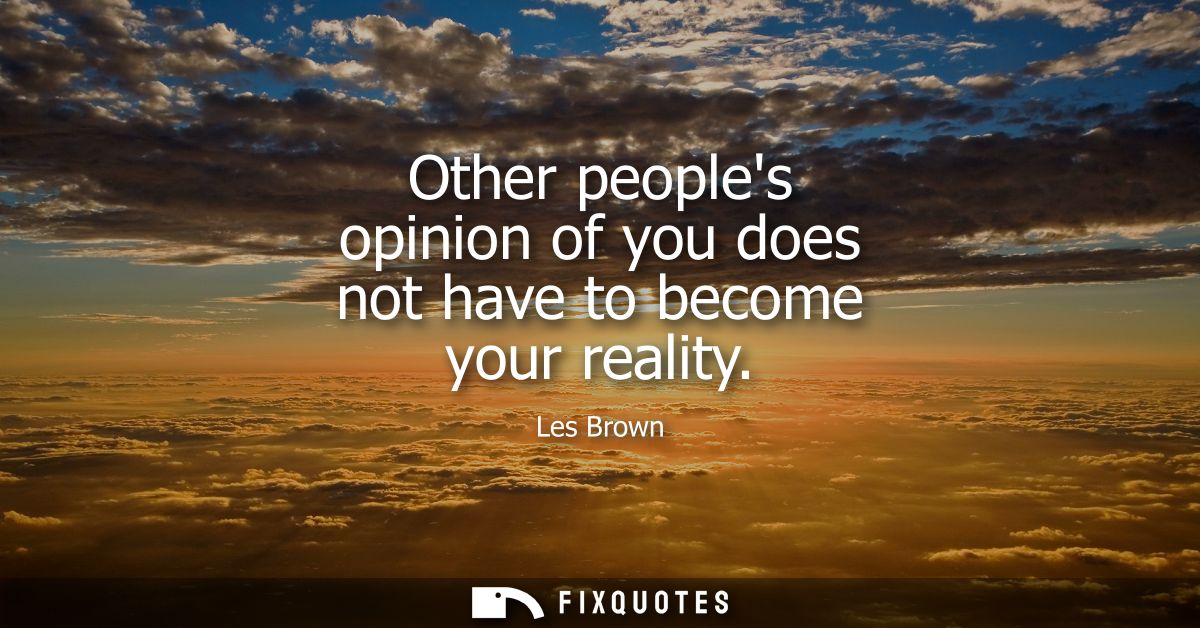
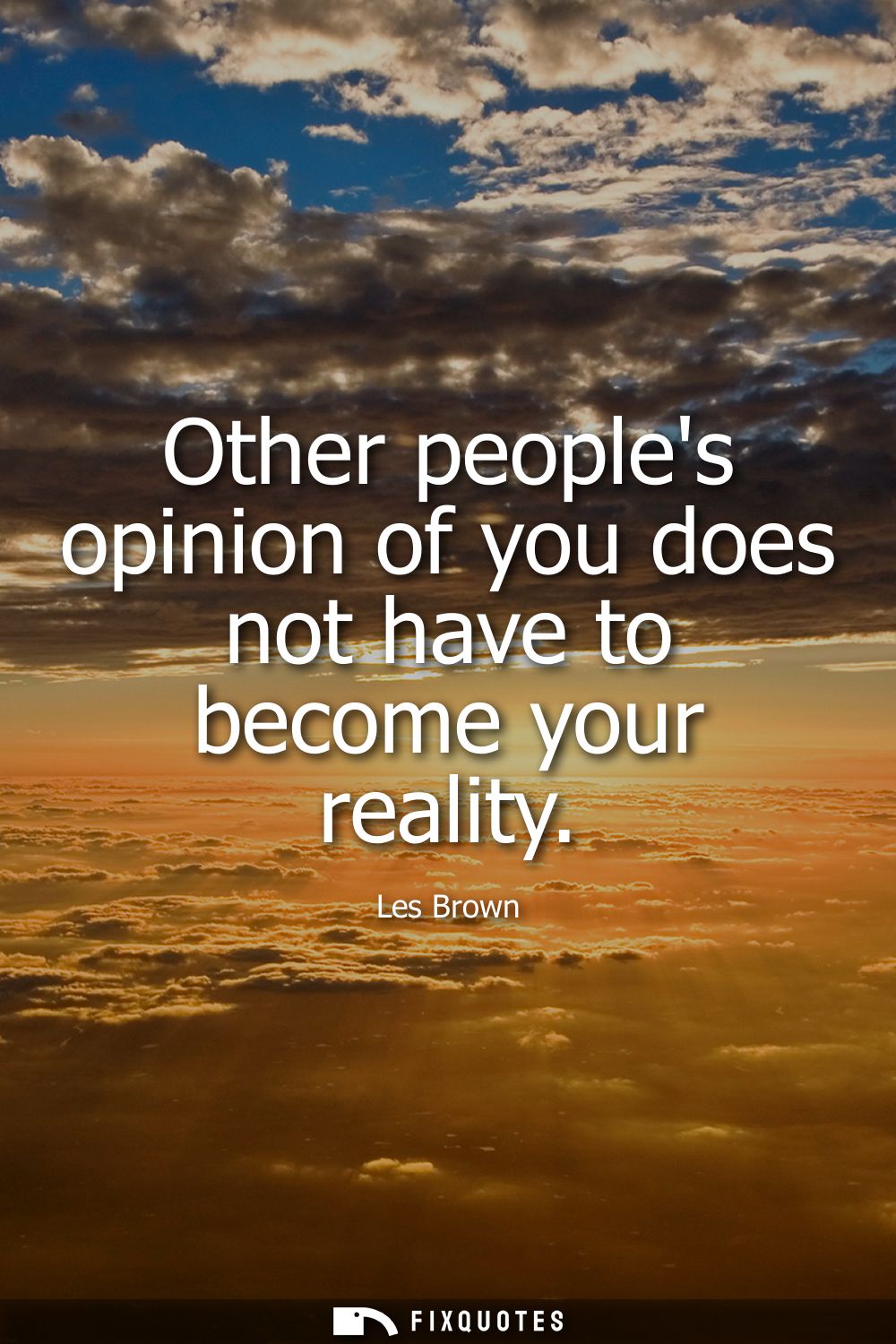
"Other people's opinion of you does not have to become your reality"
About this Quote
Les Brown’s line lands like a pocket-sized vaccine against public judgment: you can be exposed to other people’s takes without letting them infect your self-concept. It’s classic motivational rhetoric, but it works because it identifies the real battleground as interpretive, not external. “Opinion” is framed as a removable layer - something that can be heard, weighed, and discarded. “Reality,” by contrast, is the high-stakes word: it’s the story you live inside. The sentence is really about authorship. Who gets to write your narrative?
The subtext is an argument against outsourcing identity. In a workplace culture that runs on performance reviews, metrics, and brand perception, it’s easy to confuse feedback with fate. Brown draws a boundary: other people can describe you, but they don’t get to define you. That distinction matters because perception often carries institutional power - bosses, teachers, gatekeepers - and the quote quietly admits that opinions can have consequences while insisting they don’t have to colonize your inner life.
Contextually, Brown’s career as a speaker and businessman sits in the American self-help tradition where personal agency is the product. The phrase “does not have to” is doing the heavy lifting: it’s not denying social pressure; it’s offering a choice under pressure. Read it alongside today’s social media economy, it becomes even sharper. The algorithm turns everyone into a critic, but Brown is selling a counter-technology: selective belief. Not denial, not rebellion for its own sake - just the refusal to let someone else’s snapshot become your permanent address.
The subtext is an argument against outsourcing identity. In a workplace culture that runs on performance reviews, metrics, and brand perception, it’s easy to confuse feedback with fate. Brown draws a boundary: other people can describe you, but they don’t get to define you. That distinction matters because perception often carries institutional power - bosses, teachers, gatekeepers - and the quote quietly admits that opinions can have consequences while insisting they don’t have to colonize your inner life.
Contextually, Brown’s career as a speaker and businessman sits in the American self-help tradition where personal agency is the product. The phrase “does not have to” is doing the heavy lifting: it’s not denying social pressure; it’s offering a choice under pressure. Read it alongside today’s social media economy, it becomes even sharper. The algorithm turns everyone into a critic, but Brown is selling a counter-technology: selective belief. Not denial, not rebellion for its own sake - just the refusal to let someone else’s snapshot become your permanent address.
Quote Details
| Topic | Confidence |
|---|---|
| Source | Help us find the source |
| Cite |
Citation Formats
APA Style (7th ed.)
Brown, Les. (2026, January 18). Other people's opinion of you does not have to become your reality. FixQuotes. https://fixquotes.com/quotes/other-peoples-opinion-of-you-does-not-have-to-8339/
Chicago Style
Brown, Les. "Other people's opinion of you does not have to become your reality." FixQuotes. January 18, 2026. https://fixquotes.com/quotes/other-peoples-opinion-of-you-does-not-have-to-8339/.
MLA Style (9th ed.)
"Other people's opinion of you does not have to become your reality." FixQuotes, 18 Jan. 2026, https://fixquotes.com/quotes/other-peoples-opinion-of-you-does-not-have-to-8339/. Accessed 25 Mar. 2026.
More Quotes by Les
Add to List