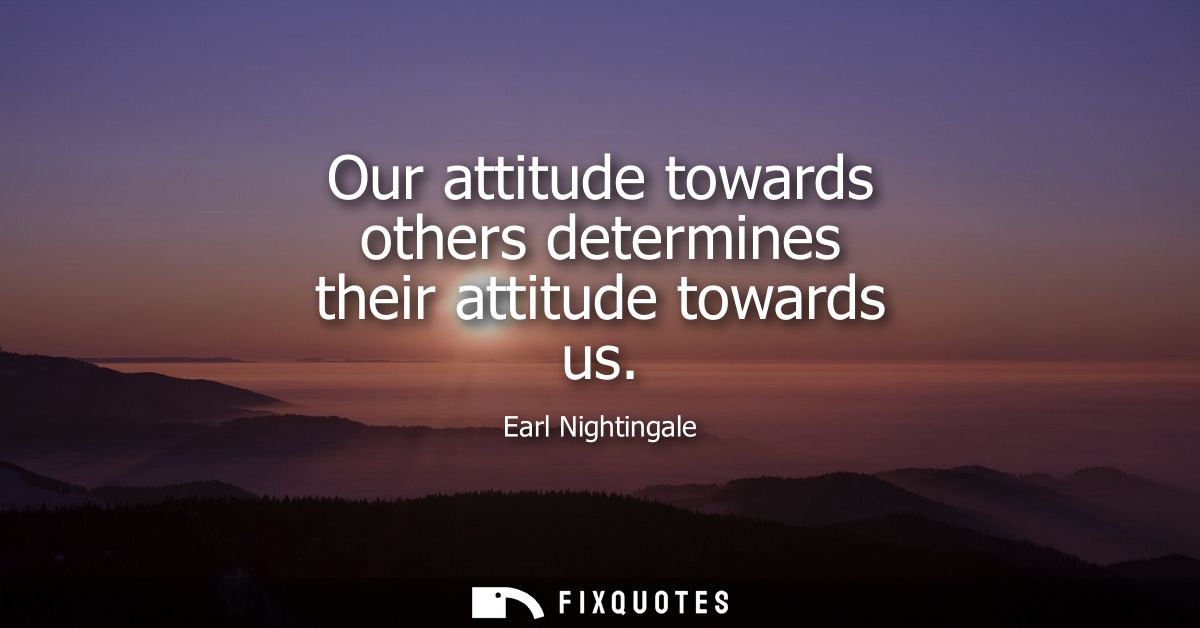
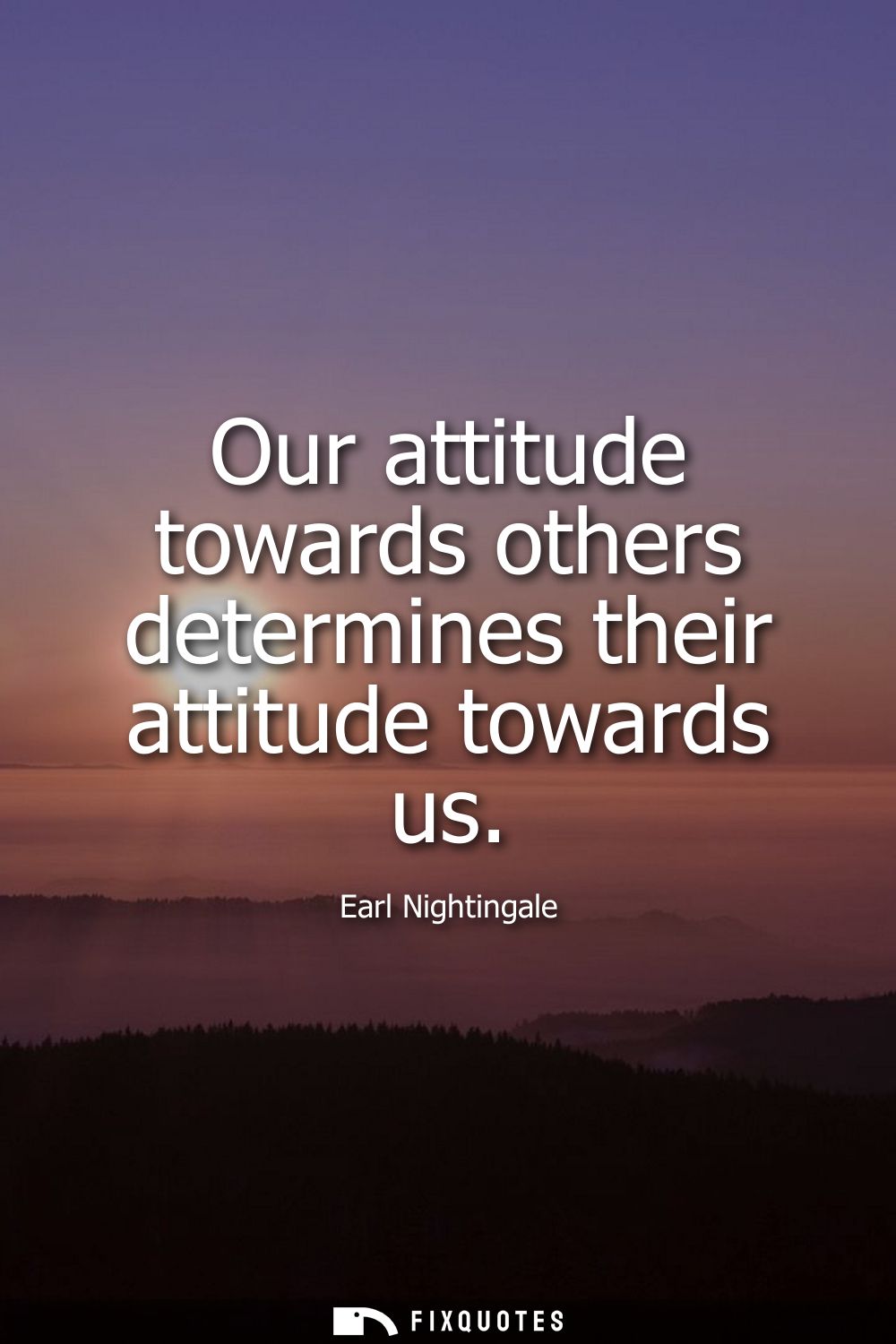
"Our attitude towards others determines their attitude towards us"
About this Quote
Nightingale’s line reads like a tidy bit of motivational arithmetic: change your attitude, change your world. That clean symmetry is the point. It turns a messy social reality into something the individual can supposedly steer, which is exactly the kind of psychological leverage self-help writing trades in. The sentence is built to feel empowering because it hands you the controls - and quietly hands you the blame, too.
The specific intent is behavioral: treat people with warmth, respect, and steadiness, and you increase the odds they mirror it back. On the level of everyday workplace politics and family dynamics, it’s practical advice. The subtext is more ambitious. It suggests relationships are less about who others are and more about what you bring out of them, a framework that flatters the listener’s agency. If you’re getting pushback, the quote implies, first check your own posture. That’s calming for an anxious reader: it converts uncertainty into a solvable self-project.
Context matters. Nightingale helped define midcentury American success culture, when managerial optimism, salesmanship, and “positive mental attitude” became a secular faith. In that era, morale was treated as a technology: a mindset that could boost productivity, polish leadership, and soften the frictions of modern life. The line’s elegance also masks its limits. Plenty of hostility isn’t a reflection; it’s a structure - prejudice, power, institutional cruelty. Still, the quote persists because it offers a socially acceptable form of control: not domination, but tone. In a culture obsessed with “vibes,” Nightingale is basically arguing that vibe is strategy.
The specific intent is behavioral: treat people with warmth, respect, and steadiness, and you increase the odds they mirror it back. On the level of everyday workplace politics and family dynamics, it’s practical advice. The subtext is more ambitious. It suggests relationships are less about who others are and more about what you bring out of them, a framework that flatters the listener’s agency. If you’re getting pushback, the quote implies, first check your own posture. That’s calming for an anxious reader: it converts uncertainty into a solvable self-project.
Context matters. Nightingale helped define midcentury American success culture, when managerial optimism, salesmanship, and “positive mental attitude” became a secular faith. In that era, morale was treated as a technology: a mindset that could boost productivity, polish leadership, and soften the frictions of modern life. The line’s elegance also masks its limits. Plenty of hostility isn’t a reflection; it’s a structure - prejudice, power, institutional cruelty. Still, the quote persists because it offers a socially acceptable form of control: not domination, but tone. In a culture obsessed with “vibes,” Nightingale is basically arguing that vibe is strategy.
Quote Details
| Topic | Respect |
|---|---|
| Source | Help us find the source |
| Cite |
Citation Formats
APA Style (7th ed.)
Nightingale, Earl. (2026, January 18). Our attitude towards others determines their attitude towards us. FixQuotes. https://fixquotes.com/quotes/our-attitude-towards-others-determines-their-14400/
Chicago Style
Nightingale, Earl. "Our attitude towards others determines their attitude towards us." FixQuotes. January 18, 2026. https://fixquotes.com/quotes/our-attitude-towards-others-determines-their-14400/.
MLA Style (9th ed.)
"Our attitude towards others determines their attitude towards us." FixQuotes, 18 Jan. 2026, https://fixquotes.com/quotes/our-attitude-towards-others-determines-their-14400/. Accessed 27 Mar. 2026.
More Quotes by Earl
Add to List