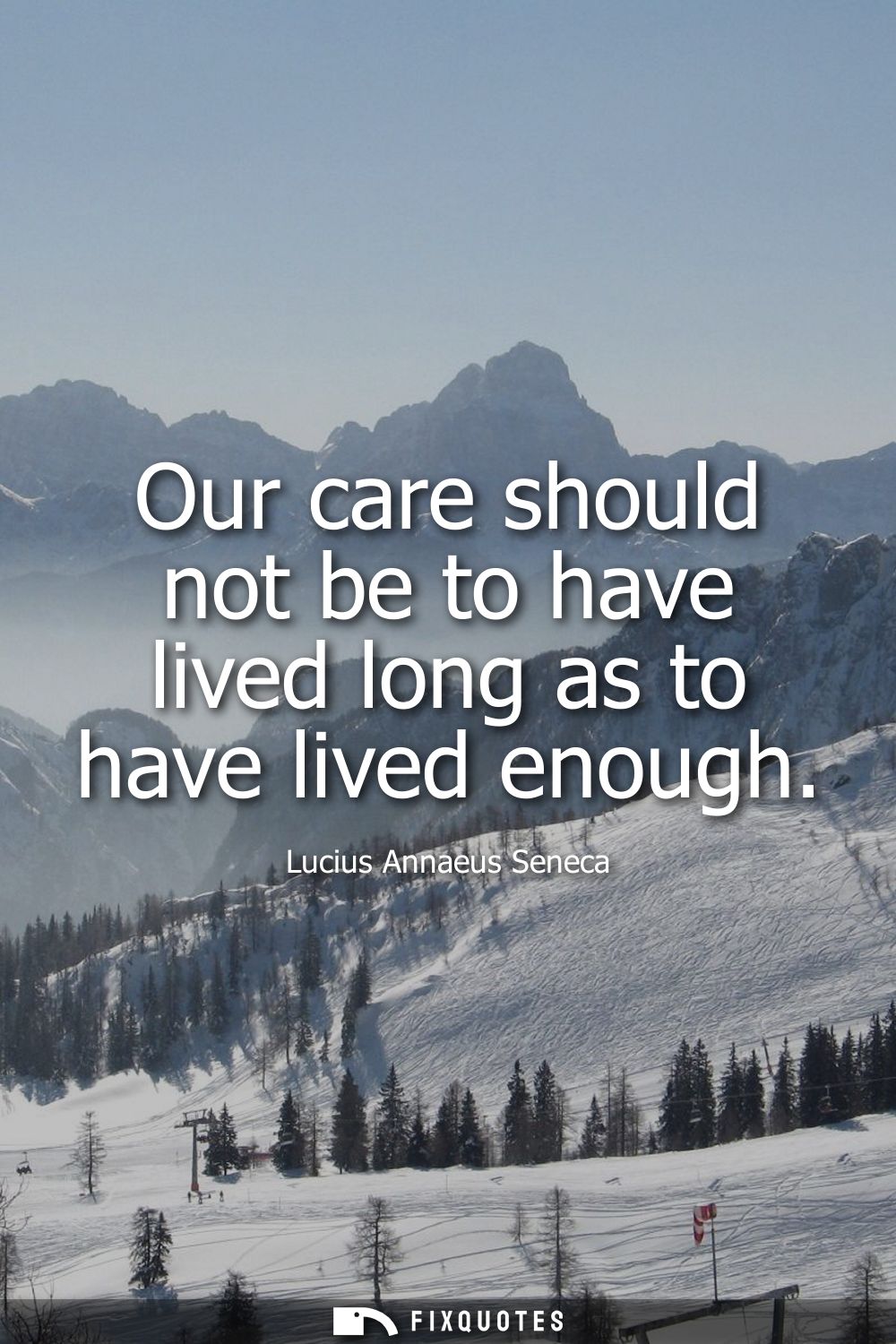
"Our care should not be to have lived long as to have lived enough"
About this Quote
Seneca’s line lands like a quiet rebuke to the Roman obsession with longevity, legacy, and outward success. “Long” is what fate hands you; “enough” is what you choose. The genius is in the pivot from quantity to sufficiency, a word that smuggles ethics into the calendar. “Enough” implies a standard of completion, as if a life can be finished well rather than merely ended. That’s a radical idea in a culture that measured status by offices held, clients gathered, and years survived in an empire where politics could shorten your lifespan overnight.
As a statesman (and eventual forced suicide under Nero), Seneca isn’t offering a wellness aphorism. He’s writing in the tense space between power and precarity, where tomorrow is never guaranteed and public life trains you to chase more: more influence, more security, more time to finally become the person you claim you’ll be. The subtext is Stoic impatience with postponement. Wanting “long” can be a sophisticated form of avoidance: if you keep the horizon far enough away, you never have to cash out your values in the present.
The phrasing also performs the lesson. It’s spare, balanced, almost legalistic: “not...so much as...” Like a judge correcting the record, Seneca reframes the case against time itself. The intent isn’t to romanticize early death; it’s to make duration irrelevant to dignity. A short life can be complete. A long one can be unfinished business dressed up as survival.
As a statesman (and eventual forced suicide under Nero), Seneca isn’t offering a wellness aphorism. He’s writing in the tense space between power and precarity, where tomorrow is never guaranteed and public life trains you to chase more: more influence, more security, more time to finally become the person you claim you’ll be. The subtext is Stoic impatience with postponement. Wanting “long” can be a sophisticated form of avoidance: if you keep the horizon far enough away, you never have to cash out your values in the present.
The phrasing also performs the lesson. It’s spare, balanced, almost legalistic: “not...so much as...” Like a judge correcting the record, Seneca reframes the case against time itself. The intent isn’t to romanticize early death; it’s to make duration irrelevant to dignity. A short life can be complete. A long one can be unfinished business dressed up as survival.
Quote Details
| Topic | Meaning of Life |
|---|---|
| Source | Help us find the source |
| Cite |
Citation Formats
APA Style (7th ed.)
Younger, Seneca the. (2026, January 15). Our care should not be to have lived long as to have lived enough. FixQuotes. https://fixquotes.com/quotes/our-care-should-not-be-to-have-lived-long-as-to-15859/
Chicago Style
Younger, Seneca the. "Our care should not be to have lived long as to have lived enough." FixQuotes. January 15, 2026. https://fixquotes.com/quotes/our-care-should-not-be-to-have-lived-long-as-to-15859/.
MLA Style (9th ed.)
"Our care should not be to have lived long as to have lived enough." FixQuotes, 15 Jan. 2026, https://fixquotes.com/quotes/our-care-should-not-be-to-have-lived-long-as-to-15859/. Accessed 12 Feb. 2026.
More Quotes by Seneca
Add to List