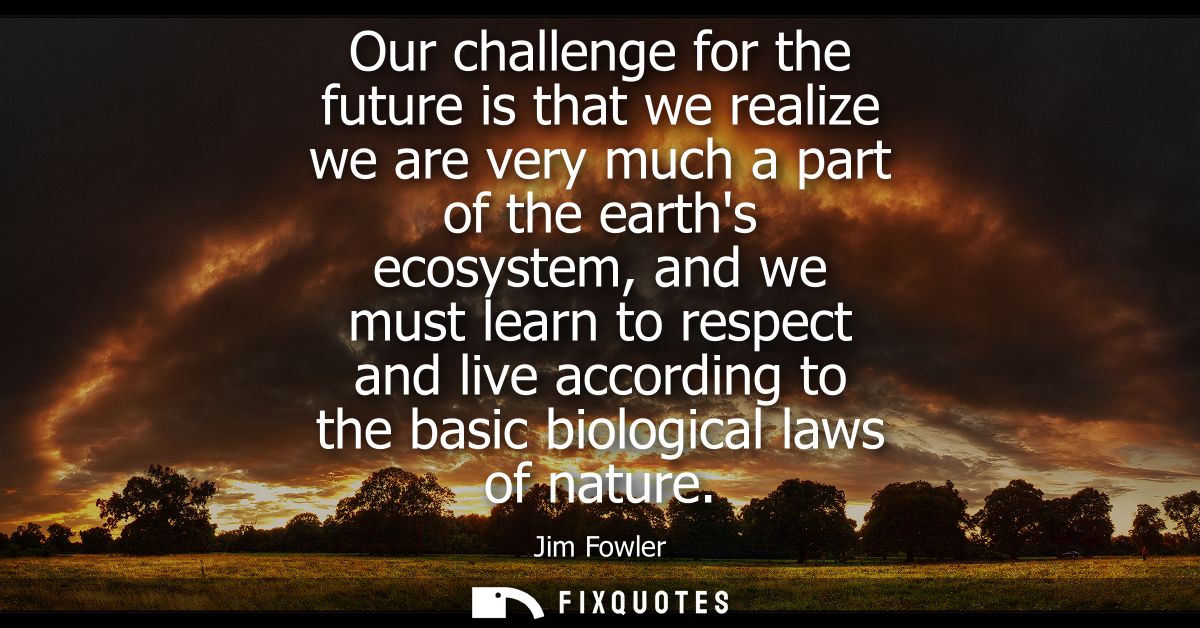
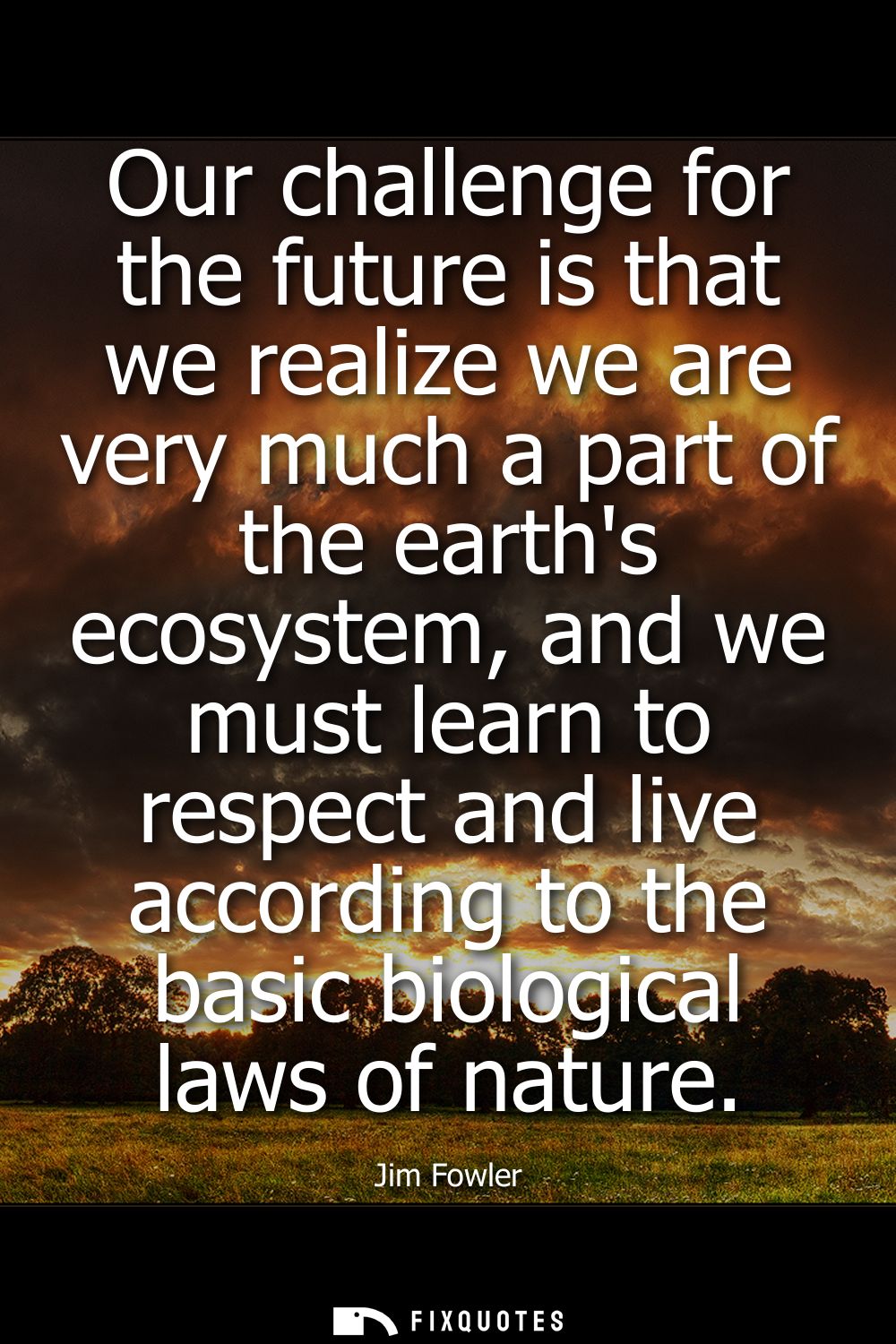
"Our challenge for the future is that we realize we are very much a part of the earth's ecosystem, and we must learn to respect and live according to the basic biological laws of nature"
About this Quote
The rhetoric does its work through demotion. “Very much a part” knocks humanity off the pedestal without needing a sermon. It implies that our current institutions behave as if we’re exempt from feedback loops: soil depletion, collapsing fisheries, zoonotic disease, biodiversity loss. Fowler’s “basic biological laws” is a strategic phrase. He’s not arguing politics or taste; he’s invoking constraints you can’t negotiate with. Biology doesn’t care about ideology, and ecosystems don’t grade on a curve.
As a scientist and public-facing naturalist, Fowler is speaking from a tradition that treats nature as both classroom and courtroom. His context is a late-20th-century America where environmentalism had to compete with consumer optimism and techno-fixes. The subtext is skeptical of the idea that innovation alone will save us; knowledge has to change behavior. “Respect and live according to” is a moral pivot disguised as practical advice: the real project isn’t admiration of nature, it’s compliance with reality.
Quote Details
| Topic | Nature |
|---|---|
| Source | Help us find the source |
| Cite |
Citation Formats
APA Style (7th ed.)
Fowler, Jim. (2026, January 17). Our challenge for the future is that we realize we are very much a part of the earth's ecosystem, and we must learn to respect and live according to the basic biological laws of nature. FixQuotes. https://fixquotes.com/quotes/our-challenge-for-the-future-is-that-we-realize-78609/
Chicago Style
Fowler, Jim. "Our challenge for the future is that we realize we are very much a part of the earth's ecosystem, and we must learn to respect and live according to the basic biological laws of nature." FixQuotes. January 17, 2026. https://fixquotes.com/quotes/our-challenge-for-the-future-is-that-we-realize-78609/.
MLA Style (9th ed.)
"Our challenge for the future is that we realize we are very much a part of the earth's ecosystem, and we must learn to respect and live according to the basic biological laws of nature." FixQuotes, 17 Jan. 2026, https://fixquotes.com/quotes/our-challenge-for-the-future-is-that-we-realize-78609/. Accessed 12 Feb. 2026.