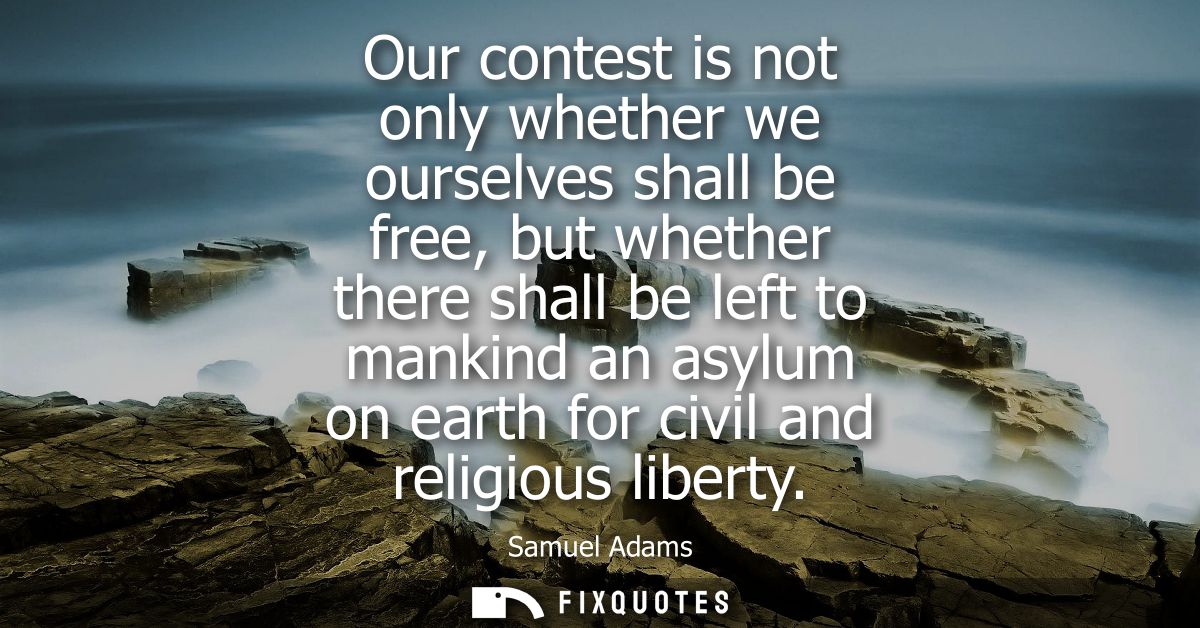
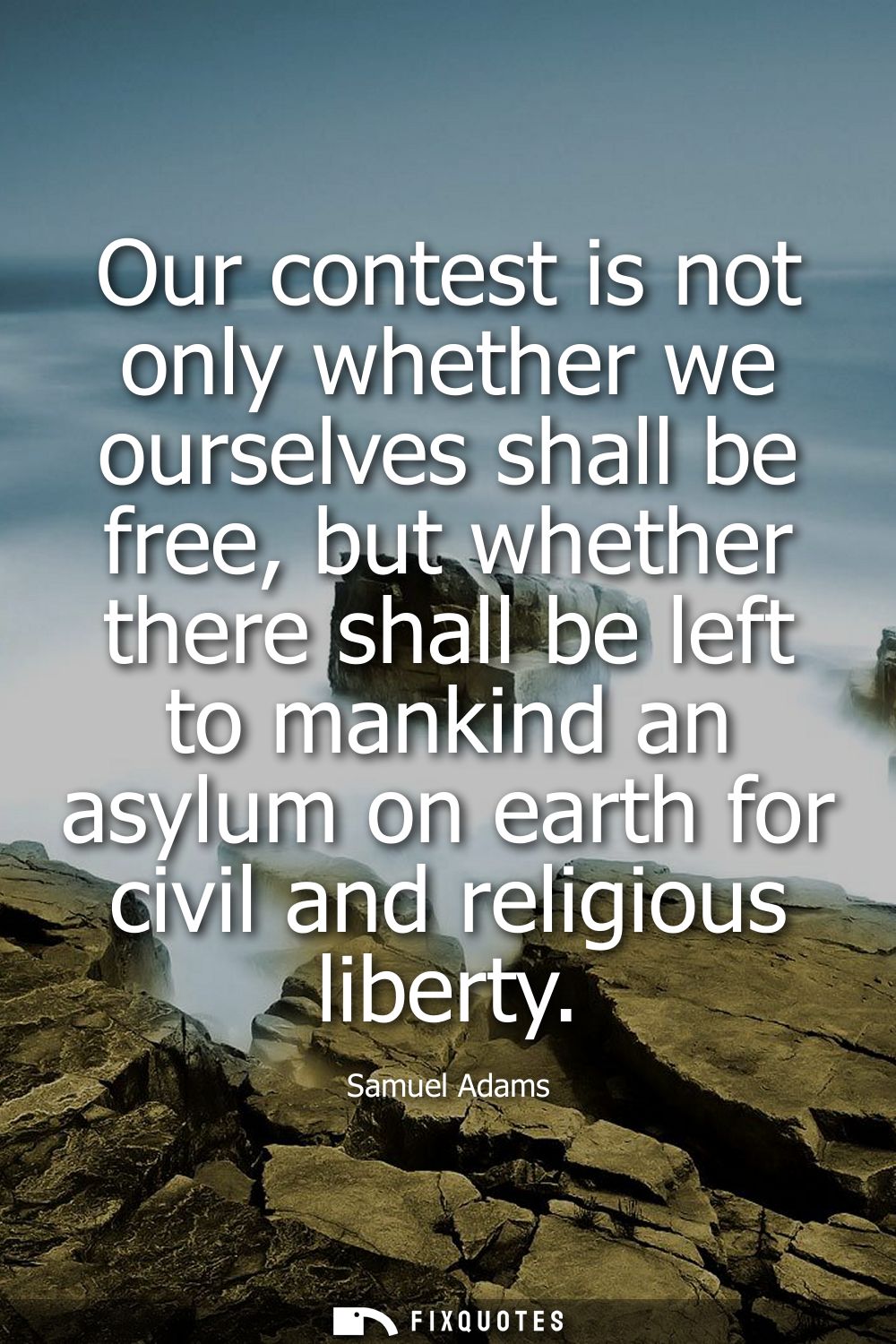
"Our contest is not only whether we ourselves shall be free, but whether there shall be left to mankind an asylum on earth for civil and religious liberty"
About this Quote
The sentence also performs a neat escalation. “Not only whether we ourselves shall be free” acknowledges the obvious motive and then deliberately shames it as insufficient. The real test, Adams insists, is whether there will be “left to mankind” any place at all where civil and religious liberty can live. That “left” is doing covert work: it assumes liberty is being actively stripped away elsewhere, so Americans are cast as the last custodians, not merely new claimants. It’s propaganda, but high-grade propaganda, built to widen the battlefield from New England to humanity.
Context matters: Adams is speaking as a revolutionary organizer trying to turn risk-averse colonists into participants in treason against the most powerful empire on earth. The appeal is strategic. By universalizing the stakes, he recasts fear and sacrifice as the price of being a beacon. The subtext is clear: neutrality is complicity, and losing would not just surrender territory; it would surrender an idea.
Quote Details
| Topic | Freedom |
|---|---|
| Source | Help us find the source |
| Cite |
Citation Formats
APA Style (7th ed.)
Adams, Samuel. (2026, January 18). Our contest is not only whether we ourselves shall be free, but whether there shall be left to mankind an asylum on earth for civil and religious liberty. FixQuotes. https://fixquotes.com/quotes/our-contest-is-not-only-whether-we-ourselves-1688/
Chicago Style
Adams, Samuel. "Our contest is not only whether we ourselves shall be free, but whether there shall be left to mankind an asylum on earth for civil and religious liberty." FixQuotes. January 18, 2026. https://fixquotes.com/quotes/our-contest-is-not-only-whether-we-ourselves-1688/.
MLA Style (9th ed.)
"Our contest is not only whether we ourselves shall be free, but whether there shall be left to mankind an asylum on earth for civil and religious liberty." FixQuotes, 18 Jan. 2026, https://fixquotes.com/quotes/our-contest-is-not-only-whether-we-ourselves-1688/. Accessed 12 Feb. 2026.