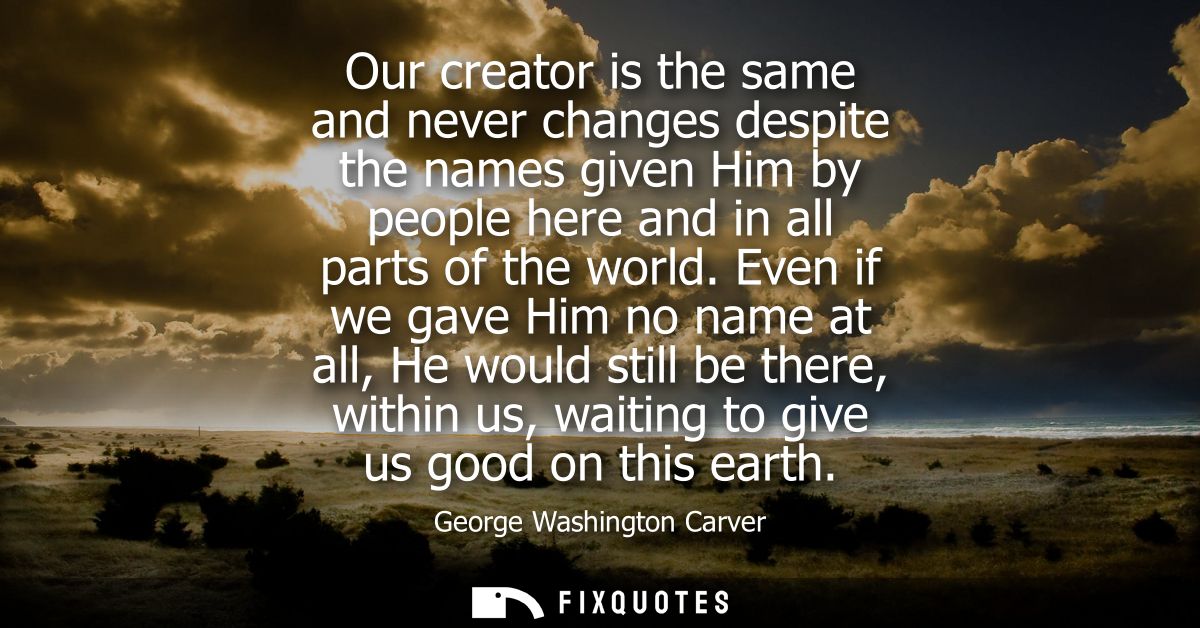
"Our creator is the same and never changes despite the names given Him by people here and in all parts of the world. Even if we gave Him no name at all, He would still be there, within us, waiting to give us good on this earth"
About this Quote
Carver affirms a universal, unchanging Creator who transcends human labels and sectarian boundaries. Names differ across cultures, but the reality they reach for remains the same. By insisting that the divine would exist even without a name, he shifts attention from dogma to experience, from argument over titles to the living presence he believes dwells within each person. The result is a theology of immanence and humility: God is not owned by any tradition and cannot be diminished by our attempts to define Him.
That inward presence, he says, is oriented toward giving good on this earth. For Carver, faith is not an escape from the world but a wellspring for practical benevolence. This emphasis mirrors his life. Born into slavery and rising to become a pioneering scientist at Tuskegee Institute, he framed his research in agriculture as cooperation with the Creator’s wisdom embedded in nature. He often described walking into the woods at dawn to pray for insight, trusting that the same divine intelligence present within him animated the plants and soils he studied. The crop rotation methods and hundreds of applications for peanuts and sweet potatoes were, in his view, answers to prayer intended to uplift poor farmers and restore exhausted land.
In an era of Jim Crow and sectarian strife, the insistence on one Creator known by many names carries a quiet plea for unity. It undercuts the impulse to divide people by creed or race, and it grounds dignity in a shared divine source. At the same time, the promise of good on this earth resists a purely otherworldly religion. Carver binds devotion to service, contemplation to problem-solving, reverence to stewardship. His words invite a faith that is generous, curious, and outward-facing: listen for the divine within, recognize it in others, and turn that recognition into concrete acts that heal communities and the land they inhabit.
That inward presence, he says, is oriented toward giving good on this earth. For Carver, faith is not an escape from the world but a wellspring for practical benevolence. This emphasis mirrors his life. Born into slavery and rising to become a pioneering scientist at Tuskegee Institute, he framed his research in agriculture as cooperation with the Creator’s wisdom embedded in nature. He often described walking into the woods at dawn to pray for insight, trusting that the same divine intelligence present within him animated the plants and soils he studied. The crop rotation methods and hundreds of applications for peanuts and sweet potatoes were, in his view, answers to prayer intended to uplift poor farmers and restore exhausted land.
In an era of Jim Crow and sectarian strife, the insistence on one Creator known by many names carries a quiet plea for unity. It undercuts the impulse to divide people by creed or race, and it grounds dignity in a shared divine source. At the same time, the promise of good on this earth resists a purely otherworldly religion. Carver binds devotion to service, contemplation to problem-solving, reverence to stewardship. His words invite a faith that is generous, curious, and outward-facing: listen for the divine within, recognize it in others, and turn that recognition into concrete acts that heal communities and the land they inhabit.
Quote Details
| Topic | God |
|---|
More Quotes by George
Add to List