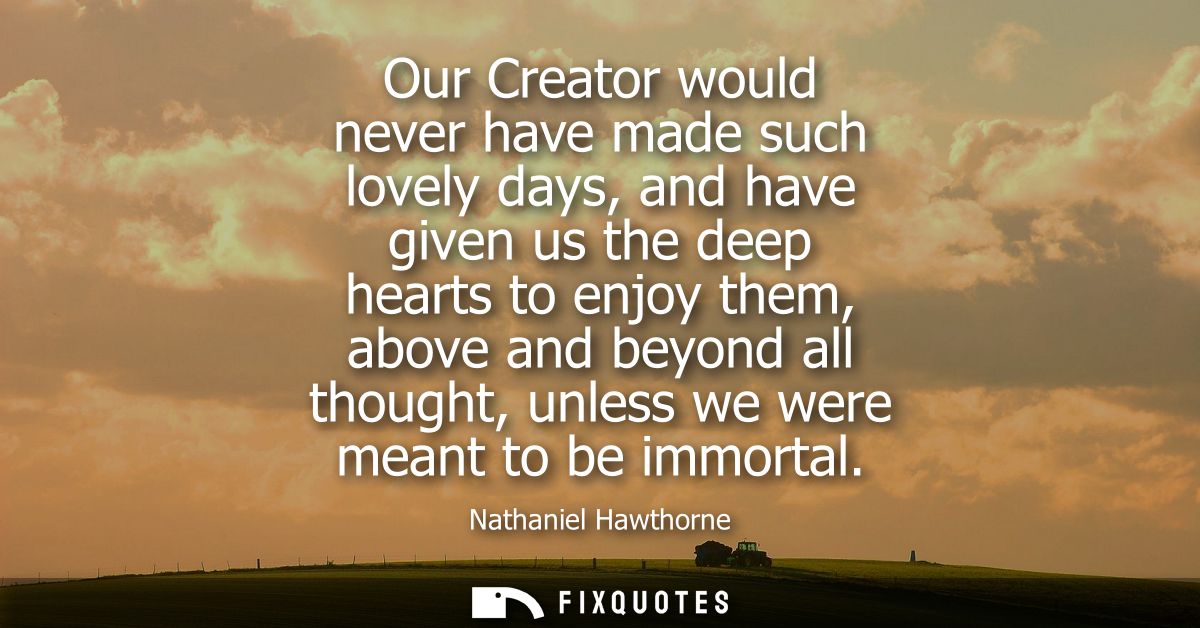
"Our Creator would never have made such lovely days, and have given us the deep hearts to enjoy them, above and beyond all thought, unless we were meant to be immortal"
About this Quote
Hawthorne turns a pleasant day into a theological provocation: if nature can feel this exquisitely right, why would it be built for creatures destined to vanish? The line works because it sneaks a metaphysical argument into an aesthetic one. He starts with “lovely days” and “deep hearts,” pairing external beauty with internal capacity, as if creation and human receptivity are a matched set. The implication is almost contractual: it would be wasteful, even cruel, for a Creator to design a world that reliably triggers transcendence and then cap the experiencer with oblivion.
That’s classic Hawthorne, though: a moralist who distrusts easy comfort, here letting longing masquerade as proof. “Above and beyond all thought” is the tell. He’s not offering doctrine so much as describing the mind slipping its leash, the moment when pleasure feels too large for a mortal container. The subtext isn’t certainty; it’s a desire to read permanence into intensity. Immortality becomes the emotional logic we reach for when joy feels unjustifiable under the terms of ordinary life.
In Hawthorne’s 19th-century New England air, saturated with Protestant seriousness and haunted by Puritan inheritance, this is also a subtle counterweight: an attempt to reclaim creation as benevolent rather than merely disciplinary. Yet the sentence never quite settles into sermon. It’s a novelist’s move, not a minister’s: converting atmosphere into argument, letting the reader feel the seduction of belief without pretending the case is airtight.
That’s classic Hawthorne, though: a moralist who distrusts easy comfort, here letting longing masquerade as proof. “Above and beyond all thought” is the tell. He’s not offering doctrine so much as describing the mind slipping its leash, the moment when pleasure feels too large for a mortal container. The subtext isn’t certainty; it’s a desire to read permanence into intensity. Immortality becomes the emotional logic we reach for when joy feels unjustifiable under the terms of ordinary life.
In Hawthorne’s 19th-century New England air, saturated with Protestant seriousness and haunted by Puritan inheritance, this is also a subtle counterweight: an attempt to reclaim creation as benevolent rather than merely disciplinary. Yet the sentence never quite settles into sermon. It’s a novelist’s move, not a minister’s: converting atmosphere into argument, letting the reader feel the seduction of belief without pretending the case is airtight.
Quote Details
| Topic | God |
|---|
More Quotes by Nathaniel
Add to List