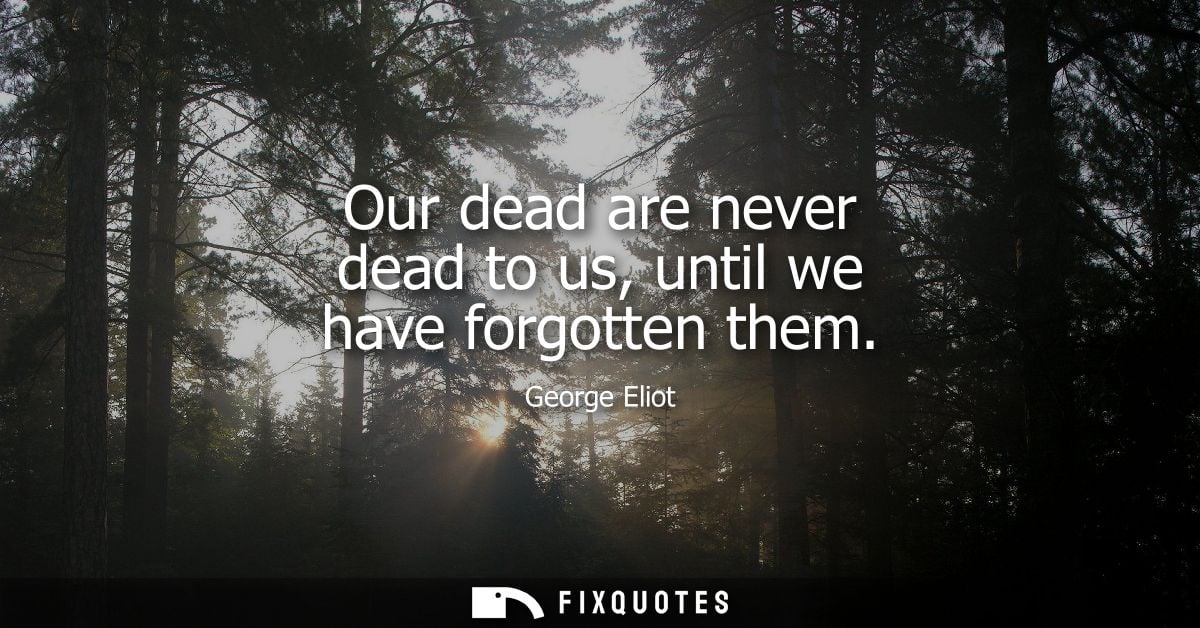
"Our dead are never dead to us, until we have forgotten them"
About this Quote
Grief, in George Eliot's hands, isn't a storm you simply wait out; it's a ledger you keep, whether you mean to or not. "Our dead are never dead to us, until we have forgotten them" turns bereavement into a moral and psychological fact: death ends a life, but it doesn't end a relationship. Eliot's phrasing insists on possession and intimacy ("our dead", "to us"), making memory less like a private scrapbook and more like an ongoing bond that shapes choices, habits, even conscience.
The line works because it flips the usual comfort offered by Victorian piety. Instead of promising reunion in heaven, Eliot plants immortality in the mind and in social life. The subtext is quietly radical: if the dead persist through remembrance, then the living carry responsibility for how they narrate and keep them. Forgetting becomes a second death, not administered by biology but by negligence, time, and the pressures of modern life to "move on". It's both consolation and accusation.
Eliot wrote in an era wrestling with shaken religious certainties, industrial acceleration, and the thinning of communal rituals that once organized mourning. Her realism treated inner life as consequential, not decorative, so this sentence doubles as a thesis for her fiction: people are haunted not by ghosts but by memory's force, by the way love and harm survive as mental architecture. The dead remain, not as saints, but as stubborn influences - until we choose, or are forced, to let them vanish.
The line works because it flips the usual comfort offered by Victorian piety. Instead of promising reunion in heaven, Eliot plants immortality in the mind and in social life. The subtext is quietly radical: if the dead persist through remembrance, then the living carry responsibility for how they narrate and keep them. Forgetting becomes a second death, not administered by biology but by negligence, time, and the pressures of modern life to "move on". It's both consolation and accusation.
Eliot wrote in an era wrestling with shaken religious certainties, industrial acceleration, and the thinning of communal rituals that once organized mourning. Her realism treated inner life as consequential, not decorative, so this sentence doubles as a thesis for her fiction: people are haunted not by ghosts but by memory's force, by the way love and harm survive as mental architecture. The dead remain, not as saints, but as stubborn influences - until we choose, or are forced, to let them vanish.
Quote Details
| Topic | Legacy & Remembrance |
|---|---|
| Source | Verified source: Adam Bede (George Eliot, 1859)
Evidence: Our dead are never dead to us until we have forgotten them; they can be injured by us, they can be wounded; they know all our penitence, all our aching sense that their place is empty; all the kisses we bestow on the smallest relic of their presence. (Chapter X). The commonly circulated version with commas instead of semicolons and often shortened to only the first clause is a modern respelling/punctuation variant. The primary source is George Eliot's novel Adam Bede, first published in 1859. In Chapter X, the line appears in the narrative while describing Lisbeth Bede after her husband's death. A verified online text shows the sentence in Chapter X. The exact first-edition page number was not confirmed here, but the chapter location is secure. Other candidates (1) George Eliot's Works: Adam Bede (George Eliot, 1893) compilation95.0% George Eliot. office of respect or love for the still corpse , to which in all her thoughts she attributed some consc... |
| Cite |
Citation Formats
APA Style (7th ed.)
Eliot, George. (2026, March 10). Our dead are never dead to us, until we have forgotten them. FixQuotes. https://fixquotes.com/quotes/our-dead-are-never-dead-to-us-until-we-have-35035/
Chicago Style
Eliot, George. "Our dead are never dead to us, until we have forgotten them." FixQuotes. March 10, 2026. https://fixquotes.com/quotes/our-dead-are-never-dead-to-us-until-we-have-35035/.
MLA Style (9th ed.)
"Our dead are never dead to us, until we have forgotten them." FixQuotes, 10 Mar. 2026, https://fixquotes.com/quotes/our-dead-are-never-dead-to-us-until-we-have-35035/. Accessed 26 Mar. 2026.
More Quotes by George
Add to List