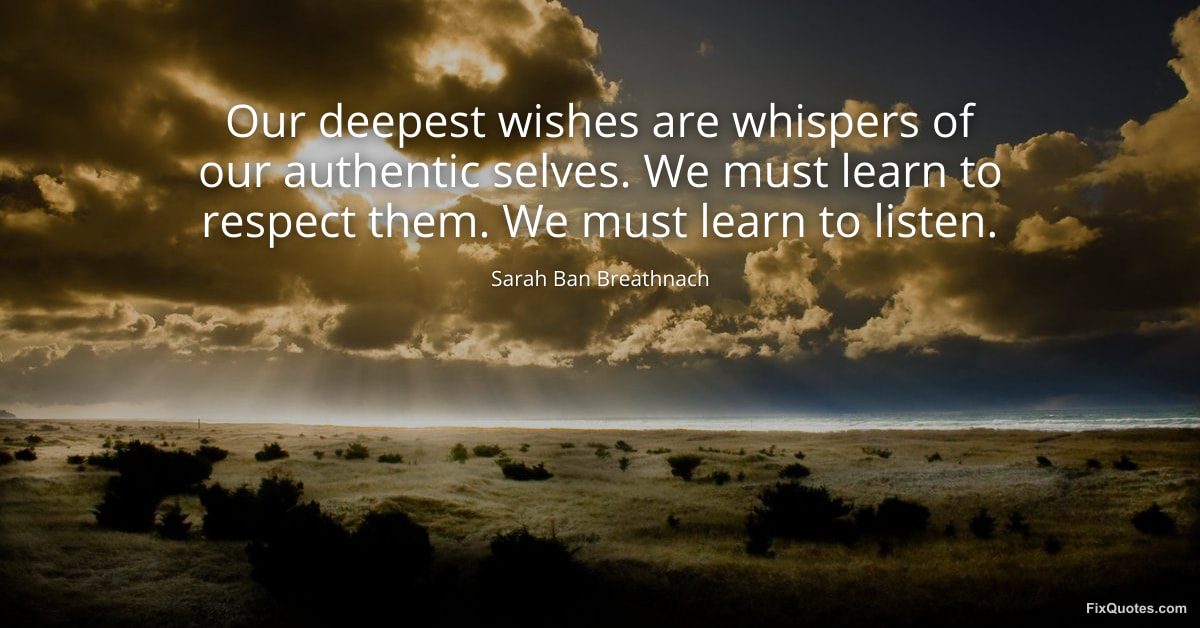
"Our deepest wishes are whispers of our authentic selves. We must learn to respect them. We must learn to listen"
About this Quote
The intent is corrective. Respect here isn’t indulgence; it’s basic human dignity applied inward. Ban Breathnach is trying to shift the reader from suspicion of desire (wishes as selfish, childish, impractical) to a kind of inner consent. The repetition - “We must learn... We must learn...” - is a gentle drumbeat that turns introspection into discipline. Listening isn’t presented as instinctive; it’s a skill you practice against resistance.
Contextually, this fits the late-20th/early-21st-century wellness and women’s spirituality tradition Ban Breathnach is known for: a response to roles that reward self-erasure. The subtext is political in miniature. If your “authentic self” is whispering, someone or something has trained you to speak over it. The quote’s power is that it makes ignoring yourself sound not just sad, but irresponsible.
Quote Details
| Topic | Self-Improvement |
|---|---|
| Source | Later attribution: Secrets Girls Keep (Carrie Silver-Stock, 2009) modern compilationISBN: 9780757313691 · ID: UHOjAgAAQBAJ
Evidence:
... Our deepest wishes are whispers of our authentic selves . We must learn to respect them . We must learn to listen . -Sarah Ban Breathnach younger sister a gymnast . Then , in ninth grade , I discovered the flute . I loved the way it ... |
| Cite |
Citation Formats
APA Style (7th ed.)
Breathnach, Sarah Ban. (2026, March 4). Our deepest wishes are whispers of our authentic selves. We must learn to respect them. We must learn to listen. FixQuotes. https://fixquotes.com/quotes/our-deepest-wishes-are-whispers-of-our-authentic-183940/
Chicago Style
Breathnach, Sarah Ban. "Our deepest wishes are whispers of our authentic selves. We must learn to respect them. We must learn to listen." FixQuotes. March 4, 2026. https://fixquotes.com/quotes/our-deepest-wishes-are-whispers-of-our-authentic-183940/.
MLA Style (9th ed.)
"Our deepest wishes are whispers of our authentic selves. We must learn to respect them. We must learn to listen." FixQuotes, 4 Mar. 2026, https://fixquotes.com/quotes/our-deepest-wishes-are-whispers-of-our-authentic-183940/. Accessed 3 Apr. 2026.