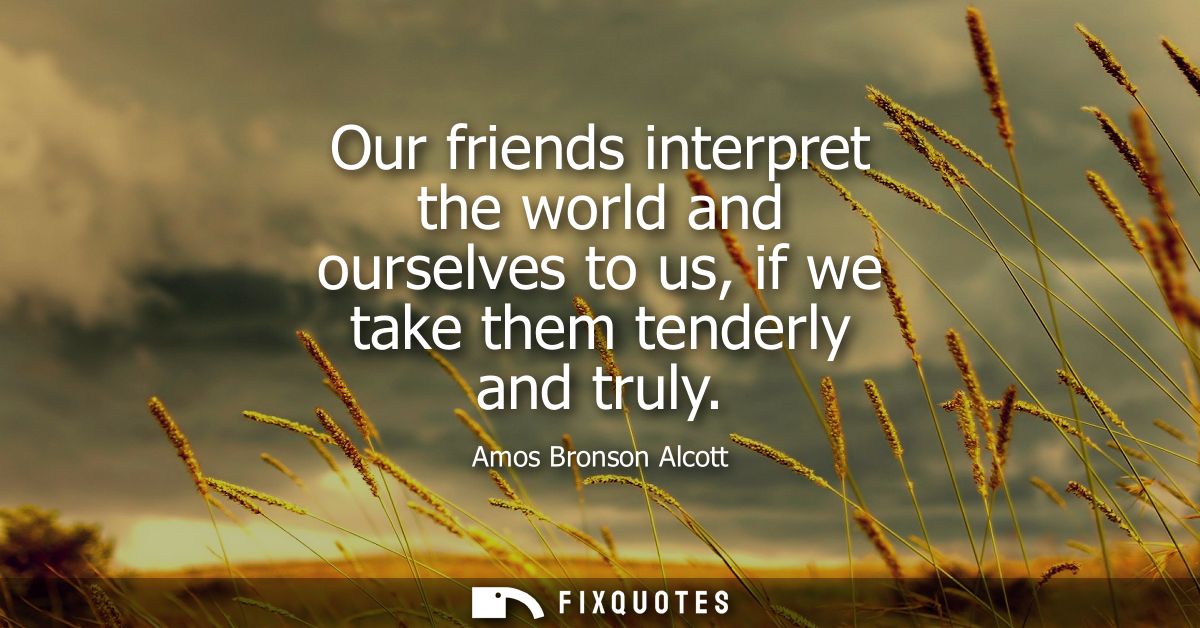
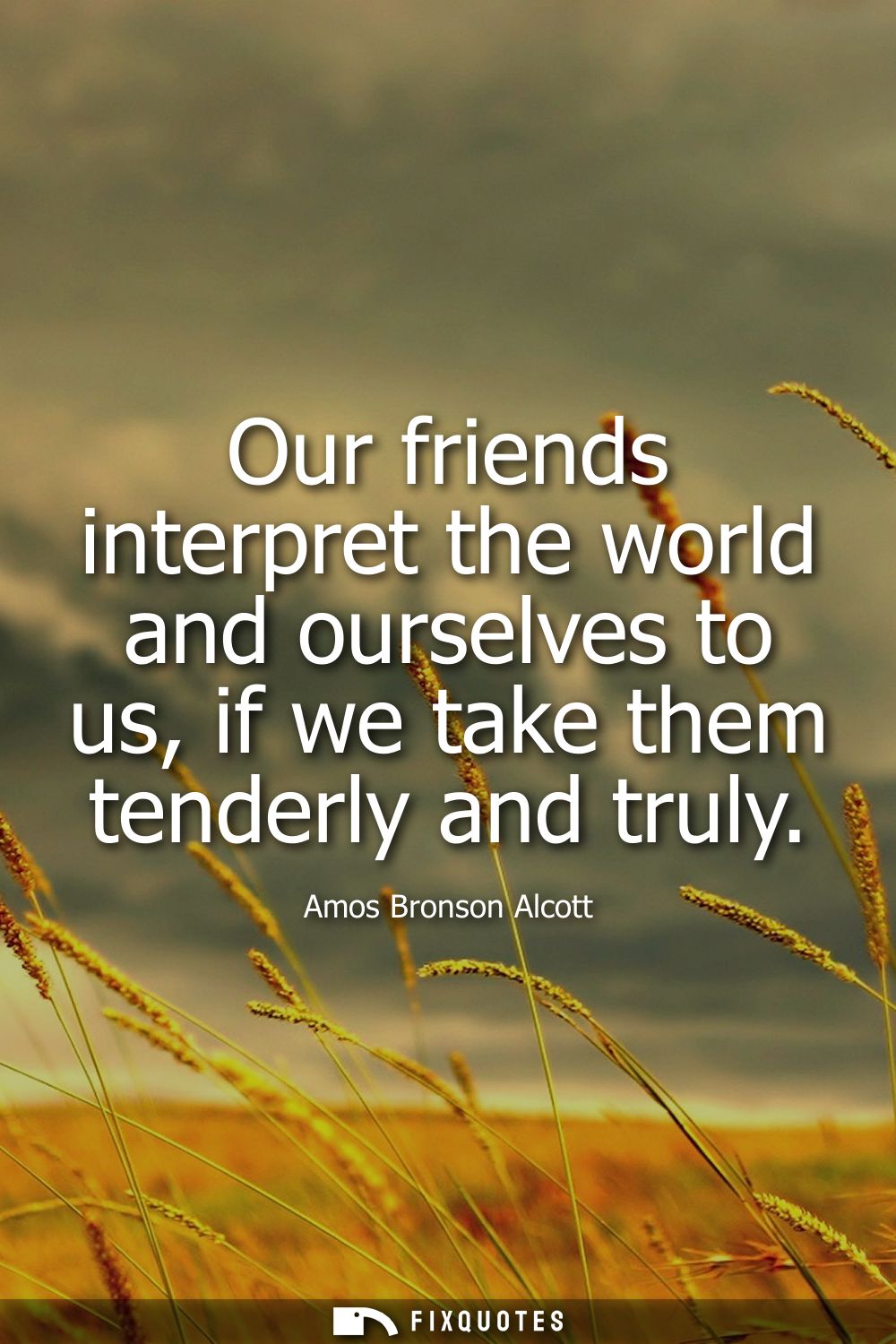
"Our friends interpret the world and ourselves to us, if we take them tenderly and truly"
About this Quote
Friendship, for Alcott, isn’t just companionship; it’s a quiet instrument of perception. The line assumes something bracing: we don’t encounter the world raw. We meet it through a running commentary, and our closest friends are among the most powerful narrators in that feed. They “interpret” the world and “ourselves” back to us, implying that identity is partly a collaborative draft, revised in conversation, tested in the friction of affection and candor.
The craftsmanship is in the conditional: “if we take them tenderly and truly.” Alcott isn’t romanticizing friends as automatic sages; he’s warning that their insight is only as good as our receptivity. “Tenderly” asks for emotional generosity, the willingness to hear an interpretation without turning it into a trial. “Truly” demands something tougher: not flattering ourselves, not weaponizing intimacy, not confusing loyalty with agreement. The pairing sets a moral standard for listening, where care and honesty aren’t opposites but a single discipline.
Context matters. As a 19th-century educator aligned with Transcendentalist currents, Alcott believed in self-culture and moral growth, but not as solitary heroism. This sentence smuggles pedagogy into friendship: friends function as unofficial teachers, offering mirrors that are warmer than self-scrutiny and sharper than public judgment. The subtext is democratic and demanding: wisdom isn’t hoarded in institutions; it emerges in relationships, provided we meet them with the rare mix of softness and rigor.
The craftsmanship is in the conditional: “if we take them tenderly and truly.” Alcott isn’t romanticizing friends as automatic sages; he’s warning that their insight is only as good as our receptivity. “Tenderly” asks for emotional generosity, the willingness to hear an interpretation without turning it into a trial. “Truly” demands something tougher: not flattering ourselves, not weaponizing intimacy, not confusing loyalty with agreement. The pairing sets a moral standard for listening, where care and honesty aren’t opposites but a single discipline.
Context matters. As a 19th-century educator aligned with Transcendentalist currents, Alcott believed in self-culture and moral growth, but not as solitary heroism. This sentence smuggles pedagogy into friendship: friends function as unofficial teachers, offering mirrors that are warmer than self-scrutiny and sharper than public judgment. The subtext is democratic and demanding: wisdom isn’t hoarded in institutions; it emerges in relationships, provided we meet them with the rare mix of softness and rigor.
Quote Details
| Topic | Friendship |
|---|
More Quotes by Amos
Add to List