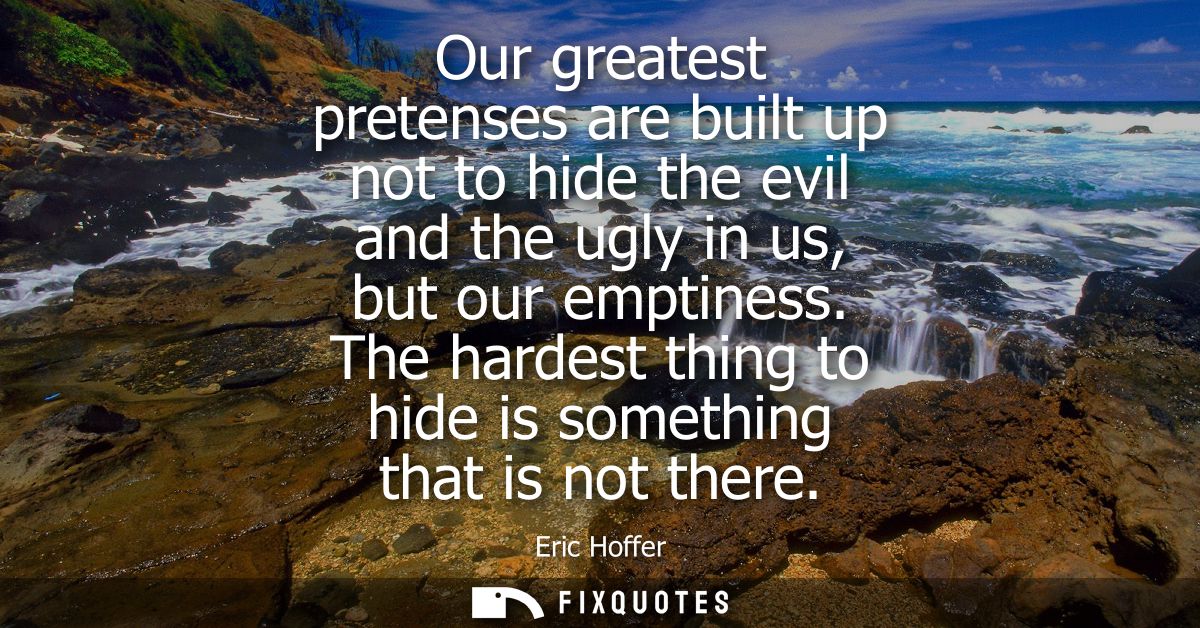
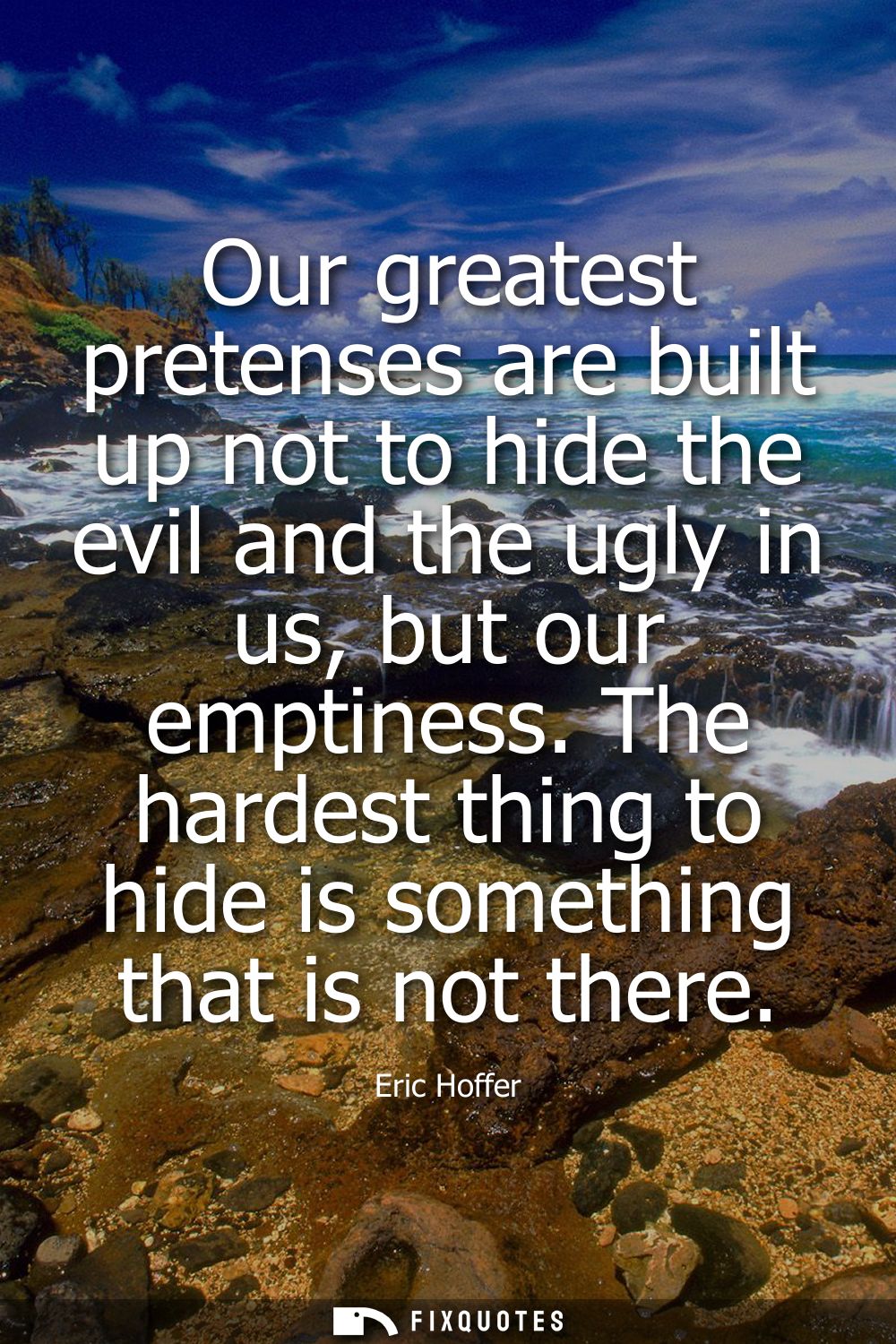
"Our greatest pretenses are built up not to hide the evil and the ugly in us, but our emptiness. The hardest thing to hide is something that is not there"
About this Quote
The phrasing is deceptively plain, but it’s doing a clever reversal. “Pretenses” typically imply concealment of the ugly; Hoffer shifts the target to a void, implying that the self is often an improvised set. “Built up” makes identity sound architectural and labor-intensive, a structure erected to withstand scrutiny. Then the kicker: “something that is not there.” You can’t camouflage a hole with another costume; the hole keeps shaping everything around it.
In context, this fits Hoffer’s lifelong obsession with mass movements and the psychology of belonging. A person unsure of their own interior resources is easier to recruit into ready-made meanings: nation, party, church, crusade, brand. The quote reads like a warning about how performative certainty spreads. When emptiness is the fear, overcompensation becomes the style: louder convictions, sharper identities, more aggressive moral signaling. Hoffer isn’t just critiquing individual vanity; he’s tracing how private hollowness can become public fervor.
Quote Details
| Topic | Wisdom |
|---|---|
| Source | Unverified source: The Passionate State of Mind, and Other Aphorisms (Eric Hoffer, 1955)
Evidence: Multiple independent quote aggregators attribute the line to Eric Hoffer’s own book *The Passionate State of Mind, and Other Aphorisms* (first edition, Harper, New York, 1955). Library catalogs confirm the book’s bibliographic details (publisher/year/pages), but I could not access a searchable sc... Other candidates (2) The New Generation of Worshipers in the 21St Century (Pastor Stephen Kyeyune, 2010) compilation97.8% ... Eric Hoffer wrote that, “Our greatest pretenses are built up not to hide the evil and the ugly in us, but our emp... Eric Hoffer (Eric Hoffer) compilation40.1% lly a search for pride section 29 when people are free to do as we please they usually imitate each other section 33 ... |
| Cite |
Citation Formats
APA Style (7th ed.)
Hoffer, Eric. (2026, January 14). Our greatest pretenses are built up not to hide the evil and the ugly in us, but our emptiness. The hardest thing to hide is something that is not there. FixQuotes. https://fixquotes.com/quotes/our-greatest-pretenses-are-built-up-not-to-hide-34710/
Chicago Style
Hoffer, Eric. "Our greatest pretenses are built up not to hide the evil and the ugly in us, but our emptiness. The hardest thing to hide is something that is not there." FixQuotes. January 14, 2026. https://fixquotes.com/quotes/our-greatest-pretenses-are-built-up-not-to-hide-34710/.
MLA Style (9th ed.)
"Our greatest pretenses are built up not to hide the evil and the ugly in us, but our emptiness. The hardest thing to hide is something that is not there." FixQuotes, 14 Jan. 2026, https://fixquotes.com/quotes/our-greatest-pretenses-are-built-up-not-to-hide-34710/. Accessed 6 Apr. 2026.