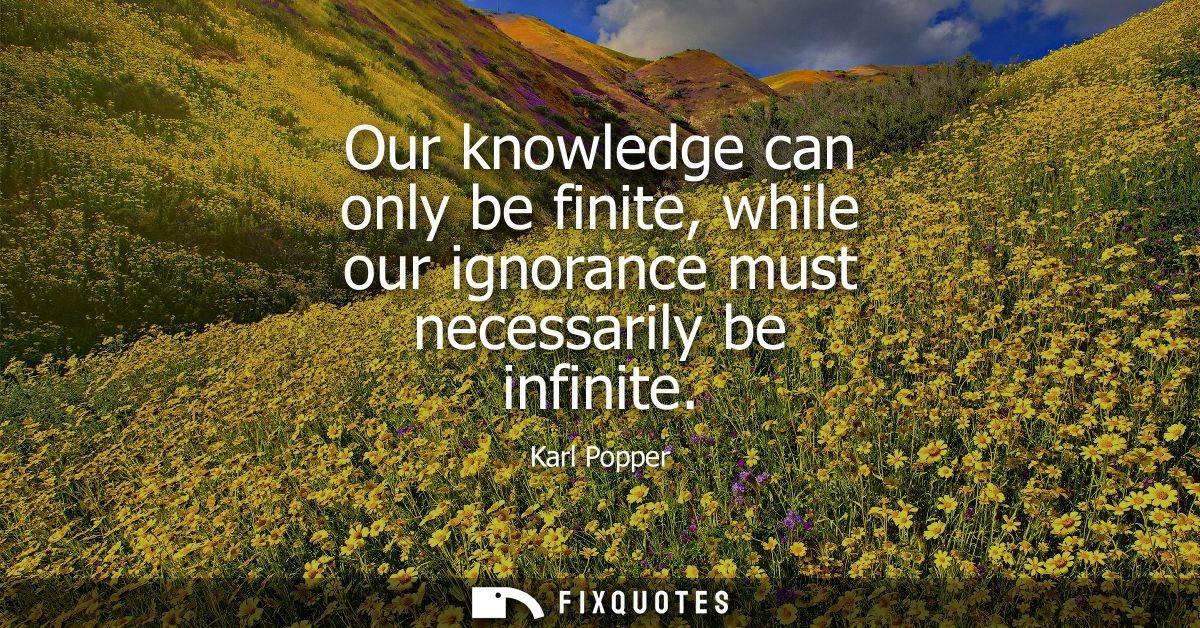
"Our knowledge can only be finite, while our ignorance must necessarily be infinite"
About this Quote
Popper lands the punch with a quiet asymmetry: finitude is the human condition, infinity belongs to what we dont know. The line works because it reverses the usual intellectual vanity. Knowledge, in most self-mythologies, expands until it feels like mastery. Popper insists its bounded not just by lifespan or brainpower, but by logic: any set of established truths is a limited island, while the space of possible errors, unknown variables, and unasked questions stretches without end.
The intent is disciplinary. Popper is policing the border between science and ideology, warning that certainty is often a costume for dogma. In his philosophy of falsification, progress doesnt come from piling up confirmations; it comes from staging ideas against reality and letting the weak ones break. That method requires a temperament: modest about what you have nailed down, aggressive about hunting what you havent. The quote smuggles in that ethic. If ignorance is infinite, then being wrong is not a scandal but a baseline risk; the scandal is refusing to design your thinking to catch errors early.
Context matters: Popper writes in the shadow of totalizing systems Marxism, historicism, fascism that claimed to read history like a script. Against that, he offers an anti-prophetic politics of knowledge. The subtext is almost civic: societies stay open when they treat every doctrine as provisional, every institution as corrigible, every expert as fallible. Infinity here isnt romantic; its a safeguard against the seductions of final answers.
The intent is disciplinary. Popper is policing the border between science and ideology, warning that certainty is often a costume for dogma. In his philosophy of falsification, progress doesnt come from piling up confirmations; it comes from staging ideas against reality and letting the weak ones break. That method requires a temperament: modest about what you have nailed down, aggressive about hunting what you havent. The quote smuggles in that ethic. If ignorance is infinite, then being wrong is not a scandal but a baseline risk; the scandal is refusing to design your thinking to catch errors early.
Context matters: Popper writes in the shadow of totalizing systems Marxism, historicism, fascism that claimed to read history like a script. Against that, he offers an anti-prophetic politics of knowledge. The subtext is almost civic: societies stay open when they treat every doctrine as provisional, every institution as corrigible, every expert as fallible. Infinity here isnt romantic; its a safeguard against the seductions of final answers.
Quote Details
| Topic | Knowledge |
|---|
More Quotes by Karl
Add to List