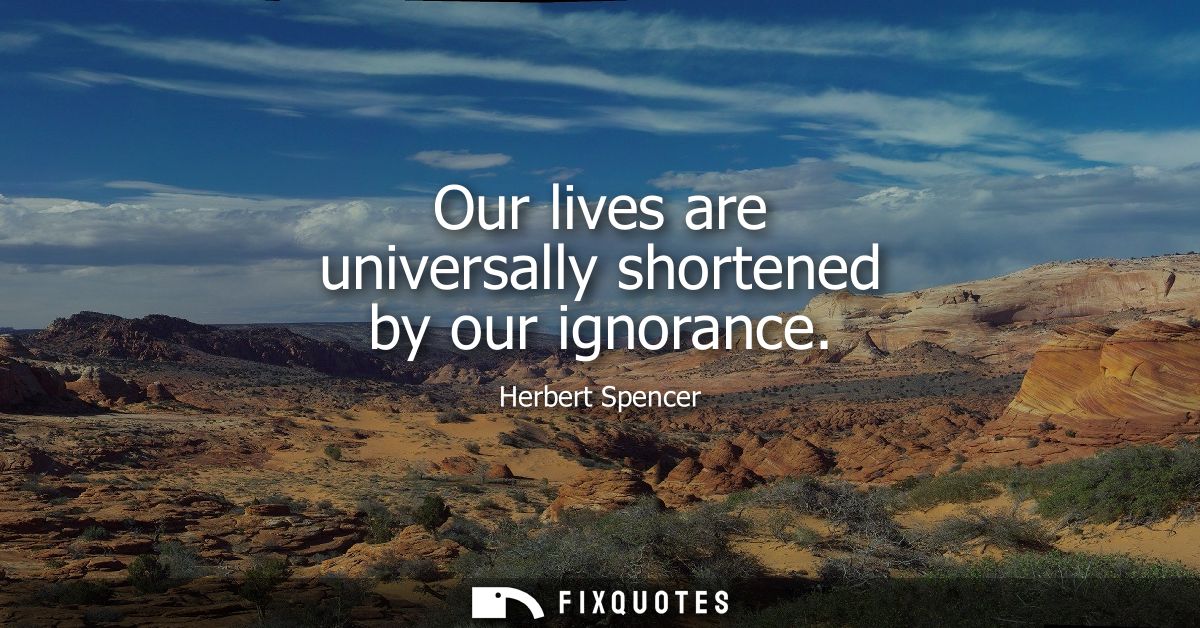
"Our lives are universally shortened by our ignorance"
About this Quote
Spencer’s line has the chilly efficiency of a Victorian diagnosis: ignorance isn’t merely embarrassing, it’s lethal. The word “universally” does heavy lifting. He’s not scolding a few benighted fools; he’s flattening the class distinction between the educated and the uneducated. Everyone pays a mortality tax for what they don’t know. That’s a shrewd rhetorical move in an era drunk on “progress” and industrial confidence: it punctures the fantasy that modernity automatically produces wisdom.
The intent is partly moral, partly managerial. Spencer, a key architect of social evolution thinking, believed societies advance through adaptation, and adaptation requires accurate knowledge. Ignorance, then, isn’t a private flaw; it’s a systemic drag on human thriving, a force that turns avoidable risks into routine suffering. The subtext: the body keeps score for bad ideas. Superstition, misinformation, and complacency don’t just distort debate; they become accidents, epidemics, workplace disasters, and political catastrophes.
Context matters: mid-19th century Britain was wrestling with public health, sanitation, and the upheaval of industrial life. “Shortened” reads less like metaphor and more like a ledger entry. Spencer is writing in a world where ignorance about germs, labor safety, and governance had measurable consequences. The line also smuggles in a liberal faith in education as social technology: knowledge can literally extend life, not through inspiration but through competent systems and informed choices.
It works because it reframes enlightenment as survival. Not “be smarter,” but “live longer.” In a single sentence, Spencer makes epistemology feel like an emergency.
The intent is partly moral, partly managerial. Spencer, a key architect of social evolution thinking, believed societies advance through adaptation, and adaptation requires accurate knowledge. Ignorance, then, isn’t a private flaw; it’s a systemic drag on human thriving, a force that turns avoidable risks into routine suffering. The subtext: the body keeps score for bad ideas. Superstition, misinformation, and complacency don’t just distort debate; they become accidents, epidemics, workplace disasters, and political catastrophes.
Context matters: mid-19th century Britain was wrestling with public health, sanitation, and the upheaval of industrial life. “Shortened” reads less like metaphor and more like a ledger entry. Spencer is writing in a world where ignorance about germs, labor safety, and governance had measurable consequences. The line also smuggles in a liberal faith in education as social technology: knowledge can literally extend life, not through inspiration but through competent systems and informed choices.
It works because it reframes enlightenment as survival. Not “be smarter,” but “live longer.” In a single sentence, Spencer makes epistemology feel like an emergency.
Quote Details
| Topic | Wisdom |
|---|---|
| Source | Help us find the source |
| Cite |
Citation Formats
APA Style (7th ed.)
Spencer, Herbert. (2026, January 15). Our lives are universally shortened by our ignorance. FixQuotes. https://fixquotes.com/quotes/our-lives-are-universally-shortened-by-our-11342/
Chicago Style
Spencer, Herbert. "Our lives are universally shortened by our ignorance." FixQuotes. January 15, 2026. https://fixquotes.com/quotes/our-lives-are-universally-shortened-by-our-11342/.
MLA Style (9th ed.)
"Our lives are universally shortened by our ignorance." FixQuotes, 15 Jan. 2026, https://fixquotes.com/quotes/our-lives-are-universally-shortened-by-our-11342/. Accessed 3 Apr. 2026.
More Quotes by Herbert
Add to List