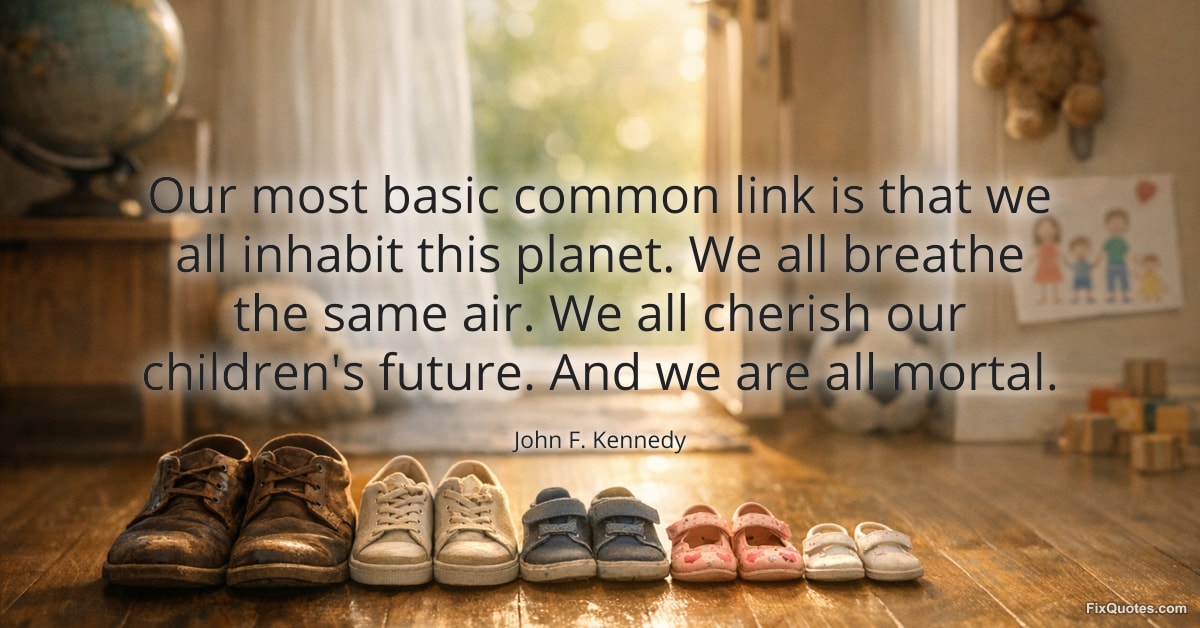
"Our most basic common link is that we all inhabit this planet. We all breathe the same air. We all cherish our children's future. And we are all mortal"
About this Quote
The intent is persuasion through inevitability. You can argue about borders and systems; you can’t argue with lungs. “We all breathe the same air” quietly collapses the fantasy of clean separation that powers conflict. It’s a line that smuggles in interdependence before anyone has a chance to reject it on partisan grounds. Then he pivots to the most reliable trigger in public life: children. “We all cherish our children’s future” isn’t sentimentality so much as a claim that the future is a moral commons, not a national possession.
The closing punch, “we are all mortal,” is the subtext made explicit. Mortality levels presidents and peasants, superpowers and small states. In the Cold War context, it reads as an indictment of nuclear brinkmanship: the ultimate policy argument is that escalation ends the argument for everyone. Kennedy’s genius is that he makes restraint sound not like concession but like realism, rooted in the one fact no ideology can outvote.
Quote Details
| Topic | Mortality |
|---|---|
| Source | Verified source: American University Commencement Address (John F. Kennedy, 1963)
Evidence: For, in the final analysis, our most basic common link is that we all inhabit this small planet. We all breathe the same air. We all cherish our children's future. And we are all mortal.. This is from President John F. Kennedy’s commencement address at American University in Washington, D.C., delivered on June 10, 1963 (often referred to as the “Strategy of Peace” speech). The JFK Library transcript contains the line exactly as above; many secondary quote sites omit the word “small” (rendering it “this planet”), which is a common truncation/variant. Other candidates (1) Interpretation (James Nolan, 2012) compilation97.9% ... John F. Kennedy , address before the General Assembly of the United Nations ... our most basic common link is tha... |
| Cite |
Citation Formats
APA Style (7th ed.)
Kennedy, John F. (2026, February 10). Our most basic common link is that we all inhabit this planet. We all breathe the same air. We all cherish our children's future. And we are all mortal. FixQuotes. https://fixquotes.com/quotes/our-most-basic-common-link-is-that-we-all-inhabit-41394/
Chicago Style
Kennedy, John F. "Our most basic common link is that we all inhabit this planet. We all breathe the same air. We all cherish our children's future. And we are all mortal." FixQuotes. February 10, 2026. https://fixquotes.com/quotes/our-most-basic-common-link-is-that-we-all-inhabit-41394/.
MLA Style (9th ed.)
"Our most basic common link is that we all inhabit this planet. We all breathe the same air. We all cherish our children's future. And we are all mortal." FixQuotes, 10 Feb. 2026, https://fixquotes.com/quotes/our-most-basic-common-link-is-that-we-all-inhabit-41394/. Accessed 6 Mar. 2026.