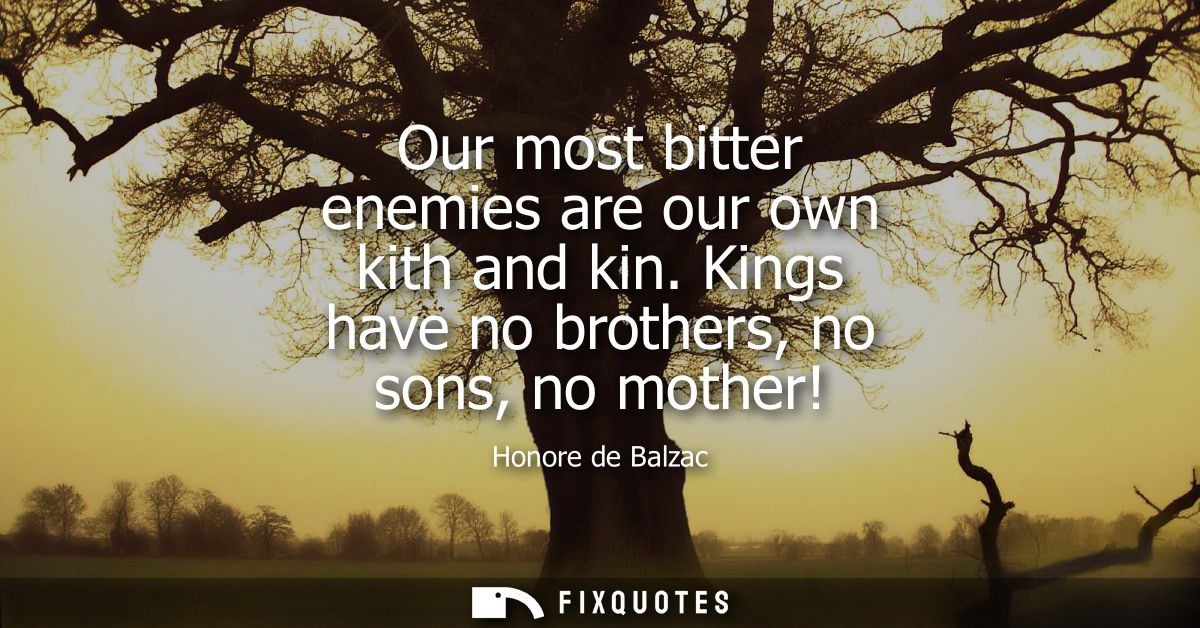
"Our most bitter enemies are our own kith and kin. Kings have no brothers, no sons, no mother!"
About this Quote
“Kings have no brothers, no sons, no mother!” reads like a grim joke, but it’s really a diagnosis of political chemistry. Monarchy pretends to be familial - dynastic portraits, “house” names, the nation as household - yet the institution cannibalizes the very relationships it borrows for its symbolism. A brother becomes a rival claimant, a son becomes the ticking clock of replacement, a mother becomes an influence to be neutralized. Kinship is recoded as strategy.
The subtext is less about royal melodrama than about the social logic Balzac tracks obsessively: status produces paranoia, and paranoia reorganizes affection. The sharper sting is “no mother.” Balzac isn’t denying biology; he’s pointing at what power demands psychologically. To rule is to accept that even the most sacred bond can be read as leverage by others, and therefore must be treated as leverage by you.
Written in post-Revolutionary France, with its revolving door of regimes and its anxious fascination with legitimacy, the sentiment reflects a culture that had watched families rise, fall, and betray to survive. Balzac’s intent is to puncture sentimental narratives of loyalty and replace them with something colder: the idea that the closest circle is where political violence starts, because it’s where the stakes are inheritable.
Quote Details
| Topic | Betrayal |
|---|---|
| Source | Help us find the source |
| Cite |
Citation Formats
APA Style (7th ed.)
Balzac, Honore de. (2026, January 15). Our most bitter enemies are our own kith and kin. Kings have no brothers, no sons, no mother! FixQuotes. https://fixquotes.com/quotes/our-most-bitter-enemies-are-our-own-kith-and-kin-24224/
Chicago Style
Balzac, Honore de. "Our most bitter enemies are our own kith and kin. Kings have no brothers, no sons, no mother!" FixQuotes. January 15, 2026. https://fixquotes.com/quotes/our-most-bitter-enemies-are-our-own-kith-and-kin-24224/.
MLA Style (9th ed.)
"Our most bitter enemies are our own kith and kin. Kings have no brothers, no sons, no mother!" FixQuotes, 15 Jan. 2026, https://fixquotes.com/quotes/our-most-bitter-enemies-are-our-own-kith-and-kin-24224/. Accessed 2 Apr. 2026.