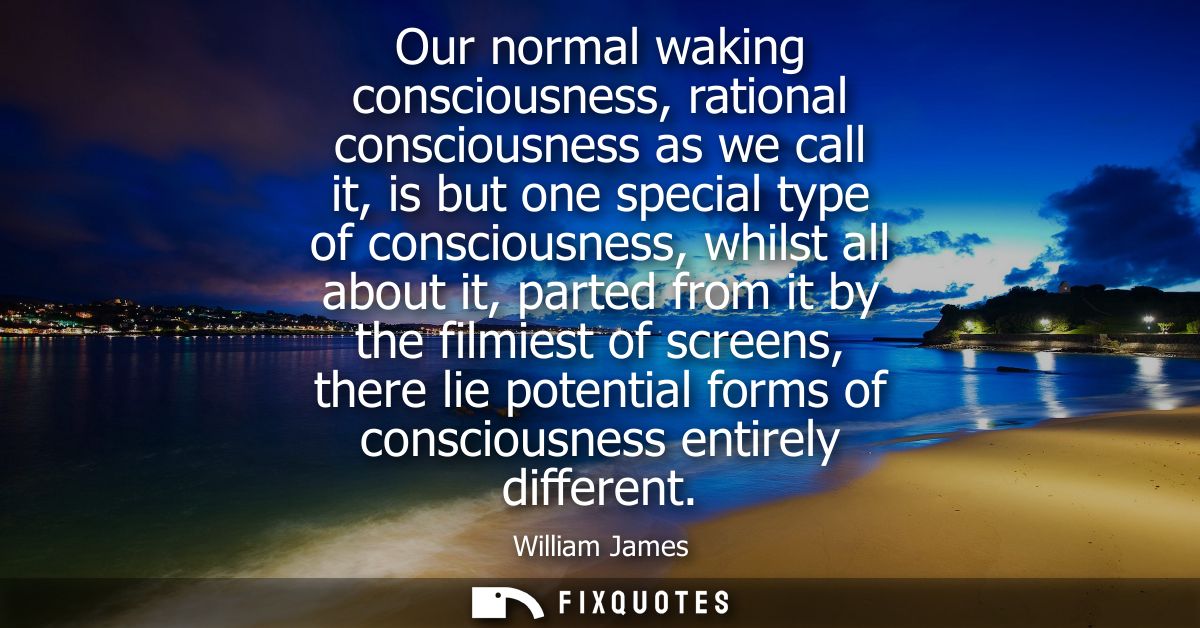
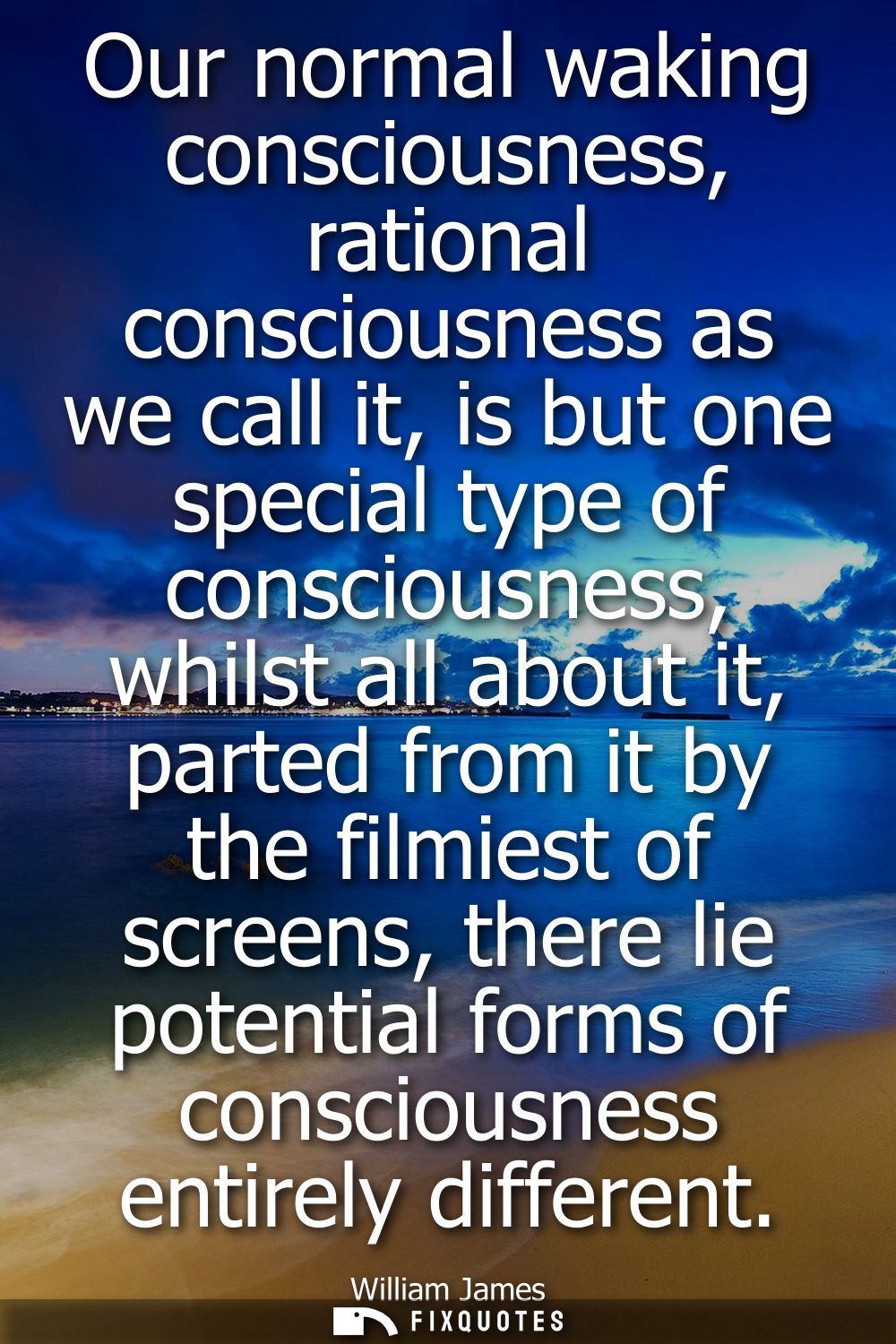
"Our normal waking consciousness, rational consciousness as we call it, is but one special type of consciousness, whilst all about it, parted from it by the filmiest of screens, there lie potential forms of consciousness entirely different"
About this Quote
The phrase “filmiest of screens” does heavy lifting. A screen suggests separation, but “filmy” suggests permeability: the border between the everyday self and other modes of mind is not a fortress, it’s tissue paper. James is signaling that what we label “normal” is less a natural fact than a social agreement reinforced by habit, education, and utility. His subtext: sanity is partly a successful bureaucracy of attention, not a metaphysical victory.
Context matters. James is writing in a moment when psychology is being born as a science, yet spiritualism, hypnosis, trance states, and the early study of mystical experience are everywhere in the cultural air. He isn’t selling occult thrills; he’s building a pluralistic framework where anomalous experiences can be investigated without being instantly dismissed as fraud or pathology.
The intent is methodological as much as philosophical: widen the evidentiary base for what counts as “mind.” By making other consciousnesses “potential,” he implies they’re not exotic exceptions but latent capacities. It’s an argument for epistemic humility dressed as an invitation: the rational self may be competent, even necessary, but it isn’t sovereign.
Quote Details
| Topic | Deep |
|---|---|
| Source | William James, The Varieties of Religious Experience (1902). The passage beginning "Our normal waking consciousness, rational consciousness as we call it, is but one special type of consciousness..." appears in this work discussing alternative states of consciousness. |
| Cite |
Citation Formats
APA Style (7th ed.)
James, William. (2026, January 17). Our normal waking consciousness, rational consciousness as we call it, is but one special type of consciousness, whilst all about it, parted from it by the filmiest of screens, there lie potential forms of consciousness entirely different. FixQuotes. https://fixquotes.com/quotes/our-normal-waking-consciousness-rational-34920/
Chicago Style
James, William. "Our normal waking consciousness, rational consciousness as we call it, is but one special type of consciousness, whilst all about it, parted from it by the filmiest of screens, there lie potential forms of consciousness entirely different." FixQuotes. January 17, 2026. https://fixquotes.com/quotes/our-normal-waking-consciousness-rational-34920/.
MLA Style (9th ed.)
"Our normal waking consciousness, rational consciousness as we call it, is but one special type of consciousness, whilst all about it, parted from it by the filmiest of screens, there lie potential forms of consciousness entirely different." FixQuotes, 17 Jan. 2026, https://fixquotes.com/quotes/our-normal-waking-consciousness-rational-34920/. Accessed 6 Apr. 2026.