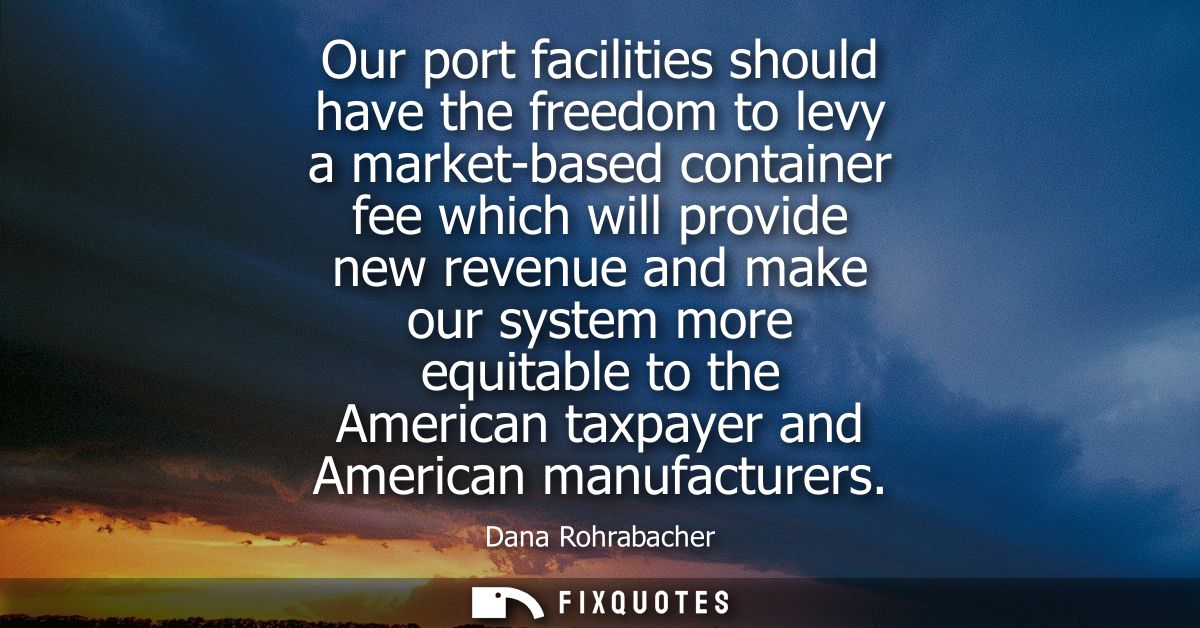
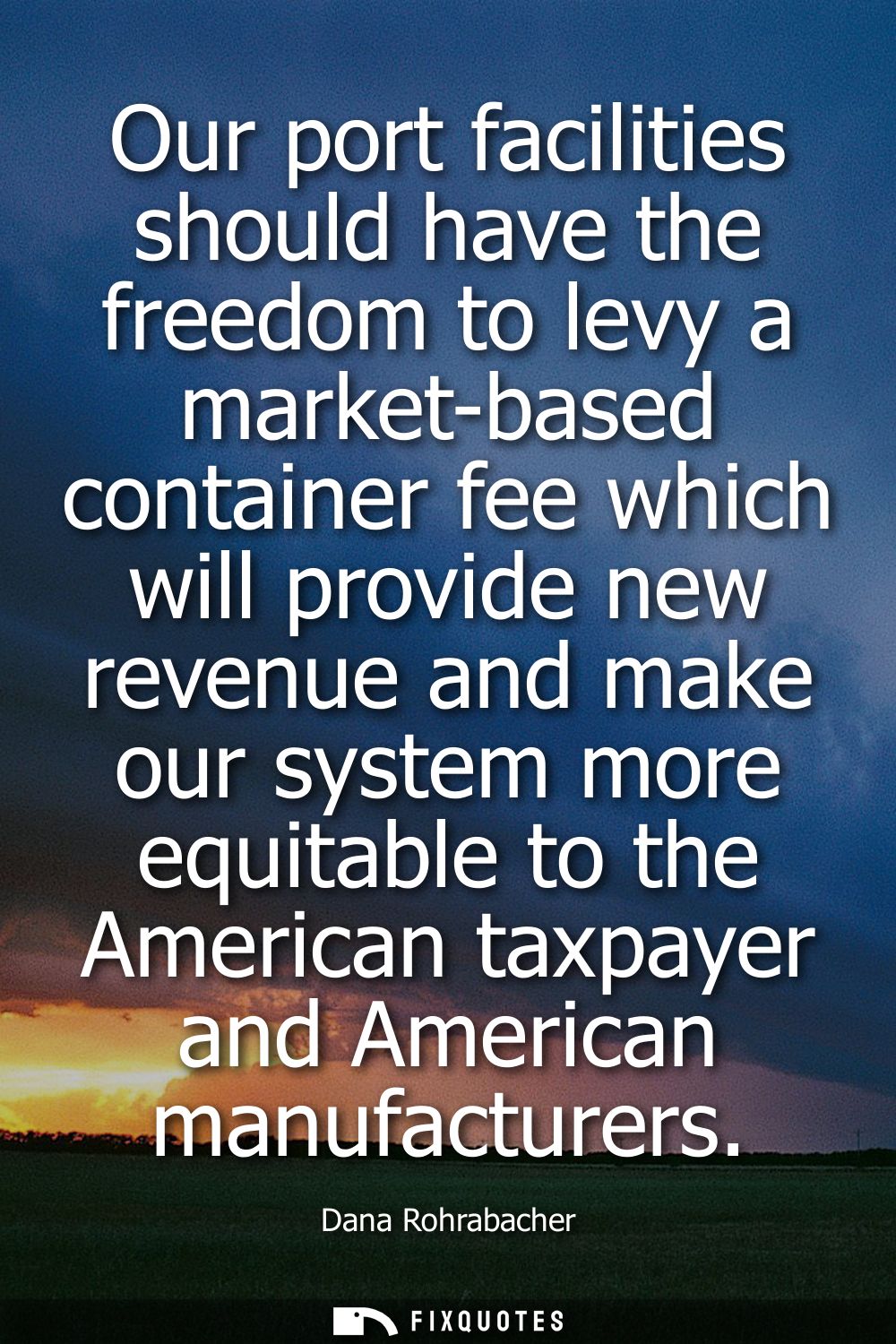
"Our port facilities should have the freedom to levy a market-based container fee which will provide new revenue and make our system more equitable to the American taxpayer and American manufacturers"
About this Quote
A technocrat’s dream wrapped in populist clothing, Rohrabacher’s line sells a new port fee as both common sense economics and moral restoration. The operative phrase is “freedom to levy”: it frames a policy change not as government imposing a charge, but as liberating local port authorities to act like market actors. That rhetorical flip matters. Fees feel like taxes until you rename them as “market-based,” a term that launderers friction into inevitability. Markets don’t argue; they “signal.”
The sentence is also doing constituency math. “New revenue” is the plain objective, but it’s paired with “equitable to the American taxpayer and American manufacturers,” a coalition stitch meant to neutralize the backlash that a container fee might raise among importers, retailers, and consumers. Equity here is not about worker pay or environmental justice; it’s about who carries the infrastructure bill. The subtext: right now, the public subsidizes the logistics machine that enables cheap imported goods, while domestic producers shoulder competition without getting commensurate support. A container fee becomes a way to shift costs onto global trade flows, and by implication, onto foreign-made products.
Contextually, this reads like early-21st-century port politics: congested gateways, aging infrastructure, and the constant hunt for dedicated funding streams without admitting to “raising taxes.” It also nods toward a mild industrial-policy instinct: use the plumbing of commerce to tilt the playing field toward American manufacturing, while keeping the pitch framed as fairness rather than protectionism. The craft is in the triangulation: pro-business language, anti-subsidy grievance, and a revenue mechanism that can be sold as user-pay instead of government spend.
The sentence is also doing constituency math. “New revenue” is the plain objective, but it’s paired with “equitable to the American taxpayer and American manufacturers,” a coalition stitch meant to neutralize the backlash that a container fee might raise among importers, retailers, and consumers. Equity here is not about worker pay or environmental justice; it’s about who carries the infrastructure bill. The subtext: right now, the public subsidizes the logistics machine that enables cheap imported goods, while domestic producers shoulder competition without getting commensurate support. A container fee becomes a way to shift costs onto global trade flows, and by implication, onto foreign-made products.
Contextually, this reads like early-21st-century port politics: congested gateways, aging infrastructure, and the constant hunt for dedicated funding streams without admitting to “raising taxes.” It also nods toward a mild industrial-policy instinct: use the plumbing of commerce to tilt the playing field toward American manufacturing, while keeping the pitch framed as fairness rather than protectionism. The craft is in the triangulation: pro-business language, anti-subsidy grievance, and a revenue mechanism that can be sold as user-pay instead of government spend.
Quote Details
| Topic | Money |
|---|
More Quotes by Dana
Add to List