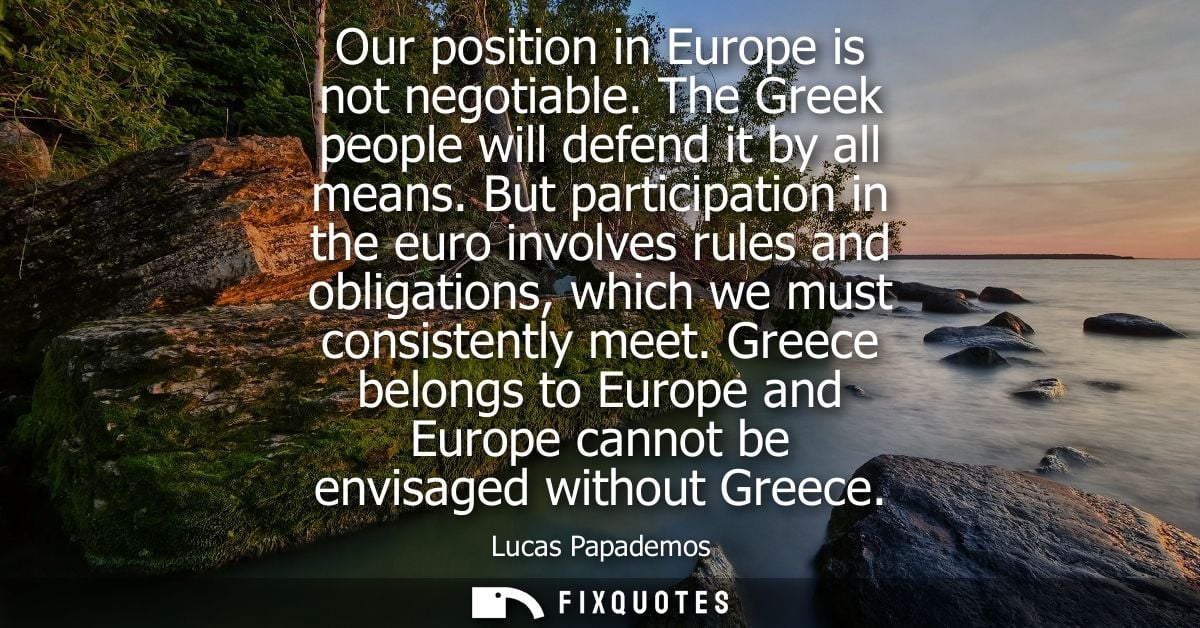
"Our position in Europe is not negotiable. The Greek people will defend it by all means. But participation in the euro involves rules and obligations, which we must consistently meet. Greece belongs to Europe and Europe cannot be envisaged without Greece"
About this Quote
The subtext is crisis-management rhetoric aimed at two audiences who distrust each other. To creditors and EU officials, Papademos promises predictability: Greece will “meet” obligations, not improvise. To domestic voters and parties tempted by brinkmanship, he frames compliance as the price of belonging rather than a capitulation. The phrase “by all means” hints at social unrest and political volatility, but it’s also a warning: push Greece too far and the project becomes ungovernable.
Most revealing is the final turn: “Greece belongs to Europe and Europe cannot be envisaged without Greece.” That’s not economics; it’s mythic branding. Papademos borrows cultural capital from antiquity to strengthen a modern negotiating position, implying that expelling Greece would be an identity crisis for Europe itself. In the eurozone debt context, it’s a bid to convert moral and historical symbolism into leverage, asking Europe to remember that the union sells itself as more than a currency regime.
Quote Details
| Topic | Vision & Strategy |
|---|---|
| Source | Help us find the source |
| Cite |
Citation Formats
APA Style (7th ed.)
Papademos, Lucas. (2026, January 16). Our position in Europe is not negotiable. The Greek people will defend it by all means. But participation in the euro involves rules and obligations, which we must consistently meet. Greece belongs to Europe and Europe cannot be envisaged without Greece. FixQuotes. https://fixquotes.com/quotes/our-position-in-europe-is-not-negotiable-the-87304/
Chicago Style
Papademos, Lucas. "Our position in Europe is not negotiable. The Greek people will defend it by all means. But participation in the euro involves rules and obligations, which we must consistently meet. Greece belongs to Europe and Europe cannot be envisaged without Greece." FixQuotes. January 16, 2026. https://fixquotes.com/quotes/our-position-in-europe-is-not-negotiable-the-87304/.
MLA Style (9th ed.)
"Our position in Europe is not negotiable. The Greek people will defend it by all means. But participation in the euro involves rules and obligations, which we must consistently meet. Greece belongs to Europe and Europe cannot be envisaged without Greece." FixQuotes, 16 Jan. 2026, https://fixquotes.com/quotes/our-position-in-europe-is-not-negotiable-the-87304/. Accessed 15 Feb. 2026.