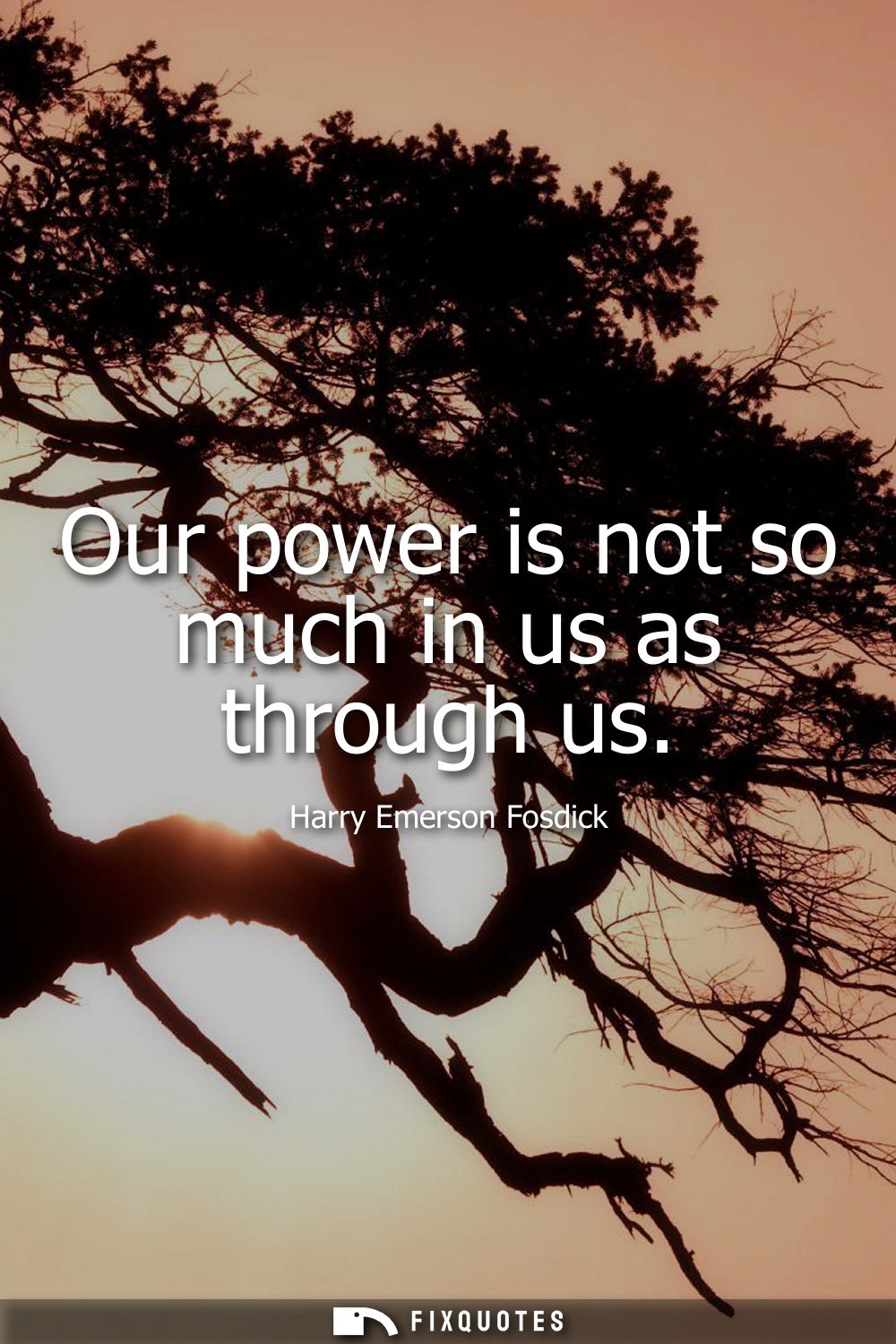
"Our power is not so much in us as through us"
About this Quote
The line sounds modest, but it’s also a quiet bid for authority: you matter most when you stop claiming ownership of what makes you matter. Fosdick, a leading liberal Protestant preacher in the early 20th century, is writing from a world where traditional religious certainty was being battered by modern science, urbanization, and the trauma of world war. In that climate, “power” couldn’t credibly mean brute dominance or doctrinal muscle. It had to be reframed as moral force.
The phrasing does the work. “Not so much in us” deflates the heroic, self-made individual that modernity loves to crown. “As through us” restores significance without turning it into ego. It’s a rhetorical two-step: humility first, then elevation. Fosdick suggests the self is less a reservoir than a conduit, a moral instrument rather than the moral source. The subtext is theological, but it doubles as a psychological strategy. If you experience courage, clarity, or endurance as something moving through you, you’re less likely to break under the pressure of having to generate it alone.
There’s also an institutional argument hiding inside the spiritual one. Clergy in Fosdick’s era were competing with new secular voices for cultural influence. This line recasts religious leadership as facilitation rather than control: the minister isn’t powerful because he commands, but because he helps transmit a larger purpose into ordinary life. It’s a democratic vision of grace, and a savvy answer to modern suspicion: the ego isn’t the engine; it’s the channel.
The phrasing does the work. “Not so much in us” deflates the heroic, self-made individual that modernity loves to crown. “As through us” restores significance without turning it into ego. It’s a rhetorical two-step: humility first, then elevation. Fosdick suggests the self is less a reservoir than a conduit, a moral instrument rather than the moral source. The subtext is theological, but it doubles as a psychological strategy. If you experience courage, clarity, or endurance as something moving through you, you’re less likely to break under the pressure of having to generate it alone.
There’s also an institutional argument hiding inside the spiritual one. Clergy in Fosdick’s era were competing with new secular voices for cultural influence. This line recasts religious leadership as facilitation rather than control: the minister isn’t powerful because he commands, but because he helps transmit a larger purpose into ordinary life. It’s a democratic vision of grace, and a savvy answer to modern suspicion: the ego isn’t the engine; it’s the channel.
Quote Details
| Topic | Faith |
|---|---|
| Source | Help us find the source |
| Cite |
Citation Formats
APA Style (7th ed.)
Fosdick, Harry Emerson. (2026, January 15). Our power is not so much in us as through us. FixQuotes. https://fixquotes.com/quotes/our-power-is-not-so-much-in-us-as-through-us-143999/
Chicago Style
Fosdick, Harry Emerson. "Our power is not so much in us as through us." FixQuotes. January 15, 2026. https://fixquotes.com/quotes/our-power-is-not-so-much-in-us-as-through-us-143999/.
MLA Style (9th ed.)
"Our power is not so much in us as through us." FixQuotes, 15 Jan. 2026, https://fixquotes.com/quotes/our-power-is-not-so-much-in-us-as-through-us-143999/. Accessed 12 Feb. 2026.
More Quotes by Harry
Add to List