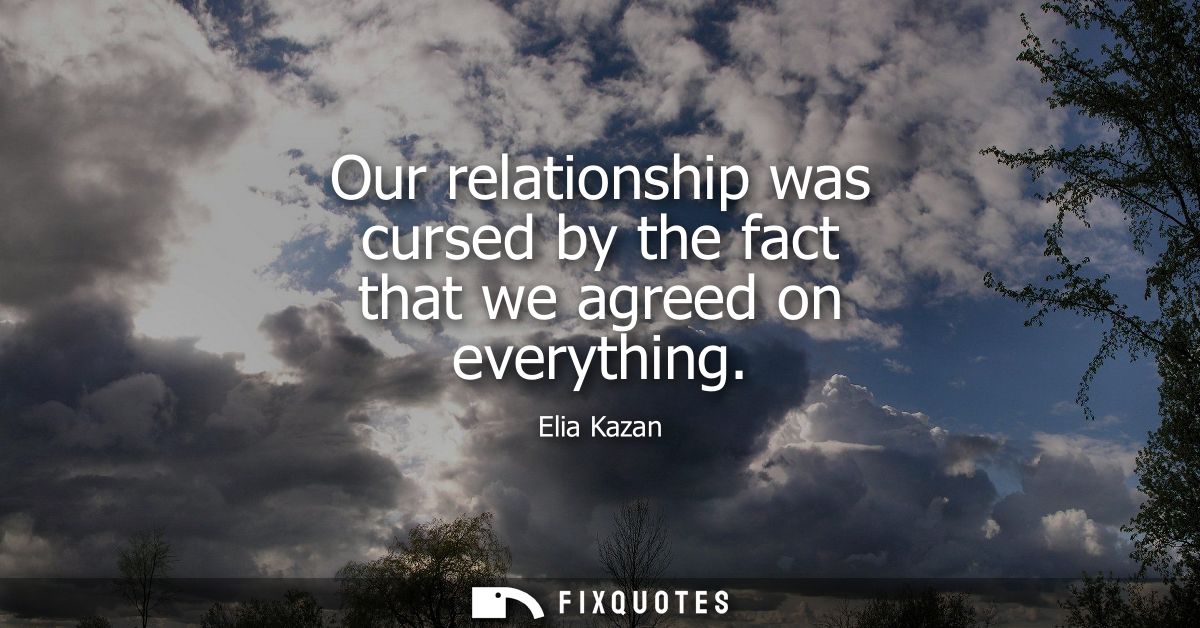
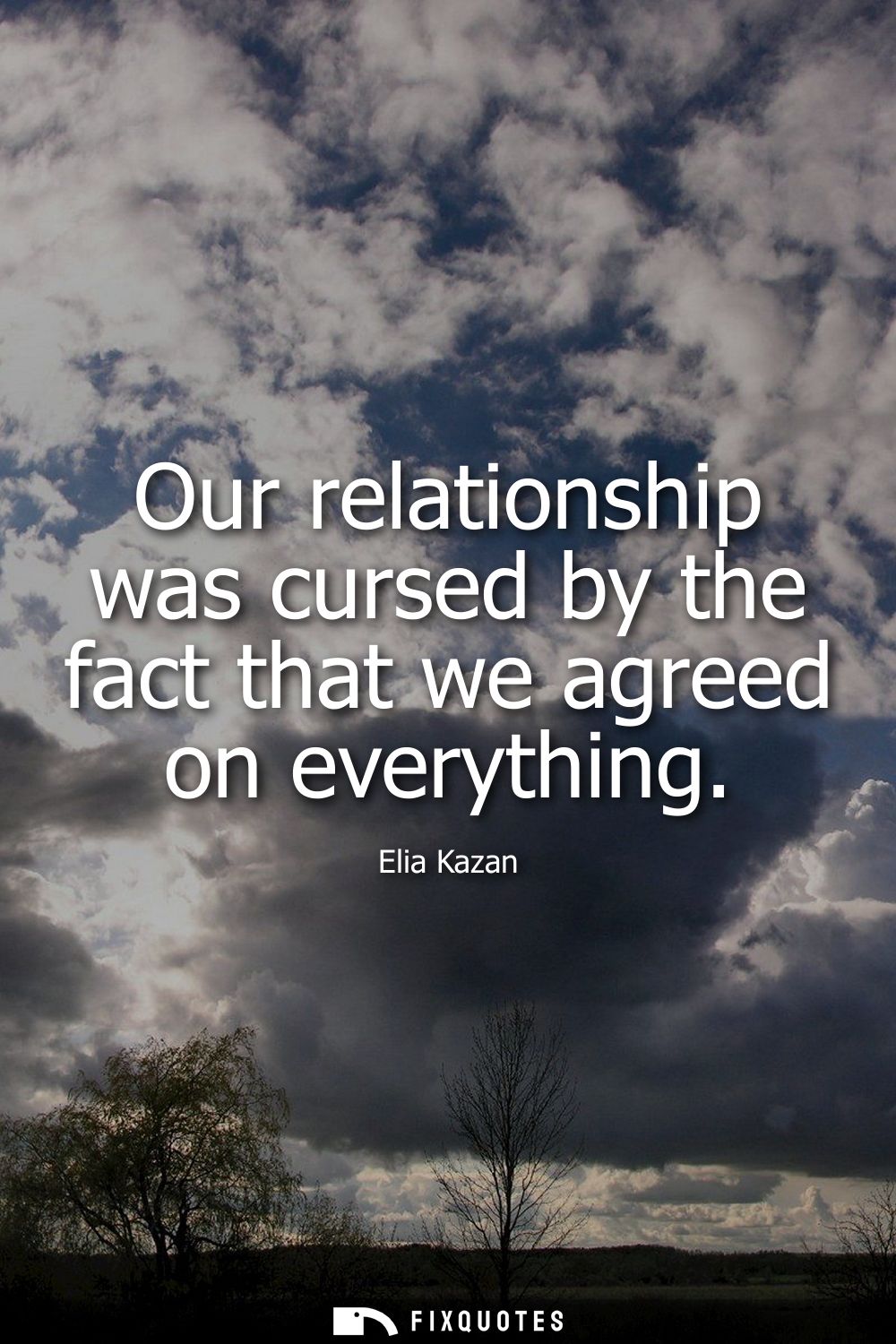
"Our relationship was cursed by the fact that we agreed on everything"
About this Quote
A relationship that “agreed on everything” sounds like the dream until Kazan slips in the dagger: agreement can be its own kind of doom. The line lands because it reverses the usual moral of romance and partnership. We’re trained to treat compatibility as the gold standard; Kazan suggests it can be a quiet form of stagnation, a pact that prevents either person from sharpening into something truer.
As a director who spent his career staging conflict - between desire and duty, belonging and betrayal - Kazan understood that drama needs resistance. So do people. Total accord can be less intimacy than avoidance: no friction means no risk, and no risk means no real disclosure. The “curse” isn’t that they shared values; it’s that agreement became a shelter from the uncomfortable work of disagreement: testing motives, naming resentments, renegotiating power. When two people never clash, it can imply one of them is disappearing, or both are outsourcing judgment to the relationship itself.
The subtext gets darker given Kazan’s biography. He’s a figure defined by the HUAC era, by choices that split friendships and allegiances and made “agreement” politically loaded. Read through that lens, the quote hints at a fear of the crowd, the bloc, the safety of unanimity - and a suspicion that harmony can be purchased by moral compromise. It’s a line about love, but it also sounds like a warning from someone who knew how consensus can anesthetize conscience.
As a director who spent his career staging conflict - between desire and duty, belonging and betrayal - Kazan understood that drama needs resistance. So do people. Total accord can be less intimacy than avoidance: no friction means no risk, and no risk means no real disclosure. The “curse” isn’t that they shared values; it’s that agreement became a shelter from the uncomfortable work of disagreement: testing motives, naming resentments, renegotiating power. When two people never clash, it can imply one of them is disappearing, or both are outsourcing judgment to the relationship itself.
The subtext gets darker given Kazan’s biography. He’s a figure defined by the HUAC era, by choices that split friendships and allegiances and made “agreement” politically loaded. Read through that lens, the quote hints at a fear of the crowd, the bloc, the safety of unanimity - and a suspicion that harmony can be purchased by moral compromise. It’s a line about love, but it also sounds like a warning from someone who knew how consensus can anesthetize conscience.
Quote Details
| Topic | Relationship |
|---|---|
| Source | Help us find the source |
| Cite |
Citation Formats
APA Style (7th ed.)
Kazan, Elia. (2026, January 17). Our relationship was cursed by the fact that we agreed on everything. FixQuotes. https://fixquotes.com/quotes/our-relationship-was-cursed-by-the-fact-that-we-58057/
Chicago Style
Kazan, Elia. "Our relationship was cursed by the fact that we agreed on everything." FixQuotes. January 17, 2026. https://fixquotes.com/quotes/our-relationship-was-cursed-by-the-fact-that-we-58057/.
MLA Style (9th ed.)
"Our relationship was cursed by the fact that we agreed on everything." FixQuotes, 17 Jan. 2026, https://fixquotes.com/quotes/our-relationship-was-cursed-by-the-fact-that-we-58057/. Accessed 4 Apr. 2026.
More Quotes by Elia
Add to List