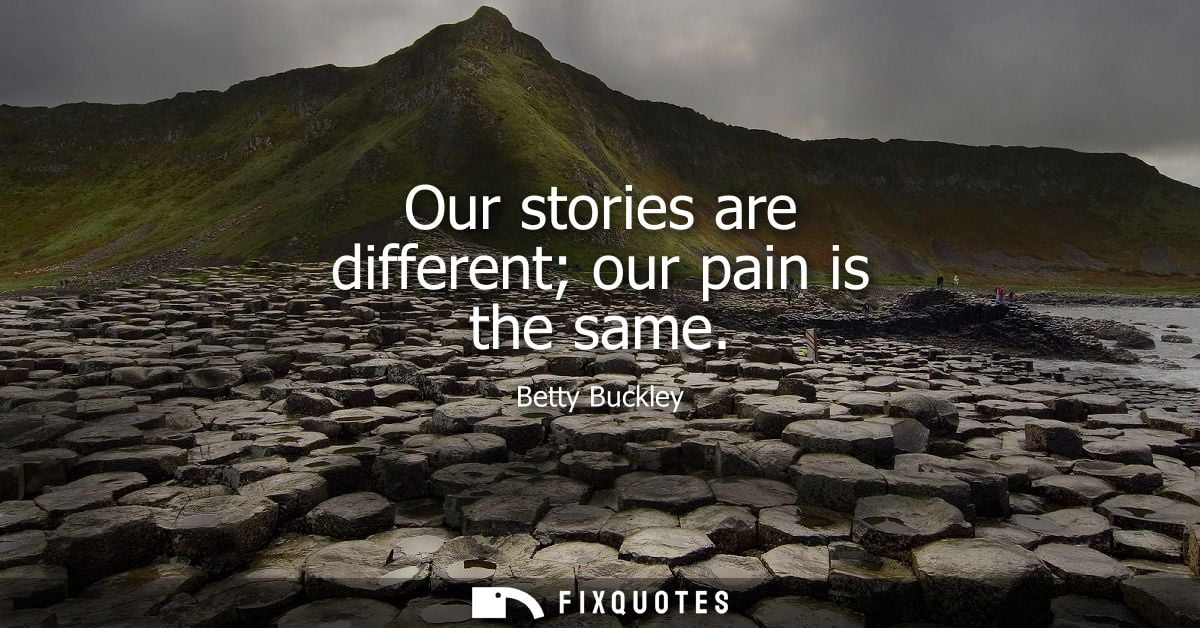
"Our stories are different; our pain is the same"
About this Quote
“Our stories are different; our pain is the same” lands with the kind of plainspoken authority you only get from someone who’s spent a career making other people’s grief believable. Betty Buckley isn’t theorizing about empathy; she’s distilling a performer’s hard-earned observation: audiences will argue about plot, politics, identity, and biography, but they’ll recognize heartbreak on sight.
The sentence is built like a bridge. “Stories” nods to the surface layer we use to sort ourselves - background, circumstance, the narrative we tell to justify why we’re the way we are. Then the pivot: “pain,” singular, stripped of ornament. The semicolon does the work of a stage pause, a breath before the emotional reveal. It’s a rhetorical move Buckley knows instinctively: hold the particulars at arm’s length, then collapse the distance with a shared sensation.
The subtext is both generous and quietly corrective. It pushes back against the competitive marketplace of suffering, where legitimacy is earned by having the “right” trauma or the most current vocabulary for it. At the same time, it refuses the easy comfort of pretending differences don’t matter. Buckley keeps the “different” intact; she just won’t let it become a moat.
In the context of an actress’s life - musicals, monologues, the nightly ritual of making private anguish public - the line reads like a backstage credo. Art isn’t a sermon. It’s a meeting point, where specificity becomes the delivery system for something bluntly human.
The sentence is built like a bridge. “Stories” nods to the surface layer we use to sort ourselves - background, circumstance, the narrative we tell to justify why we’re the way we are. Then the pivot: “pain,” singular, stripped of ornament. The semicolon does the work of a stage pause, a breath before the emotional reveal. It’s a rhetorical move Buckley knows instinctively: hold the particulars at arm’s length, then collapse the distance with a shared sensation.
The subtext is both generous and quietly corrective. It pushes back against the competitive marketplace of suffering, where legitimacy is earned by having the “right” trauma or the most current vocabulary for it. At the same time, it refuses the easy comfort of pretending differences don’t matter. Buckley keeps the “different” intact; she just won’t let it become a moat.
In the context of an actress’s life - musicals, monologues, the nightly ritual of making private anguish public - the line reads like a backstage credo. Art isn’t a sermon. It’s a meeting point, where specificity becomes the delivery system for something bluntly human.
Quote Details
| Topic | Wisdom |
|---|---|
| Source | Help us find the source |
| Cite |
Citation Formats
APA Style (7th ed.)
Buckley, Betty. (2026, January 16). Our stories are different; our pain is the same. FixQuotes. https://fixquotes.com/quotes/our-stories-are-different-our-pain-is-the-same-138403/
Chicago Style
Buckley, Betty. "Our stories are different; our pain is the same." FixQuotes. January 16, 2026. https://fixquotes.com/quotes/our-stories-are-different-our-pain-is-the-same-138403/.
MLA Style (9th ed.)
"Our stories are different; our pain is the same." FixQuotes, 16 Jan. 2026, https://fixquotes.com/quotes/our-stories-are-different-our-pain-is-the-same-138403/. Accessed 31 Mar. 2026.
More Quotes by Betty
Add to List