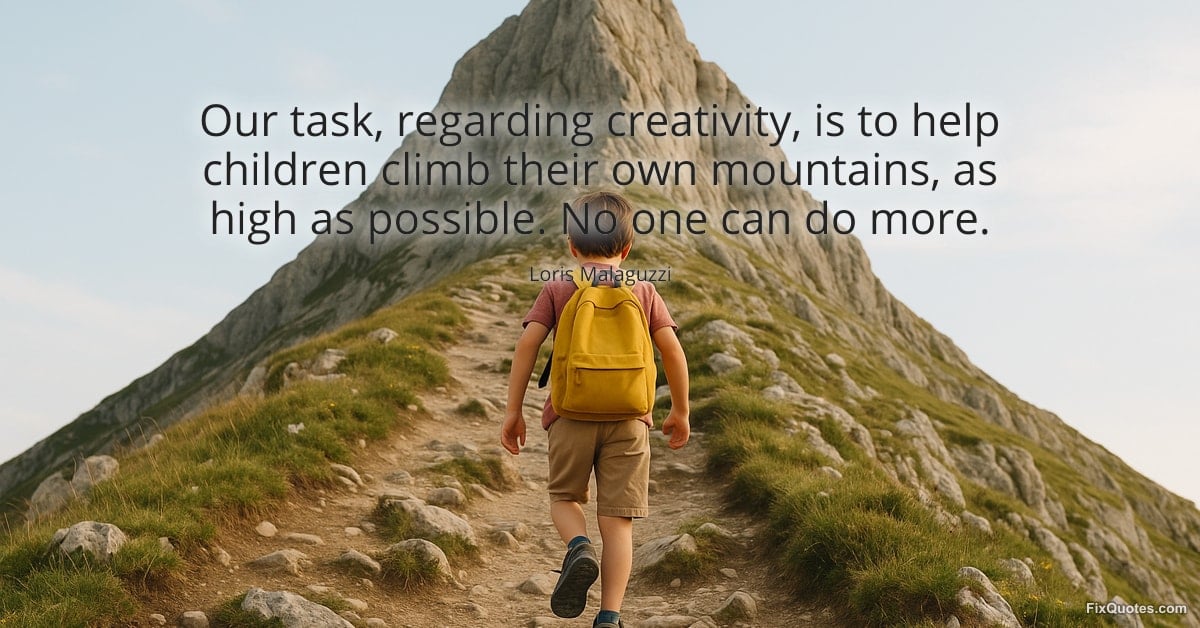
"Our task, regarding creativity, is to help children climb their own mountains, as high as possible. No one can do more"
About this Quote
Malaguzzi frames creativity as a physical climb, and the metaphor is doing quiet political work. “Their own mountains” refuses the mass-produced summit: no standardized peak, no single route, no adult-approved definition of success. The line insists that originality isn’t something you hand a child like a worksheet; it’s something you protect while it’s being discovered, often messily, in real time.
The intent is deceptively modest. Teachers aren’t cast as geniuses who “unlock” talent, nor as disciplinarians who “fix” deficits. They’re Sherpas of conditions: arranging time, materials, relationships, and permission so a child can risk trying. That’s the Reggio Emilia ethos in miniature - learning as inquiry, environment as co-teacher, children as capable meaning-makers. Creativity here isn’t an enrichment add-on; it’s a posture toward the world.
The subtext carries a gentle rebuke to adult vanity. “As high as possible” acknowledges ambition and rigor, but “No one can do more” draws a firm boundary around control. It’s an anti-helicopter line, an anti-meritocracy line, and an anti-performance line all at once. You can scaffold, you can witness, you can offer tools and language and friction. You cannot climb for them without turning their mountain into yours.
Context matters: Malaguzzi was building a postwar educational project that treated children’s thinking as civic resource, not private indulgence. The quote reads like a manifesto for societies that say they want innovation while designing schools that reward compliance.
The intent is deceptively modest. Teachers aren’t cast as geniuses who “unlock” talent, nor as disciplinarians who “fix” deficits. They’re Sherpas of conditions: arranging time, materials, relationships, and permission so a child can risk trying. That’s the Reggio Emilia ethos in miniature - learning as inquiry, environment as co-teacher, children as capable meaning-makers. Creativity here isn’t an enrichment add-on; it’s a posture toward the world.
The subtext carries a gentle rebuke to adult vanity. “As high as possible” acknowledges ambition and rigor, but “No one can do more” draws a firm boundary around control. It’s an anti-helicopter line, an anti-meritocracy line, and an anti-performance line all at once. You can scaffold, you can witness, you can offer tools and language and friction. You cannot climb for them without turning their mountain into yours.
Context matters: Malaguzzi was building a postwar educational project that treated children’s thinking as civic resource, not private indulgence. The quote reads like a manifesto for societies that say they want innovation while designing schools that reward compliance.
Quote Details
| Topic | Teaching |
|---|---|
| Source | Unverified source: The Hundred Languages of Children (2nd ed.) (Loris Malaguzzi, 1998)
Evidence: Chapter: "History, Ideas, and Basic Philosophy" (pp. 49–97); quote appears on p. 76 in the 2nd ed.. This quote appears in a Q&A/interview-style section in the chapter "History, Ideas, and Basic Philosophy" attributed to Loris Malaguzzi, included in the 2nd edition of The Hundred Languages of Chil... Other candidates (1) The Power of We (Julie K. Biddle, Barbara White, 2010) compilation96.7% ... Our task , regarding creativity , is to help children climb their own mountains , as high as possible . No one ca... |
| Video | Watch Video Quote |
| Featured | This quote was our Quote of the Day on December 10, 2025 |
More Quotes by Loris
Add to List