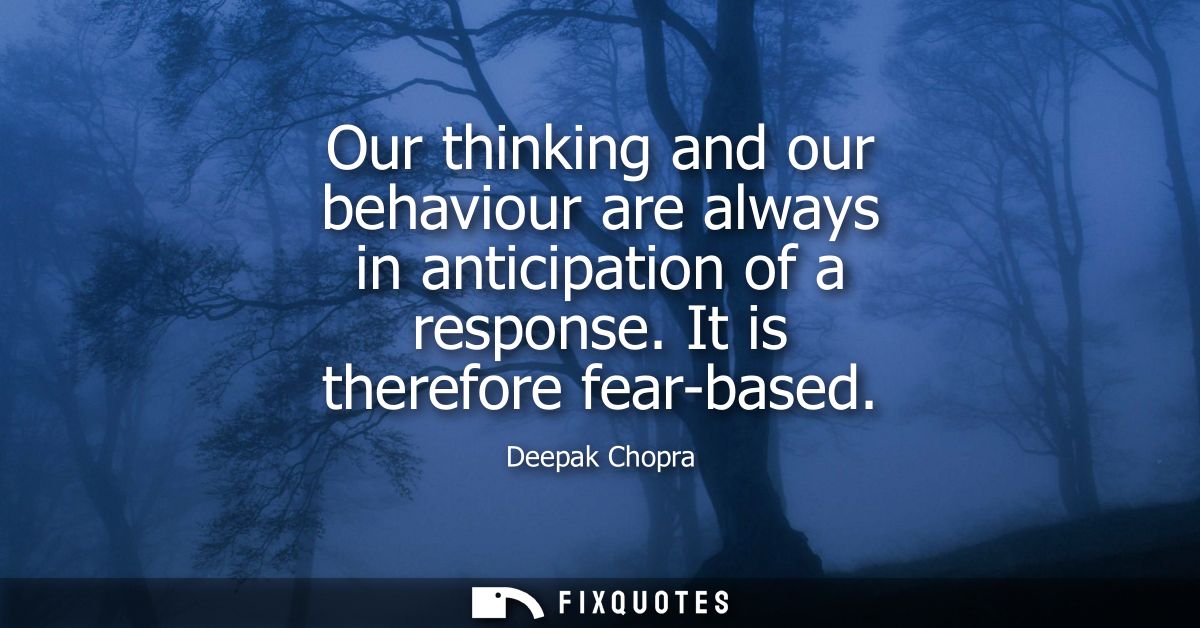
"Our thinking and our behaviour are always in anticipation of a response. It is therefore fear-based"
About this Quote
Chopra is taking a wrecking ball to the idea that we’re mostly self-authored. In one clean move, he frames the mind as a call-and-response machine: we don’t simply think, we rehearse; we don’t simply act, we audition. The provocative leap is the word “always.” It’s absolutist by design, less a clinical claim than a spiritual dare. If every thought is shaped by an expected reaction, then the “self” we defend is partly a PR department.
The subtext is social: anticipation implies an audience, even when no one’s in the room. That audience can be other people, God, a parent’s voice, a timeline of imagined consequences. Chopra collapses these into a single engine: fear. Not horror-movie fear, but the quieter fear of misalignment - losing belonging, status, control, love. He’s also indicting modern hypervisibility: in a culture trained to perform (workplace metrics, social media, personal branding), anticipation becomes the default setting. You start optimizing before you even know what you want.
Context matters because Chopra’s wider project is liberation through awareness. Labeling anticipation as “fear-based” isn’t meant to shame; it’s meant to create distance. If you can spot the mind’s constant future-facing bargaining, you can interrupt it. The line works rhetorically because it refuses neutrality: it forces you to ask whether your “choices” are desires or defenses. Even if “always” overreaches, the compression is the point - a koan disguised as a diagnosis.
The subtext is social: anticipation implies an audience, even when no one’s in the room. That audience can be other people, God, a parent’s voice, a timeline of imagined consequences. Chopra collapses these into a single engine: fear. Not horror-movie fear, but the quieter fear of misalignment - losing belonging, status, control, love. He’s also indicting modern hypervisibility: in a culture trained to perform (workplace metrics, social media, personal branding), anticipation becomes the default setting. You start optimizing before you even know what you want.
Context matters because Chopra’s wider project is liberation through awareness. Labeling anticipation as “fear-based” isn’t meant to shame; it’s meant to create distance. If you can spot the mind’s constant future-facing bargaining, you can interrupt it. The line works rhetorically because it refuses neutrality: it forces you to ask whether your “choices” are desires or defenses. Even if “always” overreaches, the compression is the point - a koan disguised as a diagnosis.
Quote Details
| Topic | Fear |
|---|
More Quotes by Deepak
Add to List