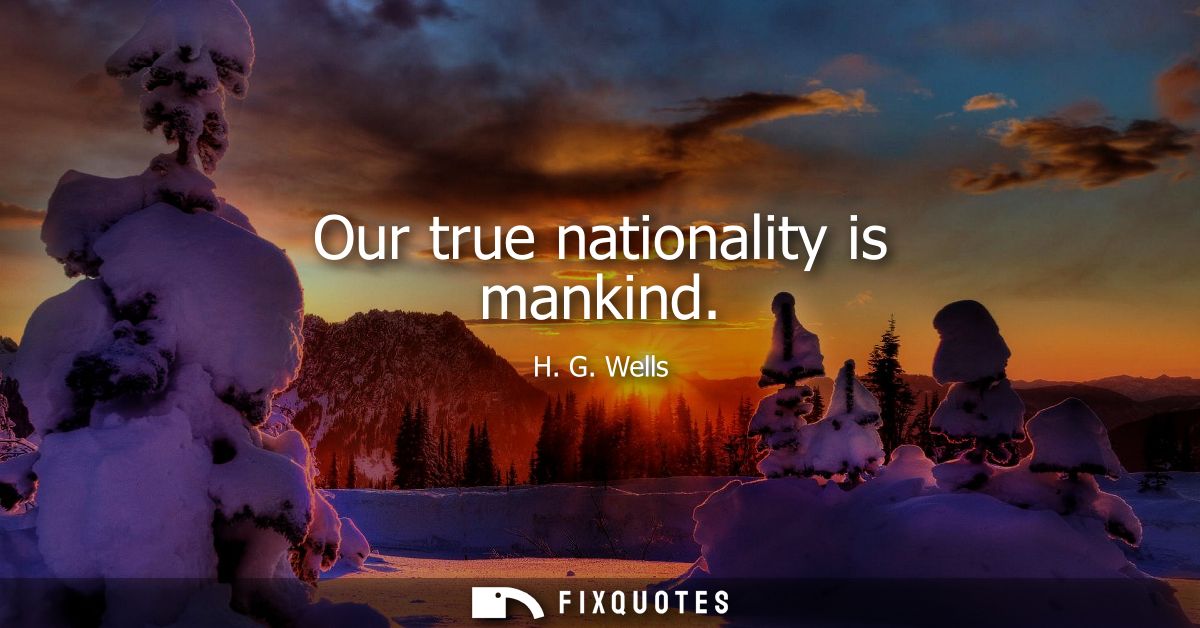
"Our true nationality is mankind"
About this Quote
A line like this only looks like a warm handshake until you remember who’s offering it: H.G. Wells, the sci-fi prophet who spent his career puncturing Victorian self-satisfaction. "Our true nationality is mankind" reads as a rebuke dressed up as a creed. Wells isn’t trying to abolish passports with a poetic flourish; he’s insisting that the nation-state is an invention, and therefore optional - a temporary story we tell ourselves that can be revised when it starts getting people killed.
The intent is moral, but the subtext is political. Wells watched industrial modernity tighten its grip: mass newspapers, mass armies, mass propaganda. National identity, in that world, becomes a technology for organizing loyalty at scale. By calling nationality "true" only when it expands to "mankind", he exposes the smaller version as counterfeit - not merely narrow, but deliberately manufactured to make sacrifice feel noble and suspicion feel natural.
Context matters: Wells wrote in the shadow of empire and the approach (and aftermath) of world war, when "civilization" was a slogan that could coexist with trenches and colonies. He was also a utopian internationalist, attracted to world-government ideas long before the phrase sounded like conspiracy bait. The line works because it turns patriotism inside out: it doesn’t ask you to stop belonging; it demands a bigger allegiance, one that treats borders as administrative facts rather than moral destinies. It’s optimistic, yes, but edged with Wells’s real warning: if we keep worshipping smaller flags, modernity will keep supplying larger catastrophes.
The intent is moral, but the subtext is political. Wells watched industrial modernity tighten its grip: mass newspapers, mass armies, mass propaganda. National identity, in that world, becomes a technology for organizing loyalty at scale. By calling nationality "true" only when it expands to "mankind", he exposes the smaller version as counterfeit - not merely narrow, but deliberately manufactured to make sacrifice feel noble and suspicion feel natural.
Context matters: Wells wrote in the shadow of empire and the approach (and aftermath) of world war, when "civilization" was a slogan that could coexist with trenches and colonies. He was also a utopian internationalist, attracted to world-government ideas long before the phrase sounded like conspiracy bait. The line works because it turns patriotism inside out: it doesn’t ask you to stop belonging; it demands a bigger allegiance, one that treats borders as administrative facts rather than moral destinies. It’s optimistic, yes, but edged with Wells’s real warning: if we keep worshipping smaller flags, modernity will keep supplying larger catastrophes.
Quote Details
| Topic | Equality |
|---|---|
| Source | Help us find the source |
| Cite | Cite this Quote |
Citation Formats
APA Style (7th ed.)
Wells, H.G. (2026, January 14). Our true nationality is mankind. FixQuotes. https://fixquotes.com/quotes/our-true-nationality-is-mankind-12841/
Chicago Style
Wells, H.G. "Our true nationality is mankind." FixQuotes. January 14, 2026. https://fixquotes.com/quotes/our-true-nationality-is-mankind-12841/.
MLA Style (9th ed.)
"Our true nationality is mankind." FixQuotes, 14 Jan. 2026, https://fixquotes.com/quotes/our-true-nationality-is-mankind-12841/. Accessed 3 Feb. 2026.
More Quotes by Wells
Add to List