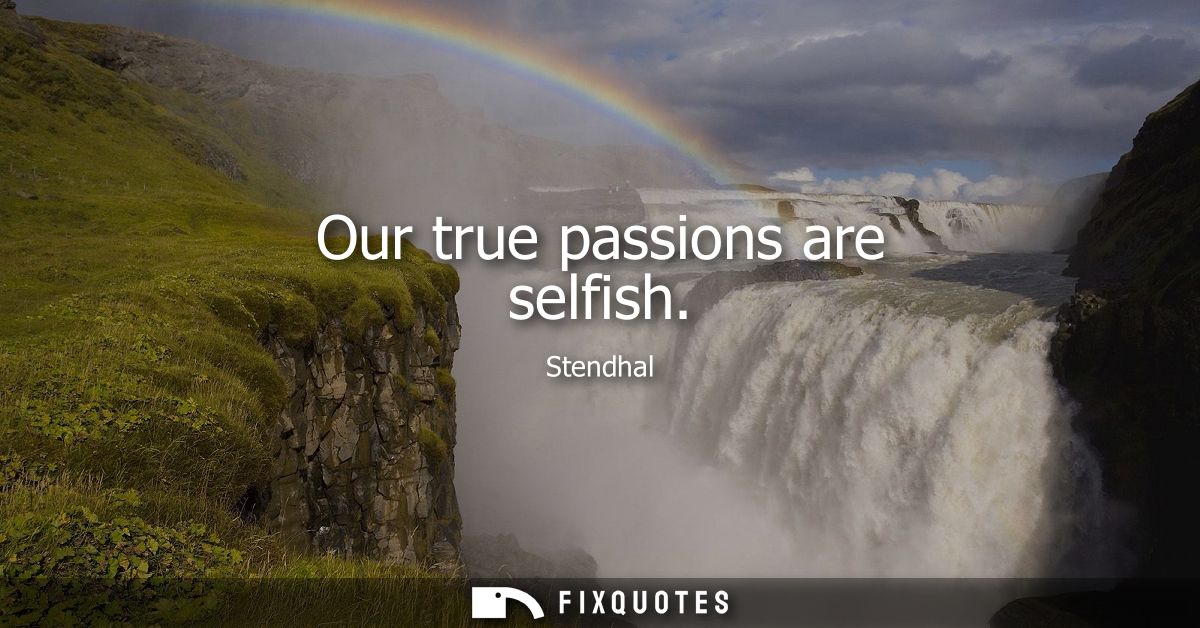
"Our true passions are selfish"
About this Quote
Stendhal’s line lands like a polite insult: it pretends to demystify passion while quietly accusing the reader of sentimental self-deception. “True” is the key provocation. Not all passions, only the ones that actually grip us, the ones we mistake for destiny or virtue. He’s slicing through the romantic pose that love, art, honor, or patriotism automatically ennoble the self. In Stendhal’s world, intensity is rarely altruistic; it’s appetite with better manners.
The subtext is less “people are bad” than “people are honest when they’re consumed.” Passion feels like surrender, but Stendhal suggests it’s a disguised assertion of the self: I want, I need, I cannot live without. Even when it’s directed at another person, passion often treats the beloved as a mirror that reflects back a more vivid version of the lover. This aligns with his famous interest in “crystallization,” the process by which desire invents qualities, turns contingency into necessity, makes the object of love seem inevitable. That imaginative labor isn’t for the beloved’s benefit; it’s for the lover’s intoxication.
Context matters. Writing in post-Revolutionary France, amid the rise of bourgeois respectability and a booming market for Romantic sincerity, Stendhal had reason to distrust public virtue and private melodrama alike. The line reads as a realist’s corrective to an era that sold noble feelings as moral credentials. It works because it doesn’t forbid passion; it punctures its self-flattering story. Passion can be beautiful, he implies, but it’s rarely innocent.
The subtext is less “people are bad” than “people are honest when they’re consumed.” Passion feels like surrender, but Stendhal suggests it’s a disguised assertion of the self: I want, I need, I cannot live without. Even when it’s directed at another person, passion often treats the beloved as a mirror that reflects back a more vivid version of the lover. This aligns with his famous interest in “crystallization,” the process by which desire invents qualities, turns contingency into necessity, makes the object of love seem inevitable. That imaginative labor isn’t for the beloved’s benefit; it’s for the lover’s intoxication.
Context matters. Writing in post-Revolutionary France, amid the rise of bourgeois respectability and a booming market for Romantic sincerity, Stendhal had reason to distrust public virtue and private melodrama alike. The line reads as a realist’s corrective to an era that sold noble feelings as moral credentials. It works because it doesn’t forbid passion; it punctures its self-flattering story. Passion can be beautiful, he implies, but it’s rarely innocent.
Quote Details
| Topic | Wisdom |
|---|
More Quotes by Stendhal
Add to List