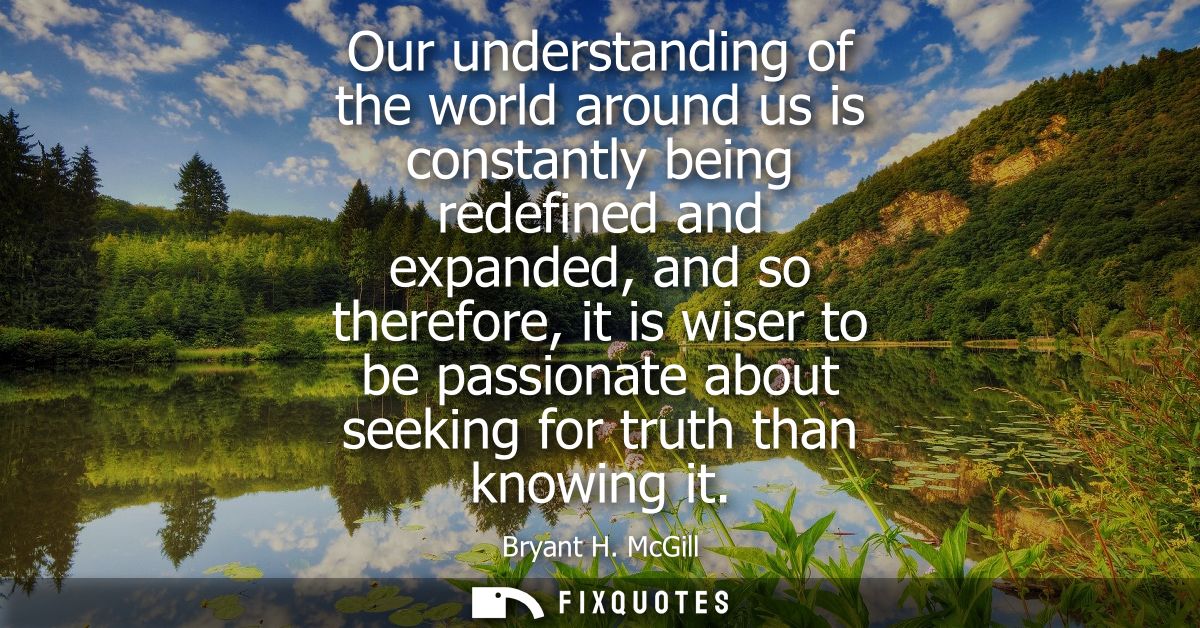
"Our understanding of the world around us is constantly being redefined and expanded, and so therefore, it is wiser to be passionate about seeking for truth than knowing it"
About this Quote
Certainty ages badly; curiosity doesn’t. McGill’s line is built to puncture the modern addiction to having an answer ready, a posture that reads as competence but often functions as armor. By insisting it’s “wiser to be passionate about seeking for truth than knowing it,” he flips the usual prestige economy: the trophy isn’t possession of truth, it’s the appetite that keeps you revising.
The phrasing matters. “Understanding” is “constantly being redefined and expanded” suggests a world where new information doesn’t simply add facts; it rearranges the frame. That’s an implicit rebuke to absolutism, but it’s also a gentler critique of the identity we fuse to our beliefs. If the world keeps shifting, then “knowing” becomes a risky emotional investment, because it invites defensiveness when reality refuses to cooperate.
There’s a subtle rhetorical hedge in “so therefore,” an over-insistence that mirrors the point: people often over-explain when they’re trying to make certainty feel airtight. McGill’s target is less science-versus-ignorance than ego-versus-humility. The subtext: treat truth like a direction, not a possession.
Contextually, this fits McGill’s broader self-help-adjacent moral philosophy, written for an era of information overload and tribal certainty. In a culture where opinions are currency and hot takes are rewarded, he argues for a different kind of status: intellectual restlessness as character. It’s not anti-knowledge; it’s anti-complacency.
The phrasing matters. “Understanding” is “constantly being redefined and expanded” suggests a world where new information doesn’t simply add facts; it rearranges the frame. That’s an implicit rebuke to absolutism, but it’s also a gentler critique of the identity we fuse to our beliefs. If the world keeps shifting, then “knowing” becomes a risky emotional investment, because it invites defensiveness when reality refuses to cooperate.
There’s a subtle rhetorical hedge in “so therefore,” an over-insistence that mirrors the point: people often over-explain when they’re trying to make certainty feel airtight. McGill’s target is less science-versus-ignorance than ego-versus-humility. The subtext: treat truth like a direction, not a possession.
Contextually, this fits McGill’s broader self-help-adjacent moral philosophy, written for an era of information overload and tribal certainty. In a culture where opinions are currency and hot takes are rewarded, he argues for a different kind of status: intellectual restlessness as character. It’s not anti-knowledge; it’s anti-complacency.
Quote Details
| Topic | Truth |
|---|---|
| Source | Help us find the source |
More Quotes by Bryant
Add to List