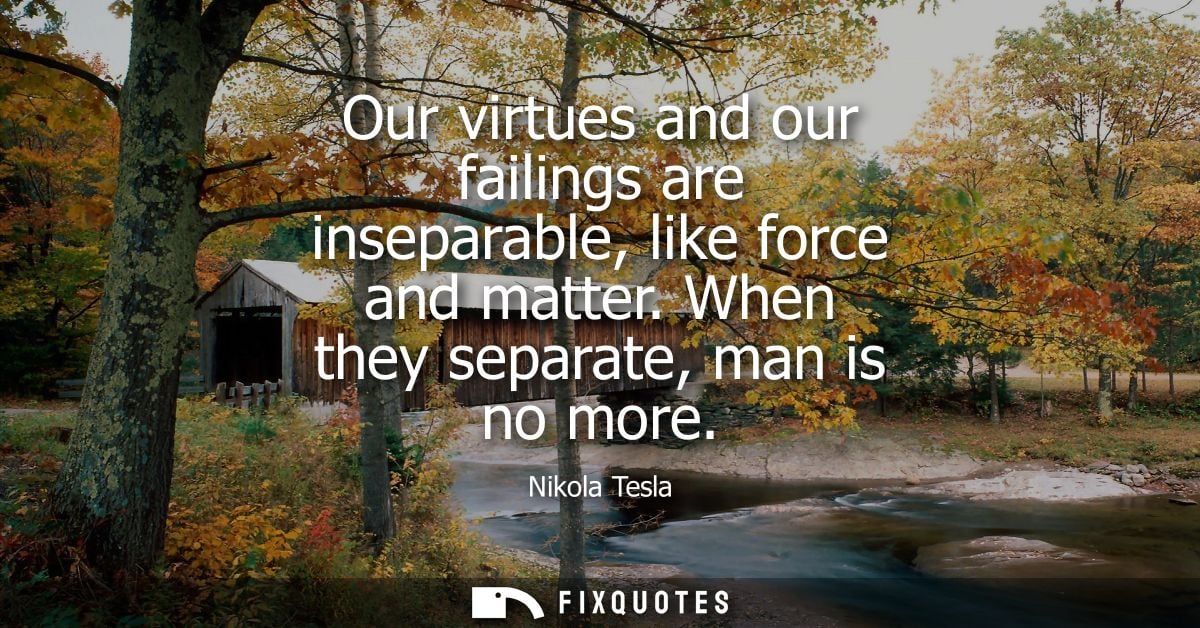
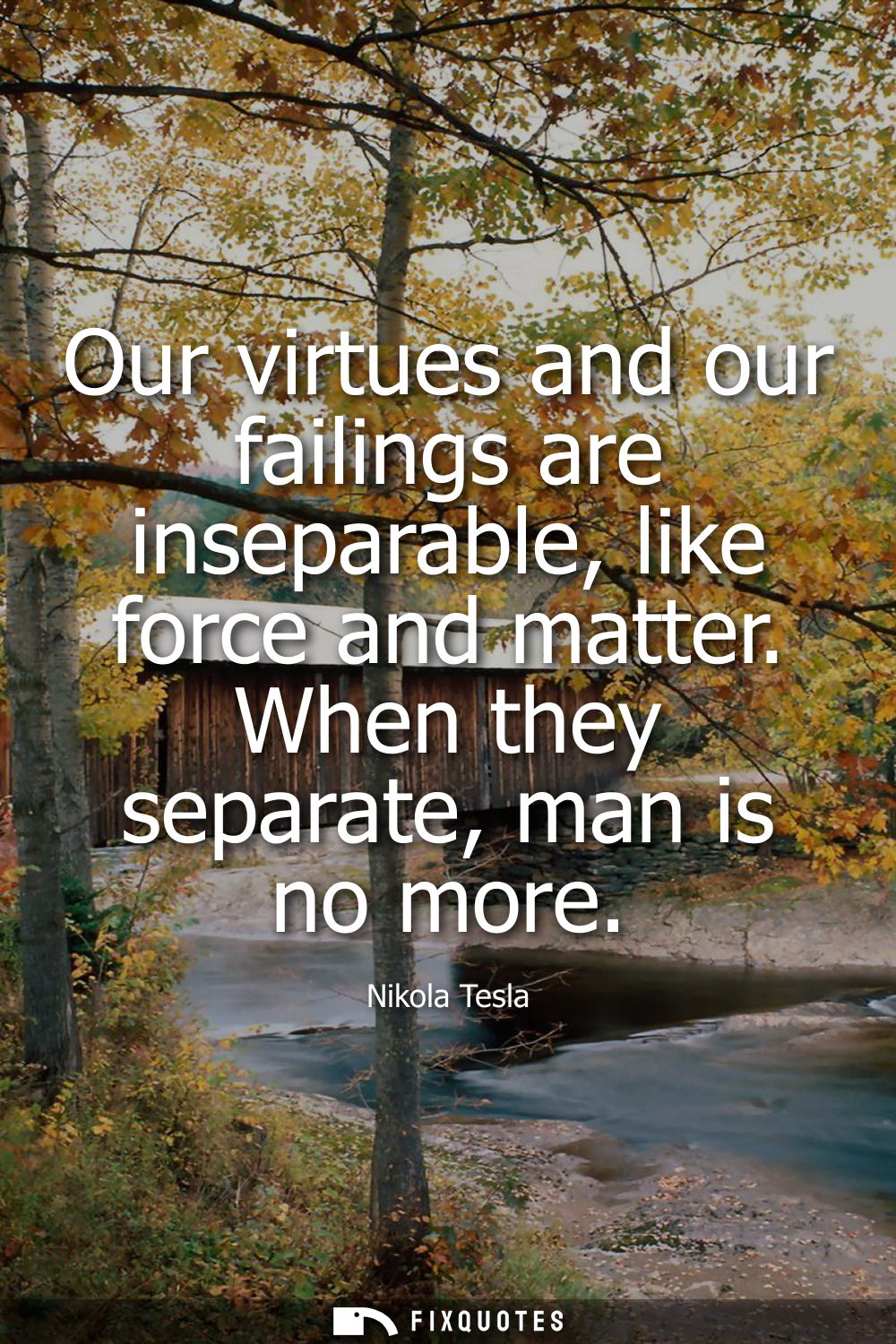
"Our virtues and our failings are inseparable, like force and matter. When they separate, man is no more"
About this Quote
The subtext is partly autobiographical. Tesla was famously rigorous, obsessive, and socially unorthodox; the traits that made him a visionary also made him brittle in business and eccentric in public life. In that light, “inseparable” reads as self-defense and diagnosis: brilliance isn’t a halo; it’s a voltage that can arc. The quote also pushes back against the era’s growing temptation to “improve” humanity through hygiene, discipline, and early eugenic fantasies. If you imagine moral perfection as a kind of technical upgrade, Tesla warns, you may be describing a different species - or a corpse.
It works because it refuses the comforting fiction that character is modular. By framing personhood as an irreducible entanglement, Tesla anticipates modern anxieties about optimization: the desire to edit out anxiety, obsession, risk, or shame without admitting how often those same forces drive invention, love, and courage.
Quote Details
| Topic | Ethics & Morality |
|---|---|
| Source | Help us find the source |
| Cite |
Citation Formats
APA Style (7th ed.)
Tesla, Nikola. (2026, January 18). Our virtues and our failings are inseparable, like force and matter. When they separate, man is no more. FixQuotes. https://fixquotes.com/quotes/our-virtues-and-our-failings-are-inseparable-like-1056/
Chicago Style
Tesla, Nikola. "Our virtues and our failings are inseparable, like force and matter. When they separate, man is no more." FixQuotes. January 18, 2026. https://fixquotes.com/quotes/our-virtues-and-our-failings-are-inseparable-like-1056/.
MLA Style (9th ed.)
"Our virtues and our failings are inseparable, like force and matter. When they separate, man is no more." FixQuotes, 18 Jan. 2026, https://fixquotes.com/quotes/our-virtues-and-our-failings-are-inseparable-like-1056/. Accessed 25 Mar. 2026.