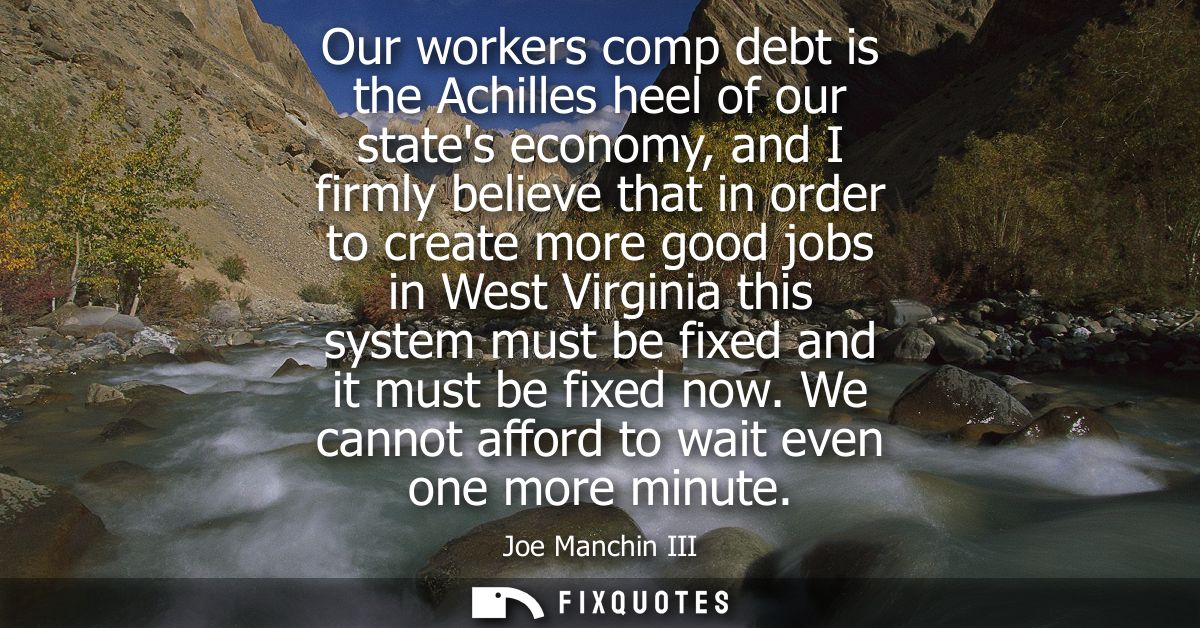
"Our workers' comp debt is the Achilles heel of our state's economy, and I firmly believe that in order to create more good jobs in West Virginia, this system must be fixed and it must be fixed now. We cannot afford to wait even one more minute"
About this Quote
The real target is business confidence. In a state long defined by coal’s boom-bust economics and high injury rates, workers’ compensation isn’t just a benefit program; it’s a cost signal. By tying comp debt directly to “more good jobs,” Manchin translates a complicated liability issue into the language employers and voters both understand: payrolls. “Good” is the rhetorical pressure point, hinting that without reform, the jobs on offer are either scarce, low-wage, or fleeting.
The urgency line - “fixed now” and “not even one more minute” - is more than theater. It’s an attempt to preempt the two predictable objections: that reform will hurt workers, and that reform can wait. Manchin is betting that anxiety about stagnation will outweigh suspicion about what “fixing” might mean: benefit cuts, stricter eligibility, or shifting costs. The subtext is a trade: accept painful adjustments in the name of economic survival, and trust that the state will still protect you when you get hurt.
Quote Details
| Topic | Work |
|---|---|
| Source | Help us find the source |
| Cite |
Citation Formats
APA Style (7th ed.)
III, Joe Manchin. (2026, February 16). Our workers' comp debt is the Achilles heel of our state's economy, and I firmly believe that in order to create more good jobs in West Virginia, this system must be fixed and it must be fixed now. We cannot afford to wait even one more minute. FixQuotes. https://fixquotes.com/quotes/our-workers-comp-debt-is-the-achilles-heel-of-our-113443/
Chicago Style
III, Joe Manchin. "Our workers' comp debt is the Achilles heel of our state's economy, and I firmly believe that in order to create more good jobs in West Virginia, this system must be fixed and it must be fixed now. We cannot afford to wait even one more minute." FixQuotes. February 16, 2026. https://fixquotes.com/quotes/our-workers-comp-debt-is-the-achilles-heel-of-our-113443/.
MLA Style (9th ed.)
"Our workers' comp debt is the Achilles heel of our state's economy, and I firmly believe that in order to create more good jobs in West Virginia, this system must be fixed and it must be fixed now. We cannot afford to wait even one more minute." FixQuotes, 16 Feb. 2026, https://fixquotes.com/quotes/our-workers-comp-debt-is-the-achilles-heel-of-our-113443/. Accessed 8 Apr. 2026.