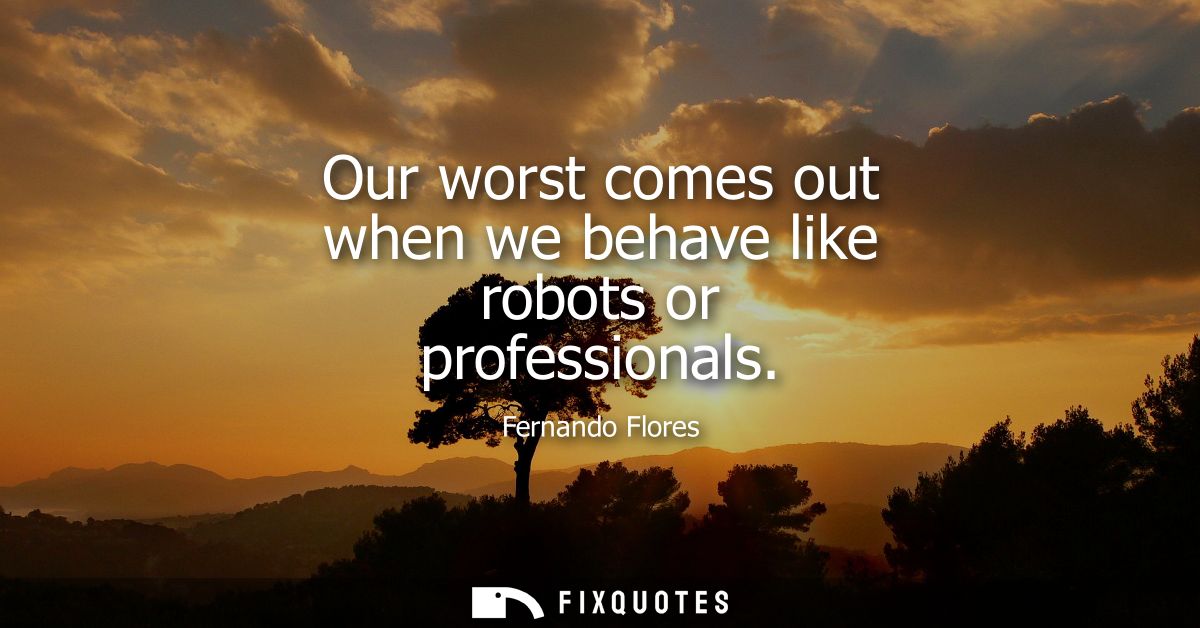
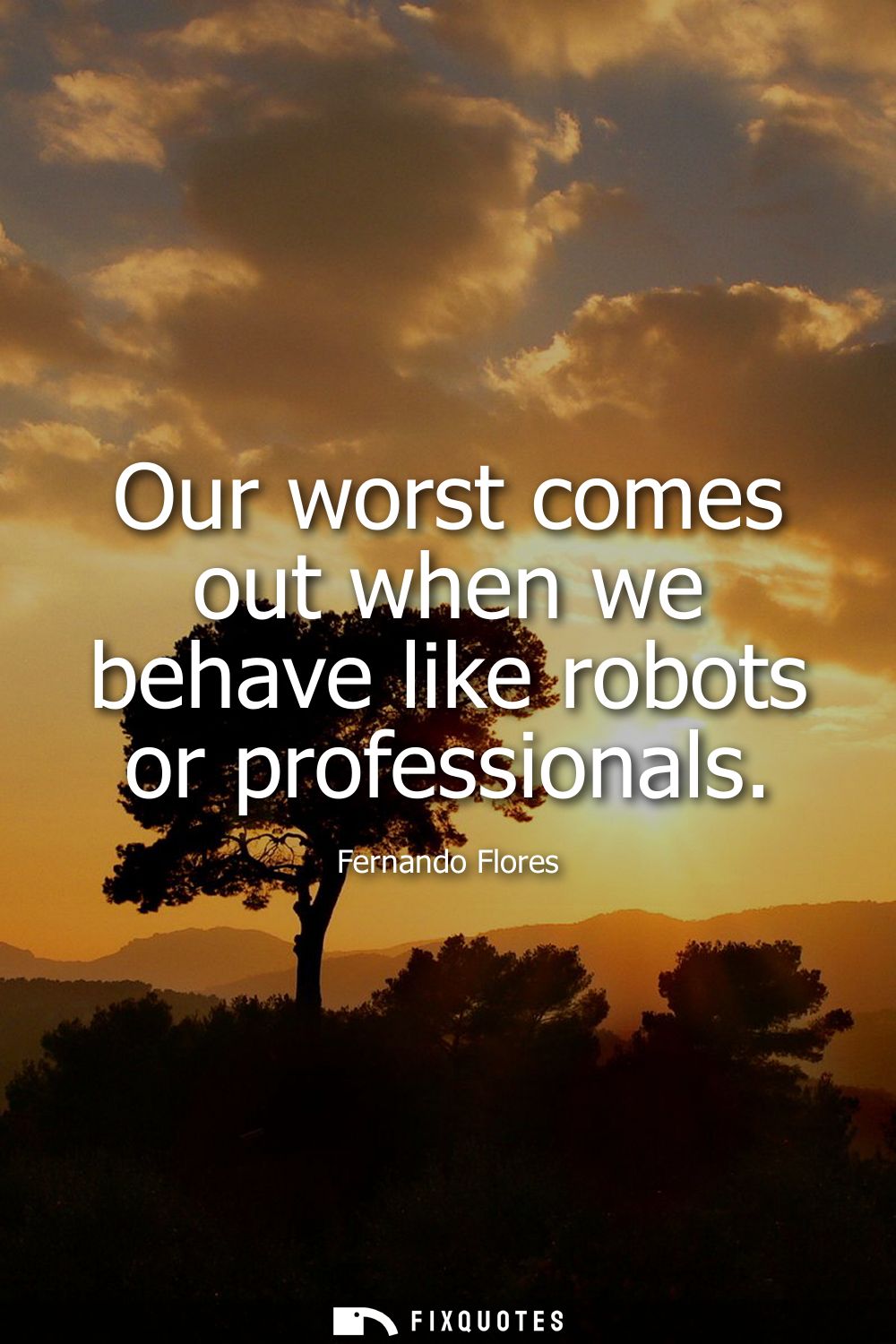
"Our worst comes out when we behave like robots or professionals"
About this Quote
The jab lands because it flips two supposedly admirable identities into a warning label. “Robots” and “professionals” are roles we’re trained to respect: efficient, competent, reliable. Flores treats them as masks that smother the messy moral equipment humans actually need. In politics especially, the promise of frictionless performance is seductive. Sound bites, protocols, “best practices,” stakeholder decks: the apparatus of professionalism can turn into a laundering system for responsibility. If you followed procedure, you’re absolved. If you hit the metric, you’re “doing your job.” Harm becomes an externality with a nice font.
The line’s intent is less anti-expertise than anti-automation of judgment. A robot doesn’t hesitate; a professional, in the pejorative sense Flores is aiming at, doesn’t either. Both are optimized for predictability, and predictability is often what institutions reward. The subtext is that our “worst” isn’t rage or impulse; it’s the cold, defended posture of someone who has outsourced conscience to a script. Think of the bureaucrat who “can’t make exceptions,” the operative who repeats talking points while a community burns, the manager who calls a layoff “right-sizing.” Language becomes a shield.
Flores, a politician, is also indicting his own ecosystem: modern governance runs on systems, not souls. The quote is a plea for human presence inside public life - for leaders who can break character, admit uncertainty, and act with ethical improvisation. Professionalism, when it hardens into performance, is just robotics with better tailoring.
The line’s intent is less anti-expertise than anti-automation of judgment. A robot doesn’t hesitate; a professional, in the pejorative sense Flores is aiming at, doesn’t either. Both are optimized for predictability, and predictability is often what institutions reward. The subtext is that our “worst” isn’t rage or impulse; it’s the cold, defended posture of someone who has outsourced conscience to a script. Think of the bureaucrat who “can’t make exceptions,” the operative who repeats talking points while a community burns, the manager who calls a layoff “right-sizing.” Language becomes a shield.
Flores, a politician, is also indicting his own ecosystem: modern governance runs on systems, not souls. The quote is a plea for human presence inside public life - for leaders who can break character, admit uncertainty, and act with ethical improvisation. Professionalism, when it hardens into performance, is just robotics with better tailoring.
Quote Details
| Topic | Self-Improvement |
|---|---|
| Source | Help us find the source |
| Cite |
Citation Formats
APA Style (7th ed.)
Flores, Fernando. (2026, January 17). Our worst comes out when we behave like robots or professionals. FixQuotes. https://fixquotes.com/quotes/our-worst-comes-out-when-we-behave-like-robots-or-59978/
Chicago Style
Flores, Fernando. "Our worst comes out when we behave like robots or professionals." FixQuotes. January 17, 2026. https://fixquotes.com/quotes/our-worst-comes-out-when-we-behave-like-robots-or-59978/.
MLA Style (9th ed.)
"Our worst comes out when we behave like robots or professionals." FixQuotes, 17 Jan. 2026, https://fixquotes.com/quotes/our-worst-comes-out-when-we-behave-like-robots-or-59978/. Accessed 28 Mar. 2026.
More Quotes by Fernando
Add to List