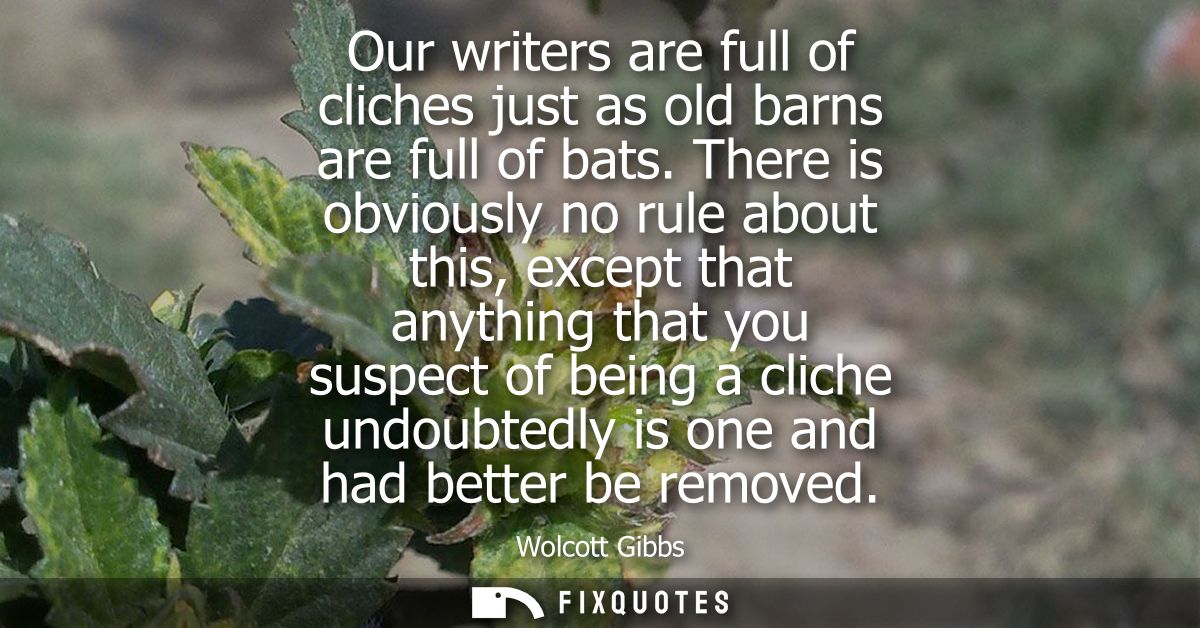
"Our writers are full of cliches just as old barns are full of bats. There is obviously no rule about this, except that anything that you suspect of being a cliche undoubtedly is one and had better be removed"
About this Quote
His “rule” is a fake rule, the kind editors use when they know the real standard can’t be reduced to a checklist: taste. “Anything that you suspect…undoubtedly is one” sounds authoritarian, but it’s actually a bet on the writer’s ear. If your internal alarm goes off, that’s not neurosis; it’s craft. Gibbs is telling you to treat that faint embarrassment as diagnostic. Cliches aren’t merely unoriginal. They’re the moment your prose stops making contact with lived perception and starts replaying prepackaged sentiment.
Context matters here: Gibbs was a New Yorker fixture, part of a magazine culture that prized compression, surprise, and the clean snap of the right word. In that world, a cliche isn’t harmless decor; it’s professional negligence, a signal that the writer is leaning on communal autopilot instead of doing the hard work of naming what they actually mean. The wit is surgical, but the intent is practical: revise until the language can’t be mistaken for anyone else’s.
Quote Details
| Topic | Writing |
|---|---|
| Source | Verified source: Theory and Practice of Editing New Yorker Articles (Wolcott Gibbs, 1937)
Evidence:
Our writers are full of cliches, just as old barns are full of bats. There is obviously no rule about this, except that anything that you suspect of being a cliche undoubtedly is one, and had better be removed. (Item 3; page 1 in later reproduced typescript). The earliest primary-source evidence I found is Wolcott Gibbs' own document 'Theory and Practice of Editing New Yorker Articles,' a New Yorker internal editorial memorandum. The reproduced typescript states it 'was written by Wolcott Gibbs around 1937, apparently at the request of Katharine White.' In that document, the quotation appears as item 3 on page 1. I did not find evidence that it was first published publicly in 1937; the evidence suggests it may originally have circulated privately inside The New Yorker and was only published much later in anthologies/excerpts. So the best verified original source is Gibbs' own 1937 internal memo, but the first public publication remains unconfirmed from the materials I located. |
| Cite |
Citation Formats
APA Style (7th ed.)
Gibbs, Wolcott. (2026, March 13). Our writers are full of cliches just as old barns are full of bats. There is obviously no rule about this, except that anything that you suspect of being a cliche undoubtedly is one and had better be removed. FixQuotes. https://fixquotes.com/quotes/our-writers-are-full-of-cliches-just-as-old-barns-130526/
Chicago Style
Gibbs, Wolcott. "Our writers are full of cliches just as old barns are full of bats. There is obviously no rule about this, except that anything that you suspect of being a cliche undoubtedly is one and had better be removed." FixQuotes. March 13, 2026. https://fixquotes.com/quotes/our-writers-are-full-of-cliches-just-as-old-barns-130526/.
MLA Style (9th ed.)
"Our writers are full of cliches just as old barns are full of bats. There is obviously no rule about this, except that anything that you suspect of being a cliche undoubtedly is one and had better be removed." FixQuotes, 13 Mar. 2026, https://fixquotes.com/quotes/our-writers-are-full-of-cliches-just-as-old-barns-130526/. Accessed 23 Mar. 2026.