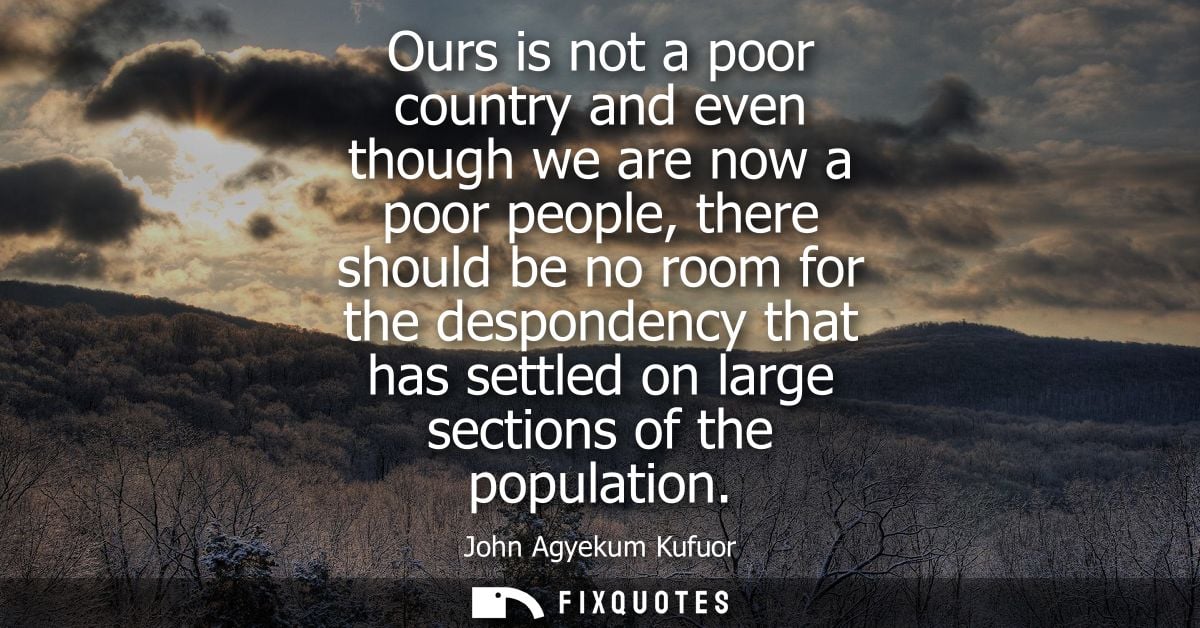
"Ours is not a poor country, and even though we are now a poor people, there should be no room for the despondency that has settled on large sections of the population"
About this Quote
The rhetorical trick is the contrast between structural wealth and social poverty. By framing poverty as a condition of people rather than land, Kufuor shifts the problem from destiny to policy. That matters in a postcolonial context where “we’re poor” can become a permanent alibi, and where external actors (donors, lenders) often narrate African economies as inherently deficient. He’s asserting agency: Ghana’s problems are not geological; they’re political and administrative.
“Despondency” is doing strategic work too. It casts despair as a national risk, not just a private feeling - the kind of mood that depresses investment, invites populism, and normalizes low expectations. The subtext is disciplinary: hope is framed as civic duty. But it’s also an invitation to a new story of competence - a leader asking the public to endure reform and sacrifice because the country’s fundamentals, he implies, justify the struggle.
Quote Details
| Topic | Optimism |
|---|---|
| Source | Help us find the source |
| Cite |
Citation Formats
APA Style (7th ed.)
Kufuor, John Agyekum. (2026, February 18). Ours is not a poor country, and even though we are now a poor people, there should be no room for the despondency that has settled on large sections of the population. FixQuotes. https://fixquotes.com/quotes/ours-is-not-a-poor-country-and-even-though-we-are-69836/
Chicago Style
Kufuor, John Agyekum. "Ours is not a poor country, and even though we are now a poor people, there should be no room for the despondency that has settled on large sections of the population." FixQuotes. February 18, 2026. https://fixquotes.com/quotes/ours-is-not-a-poor-country-and-even-though-we-are-69836/.
MLA Style (9th ed.)
"Ours is not a poor country, and even though we are now a poor people, there should be no room for the despondency that has settled on large sections of the population." FixQuotes, 18 Feb. 2026, https://fixquotes.com/quotes/ours-is-not-a-poor-country-and-even-though-we-are-69836/. Accessed 14 Mar. 2026.