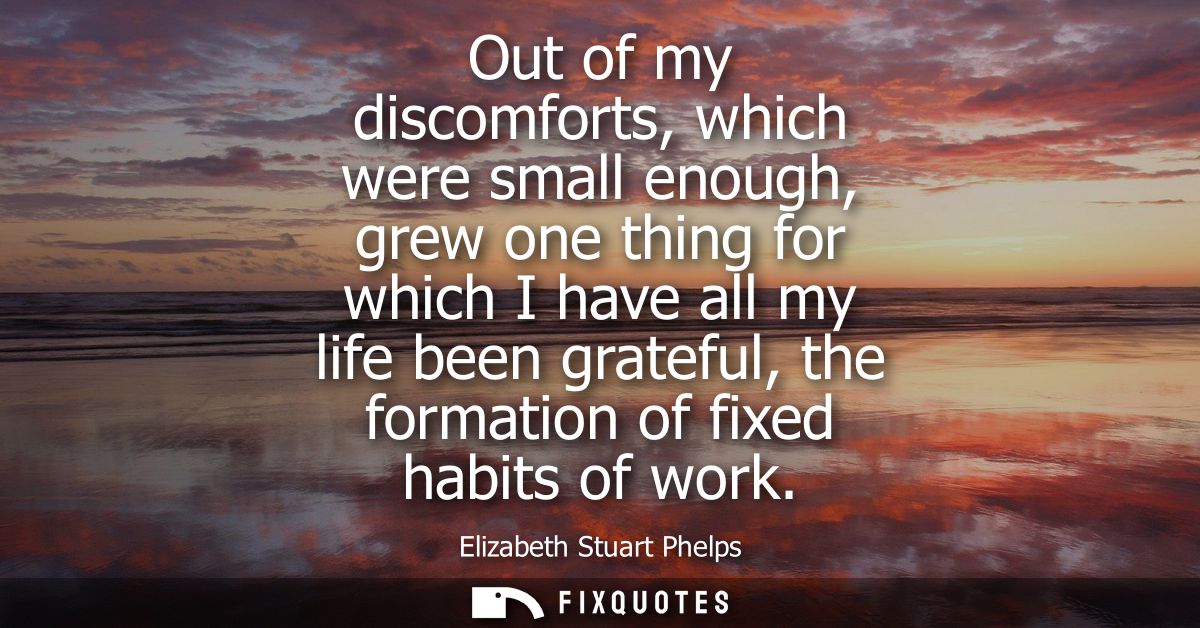
"Out of my discomforts, which were small enough, grew one thing for which I have all my life been grateful, the formation of fixed habits of work"
About this Quote
Phelps is doing something slyly bracing here: she refuses the romantic myth that art is born from lightning bolts and instead credits a far less glamorous engine - routine. The phrase “discomforts, which were small enough” carries a double edge. It’s modesty, yes, but also a quiet corrective to the era’s taste for melodramatic suffering as proof of depth. She’s not claiming trauma as artistic capital; she’s insisting that even minor frictions can be metabolized into structure.
The real pivot is “grew one thing.” Discomfort becomes soil, not a sentence. That verb frames hardship as generative rather than ennobling, and it neatly sidesteps self-pity. Then comes the moral center: “fixed habits of work.” Fixed is the tell. It signals discipline as a chosen identity, not a temporary coping strategy. For a 19th-century woman writer navigating domestic expectations and a literary marketplace that often patronized or constrained female ambition, “habits” are also camouflage and leverage: a way to make creativity legible as duty, and therefore socially defensible.
Subtextually, Phelps is proposing a democratic, almost modern theory of productivity: you don’t wait to feel inspired or validated; you build a system sturdy enough to survive mood, interruption, and doubt. Gratitude, in this frame, isn’t for suffering itself. It’s for the accidental training in endurance - the kind that turns writing from a temperament into a practice.
The real pivot is “grew one thing.” Discomfort becomes soil, not a sentence. That verb frames hardship as generative rather than ennobling, and it neatly sidesteps self-pity. Then comes the moral center: “fixed habits of work.” Fixed is the tell. It signals discipline as a chosen identity, not a temporary coping strategy. For a 19th-century woman writer navigating domestic expectations and a literary marketplace that often patronized or constrained female ambition, “habits” are also camouflage and leverage: a way to make creativity legible as duty, and therefore socially defensible.
Subtextually, Phelps is proposing a democratic, almost modern theory of productivity: you don’t wait to feel inspired or validated; you build a system sturdy enough to survive mood, interruption, and doubt. Gratitude, in this frame, isn’t for suffering itself. It’s for the accidental training in endurance - the kind that turns writing from a temperament into a practice.
Quote Details
| Topic | Habits |
|---|
More Quotes by Elizabeth
Add to List