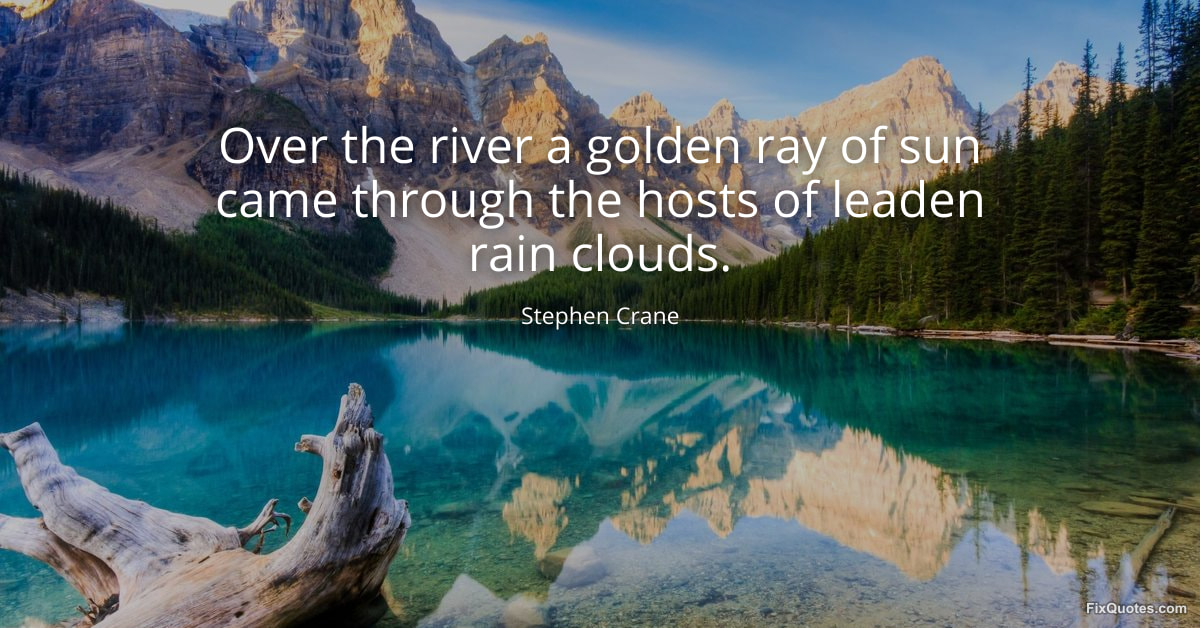
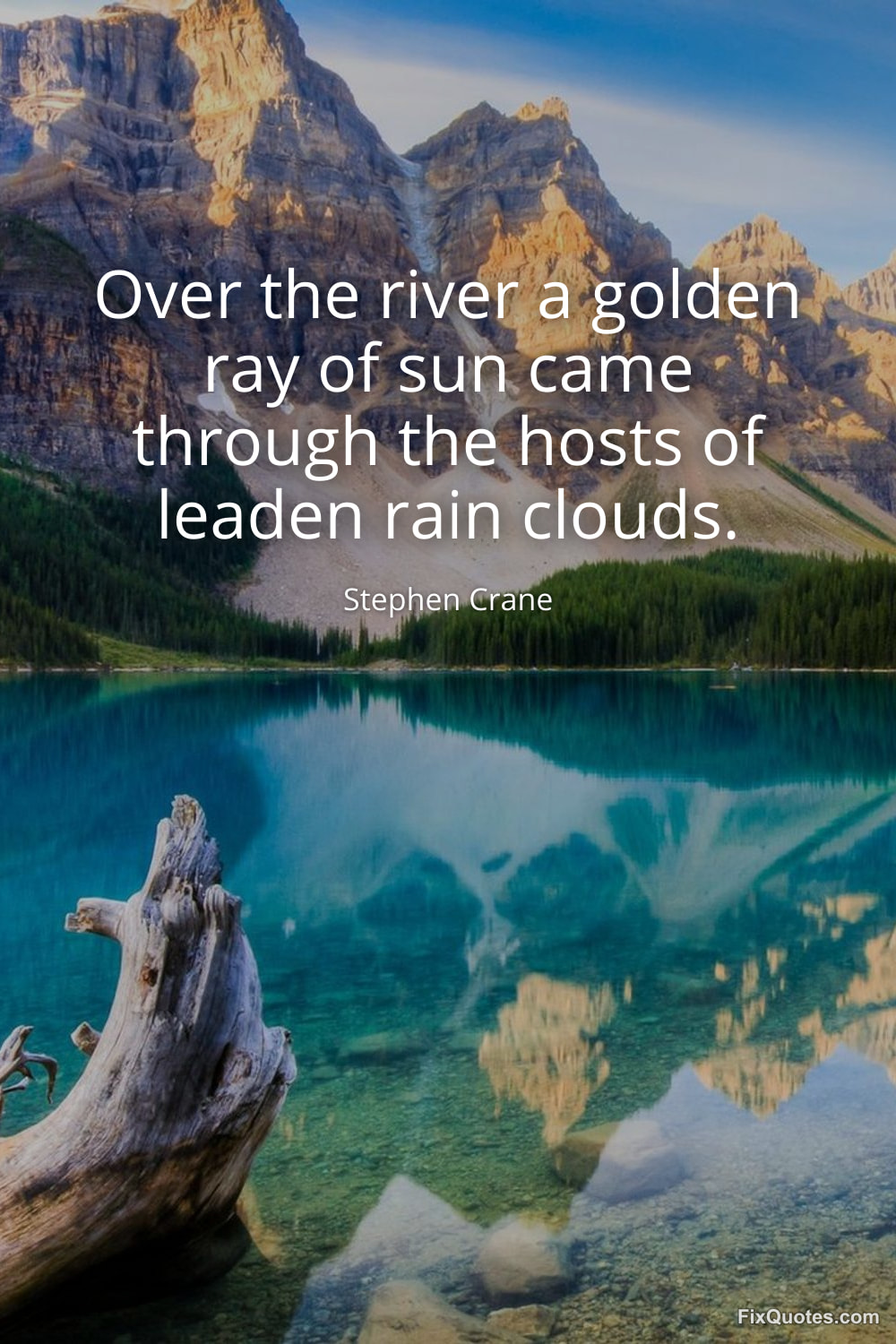
"Over the river, a golden ray of sun came through the hosts of leaden rain clouds"
About this Quote
The intent feels characteristically Crane: to dramatize how meaning arrives in flashes under pressure, not as a stable, comforting backdrop. He was a writer of modern nerves and indifferent landscapes, best known for treating war and nature as impersonal forces that grind on without consulting human desire. The subtext here is not “hope wins,” but “hope is measurable.” It’s a ray, singular and partial, arriving “over the river” - a distance marker that reads like a threshold. The river becomes both geography and metaphor: a line between where you are (under the storm) and where light is still possible.
Contextually, Crane’s late-19th-century realism (and proto-naturalism) loved these collisions: beauty that doesn’t redeem, light that doesn’t guarantee. The sentence works because it refuses to resolve the tension. It gives you gold, then makes you look back at the lead.
Quote Details
| Topic | Nature |
|---|---|
| Source | Help us find the source |
| Cite |
Citation Formats
APA Style (7th ed.)
Crane, Stephen. (2026, February 16). Over the river, a golden ray of sun came through the hosts of leaden rain clouds. FixQuotes. https://fixquotes.com/quotes/over-the-river-a-golden-ray-of-sun-came-through-173385/
Chicago Style
Crane, Stephen. "Over the river, a golden ray of sun came through the hosts of leaden rain clouds." FixQuotes. February 16, 2026. https://fixquotes.com/quotes/over-the-river-a-golden-ray-of-sun-came-through-173385/.
MLA Style (9th ed.)
"Over the river, a golden ray of sun came through the hosts of leaden rain clouds." FixQuotes, 16 Feb. 2026, https://fixquotes.com/quotes/over-the-river-a-golden-ray-of-sun-came-through-173385/. Accessed 22 Feb. 2026.