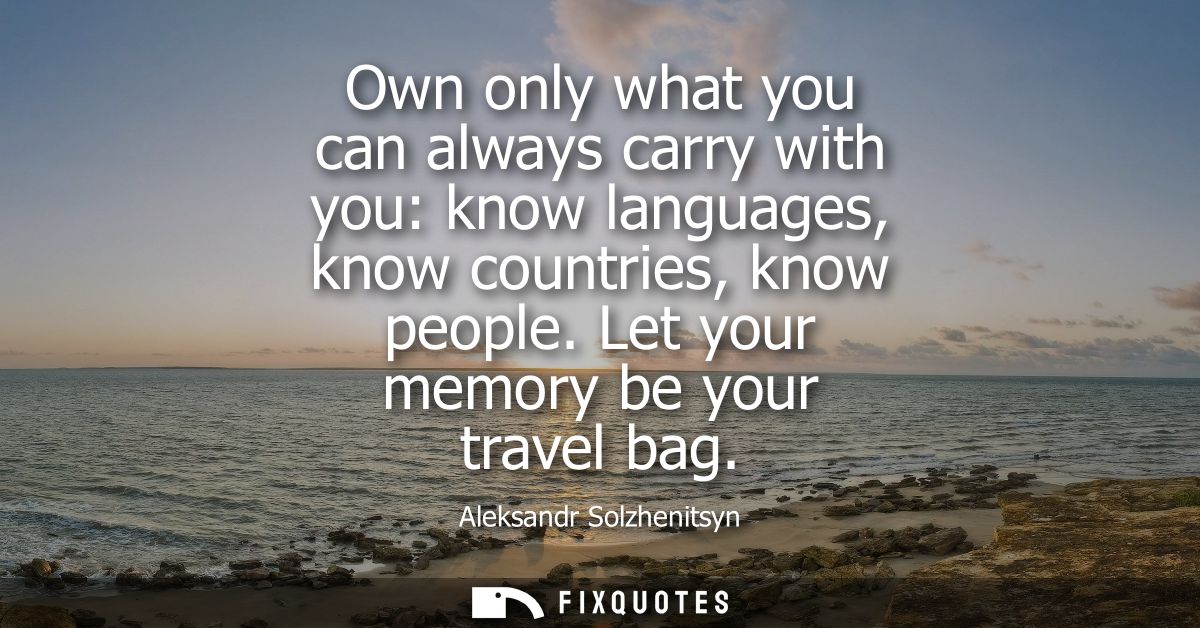
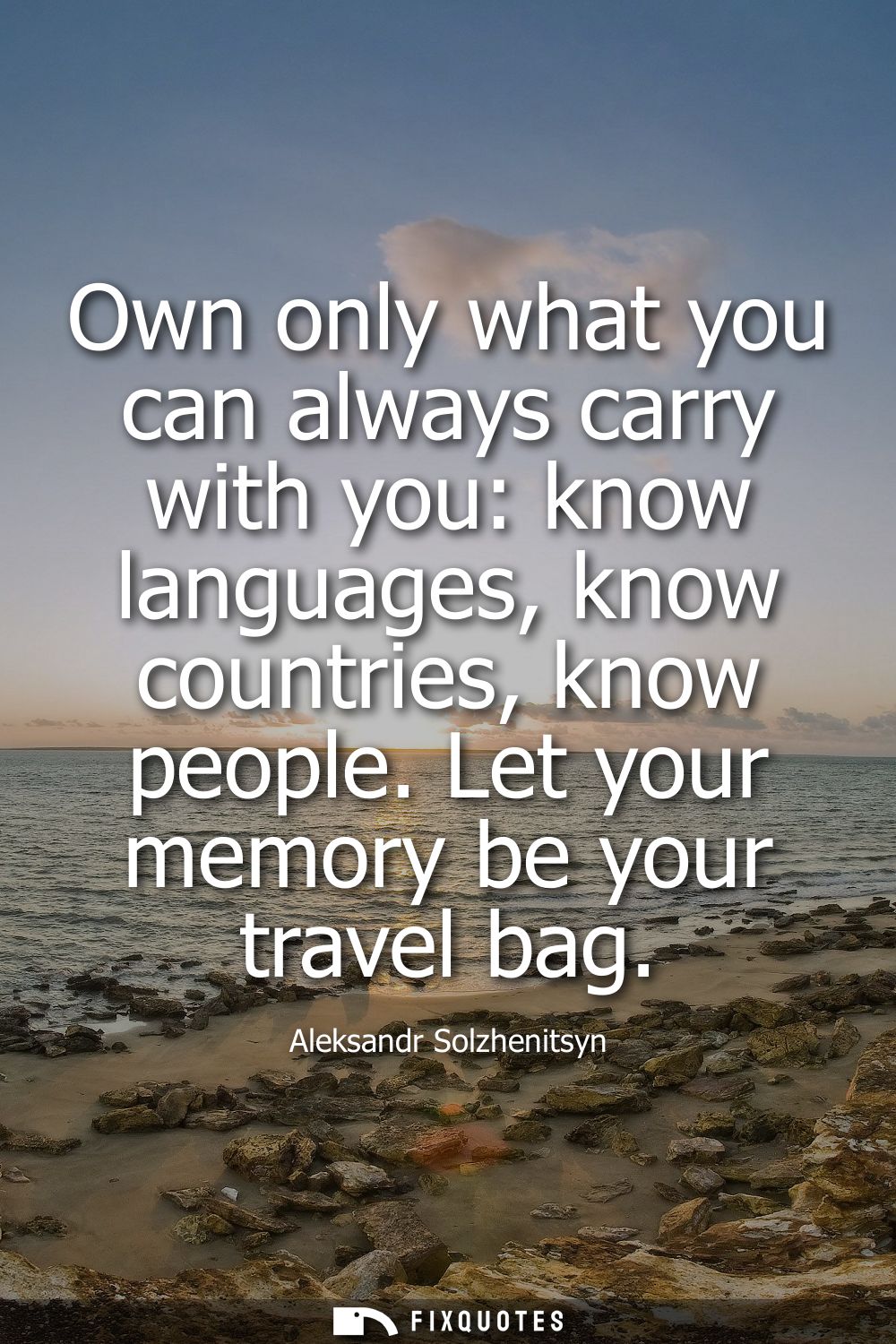
"Own only what you can always carry with you: know languages, know countries, know people. Let your memory be your travel bag"
About this Quote
The triad "know languages, know countries, know people" is doing quiet ideological work. It’s not tourism; it’s literacy. Languages are access codes; countries are vantage points; people are the evidence that reality exceeds whatever official story you’ve been handed. That list also smuggles in a counter-nationalism: the self that can’t be pinned to one border, one narrative, one obedient vocabulary.
"Let your memory be your travel bag" lands with Solzhenitsyn’s characteristic moral severity. Memory isn’t sentimental; it’s portable capital and a form of resistance. If a regime relies on amnesia - on rewriting yesterday so it can command today - then memory becomes contraband, the one possession you can’t legally seize without destroying the person. The subtext is clear: the safest wealth is interior, but it’s also a responsibility. Carrying memory means refusing to be edited, refusing to forget what you’ve seen, and refusing the comforting lie that comfort is guaranteed.
Quote Details
| Topic | Travel |
|---|---|
| Source | A World Split Apart (Harvard Commencement Address), Aleksandr Solzhenitsyn, delivered June 8, 1978; contains the line advising to 'own only what you can always carry with you.' (published as the speech transcript, June 1978) |
| Cite |
Citation Formats
APA Style (7th ed.)
Solzhenitsyn, Aleksandr. (2026, January 17). Own only what you can always carry with you: know languages, know countries, know people. Let your memory be your travel bag. FixQuotes. https://fixquotes.com/quotes/own-only-what-you-can-always-carry-with-you-know-34757/
Chicago Style
Solzhenitsyn, Aleksandr. "Own only what you can always carry with you: know languages, know countries, know people. Let your memory be your travel bag." FixQuotes. January 17, 2026. https://fixquotes.com/quotes/own-only-what-you-can-always-carry-with-you-know-34757/.
MLA Style (9th ed.)
"Own only what you can always carry with you: know languages, know countries, know people. Let your memory be your travel bag." FixQuotes, 17 Jan. 2026, https://fixquotes.com/quotes/own-only-what-you-can-always-carry-with-you-know-34757/. Accessed 18 Feb. 2026.