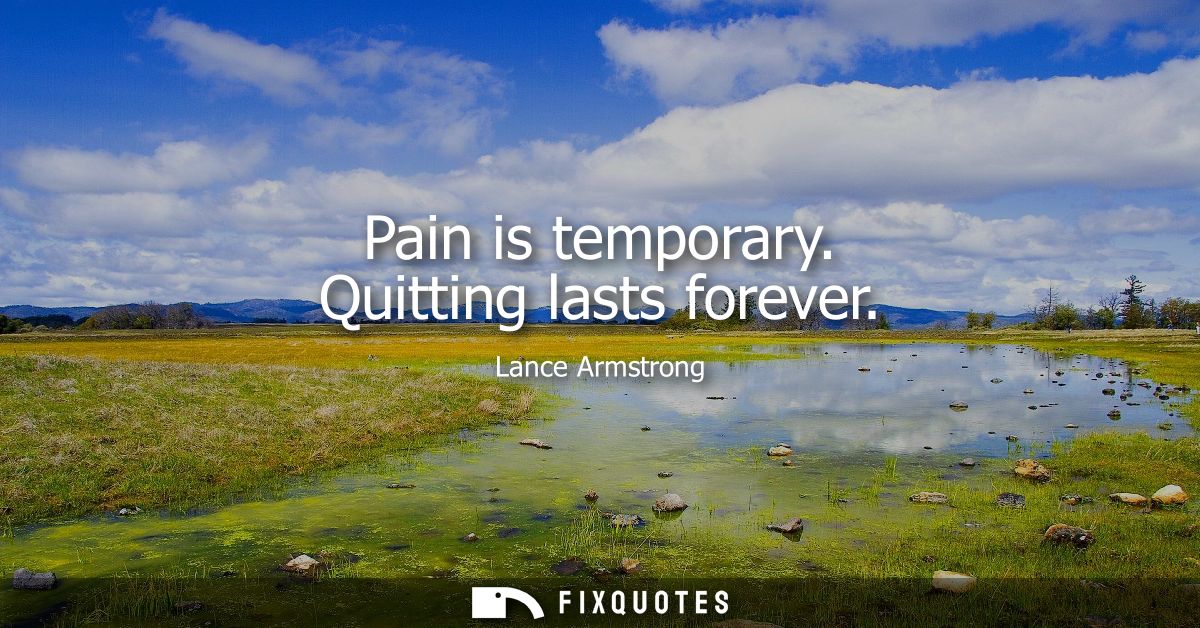
"Pain is temporary. Quitting lasts forever"
About this Quote
“Pain is temporary. Quitting lasts forever” is pure endurance-sport scripture: blunt, rhythmic, and engineered to get you through the next hill by making the alternative feel existential. Two short sentences, each with a clean moral math. Pain is downgraded to weather; quitting is upgraded to identity. That reversal is the trick. It reframes suffering as a passing inconvenience while turning a single decision to stop into a permanent stain, a story you’ll retell about yourself.
The subtext is less about pain than about narrative control. Athletes don’t just compete against competitors; they compete against the possibility of regret. Armstrong’s line weaponizes that fear. It also flirts with absolutism: “temporary” and “forever” are psychological extremes, not physiological truths. The body keeps receipts, and “quitting” can be strategy, survival, or wisdom. But as a locker-room mantra, it’s effective because it collapses nuance. In a moment of fatigue, nuance is the enemy.
Context complicates it. Armstrong became a symbol of superhuman resilience, then a symbol of the costs of worshiping that resilience at any price. Read post-scandal, the quote doubles back on itself: if quitting lasts forever, so does the decision to keep going when you shouldn’t - to treat limits as moral failure, to turn ambition into entitlement. That’s why it endures culturally: it captures the intoxicating romance of grit while inadvertently exposing grit’s shadow, the part that can’t tell perseverance from self-erasure.
The subtext is less about pain than about narrative control. Athletes don’t just compete against competitors; they compete against the possibility of regret. Armstrong’s line weaponizes that fear. It also flirts with absolutism: “temporary” and “forever” are psychological extremes, not physiological truths. The body keeps receipts, and “quitting” can be strategy, survival, or wisdom. But as a locker-room mantra, it’s effective because it collapses nuance. In a moment of fatigue, nuance is the enemy.
Context complicates it. Armstrong became a symbol of superhuman resilience, then a symbol of the costs of worshiping that resilience at any price. Read post-scandal, the quote doubles back on itself: if quitting lasts forever, so does the decision to keep going when you shouldn’t - to treat limits as moral failure, to turn ambition into entitlement. That’s why it endures culturally: it captures the intoxicating romance of grit while inadvertently exposing grit’s shadow, the part that can’t tell perseverance from self-erasure.
Quote Details
| Topic | Never Give Up |
|---|---|
| Source | Help us find the source |
| Cite |
Citation Formats
APA Style (7th ed.)
Armstrong, Lance. (2026, January 17). Pain is temporary. Quitting lasts forever. FixQuotes. https://fixquotes.com/quotes/pain-is-temporary-quitting-lasts-forever-81694/
Chicago Style
Armstrong, Lance. "Pain is temporary. Quitting lasts forever." FixQuotes. January 17, 2026. https://fixquotes.com/quotes/pain-is-temporary-quitting-lasts-forever-81694/.
MLA Style (9th ed.)
"Pain is temporary. Quitting lasts forever." FixQuotes, 17 Jan. 2026, https://fixquotes.com/quotes/pain-is-temporary-quitting-lasts-forever-81694/. Accessed 27 Mar. 2026.
More Quotes by Lance
Add to List