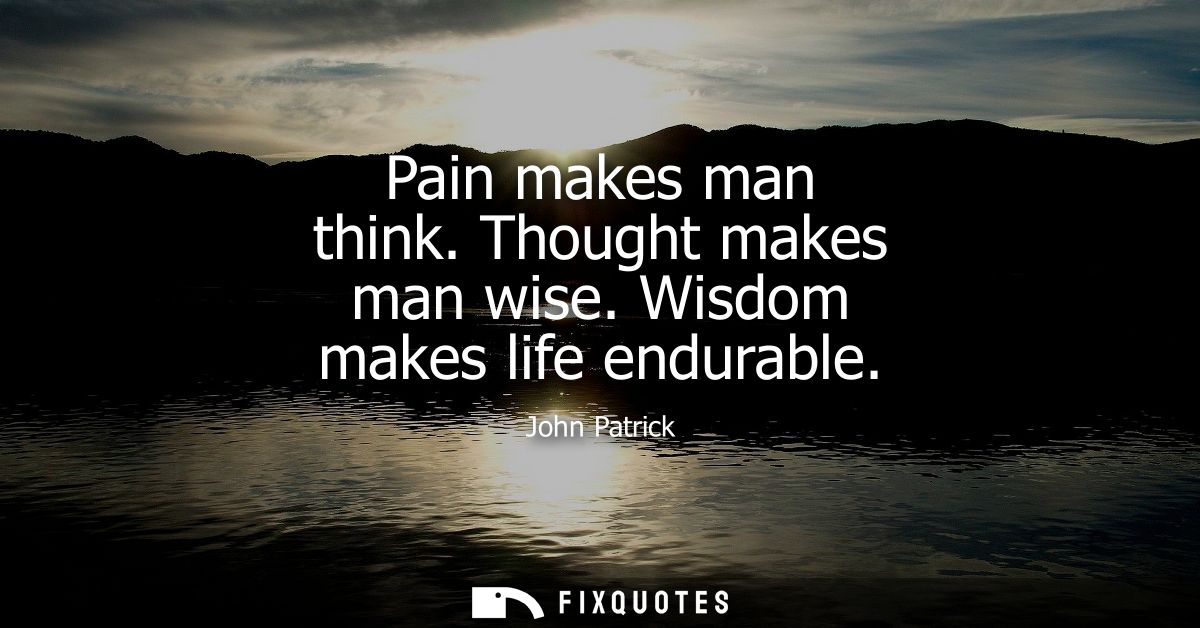
"Pain makes man think. Thought makes man wise. Wisdom makes life endurable"
About this Quote
The subtext is almost transactional: pain charges a fee, and the receipt is thought. But Patrick avoids martyrdom. He doesn't claim pain makes you good; it makes you think. Thinking, in turn, doesn't make you happy; it makes you wise. Wisdom doesn't redeem life; it merely makes it "endurable", a word that lowers the temperature from inspiration to survival. That's a quietly modern move, closer to stoic pragmatism than uplift: the best-case scenario isn't bliss, it's tolerability.
Context matters here. Patrick wrote for mid-century audiences who'd lived through depression, war, and domestic readjustment - people trained to mistrust grand promises. The line flatters neither suffering nor the sufferer; it offers a spare ethic of consequence. In a culture that often treats pain as either private failure or public spectacle, Patrick reframes it as narrative pressure, the thing that forces character to develop. Not glamorous. Just necessary.
Quote Details
| Topic | Wisdom |
|---|---|
| Source | Later attribution: Respectfully Quoted (James H. Billington, Library of Congress, 2010) modern compilationISBN: 9780486472881 · ID: 91IFAYFhtOMC
Evidence:
... JOHN STUART MILL . - Adlai E. Stevenson , Call to Greatness , p . 102 ( 1954 ) . Unverified . 2002 Pain makes man think . Thought makes man wise . Wisdom makes life endurable . JOHN PATRICK , The Teahouse of the August Moon , act I ... |
| Cite |
Citation Formats
APA Style (7th ed.)
Patrick, John. (2026, March 23). Pain makes man think. Thought makes man wise. Wisdom makes life endurable. FixQuotes. https://fixquotes.com/quotes/pain-makes-man-think-thought-makes-man-wise-106972/
Chicago Style
Patrick, John. "Pain makes man think. Thought makes man wise. Wisdom makes life endurable." FixQuotes. March 23, 2026. https://fixquotes.com/quotes/pain-makes-man-think-thought-makes-man-wise-106972/.
MLA Style (9th ed.)
"Pain makes man think. Thought makes man wise. Wisdom makes life endurable." FixQuotes, 23 Mar. 2026, https://fixquotes.com/quotes/pain-makes-man-think-thought-makes-man-wise-106972/. Accessed 27 Mar. 2026.