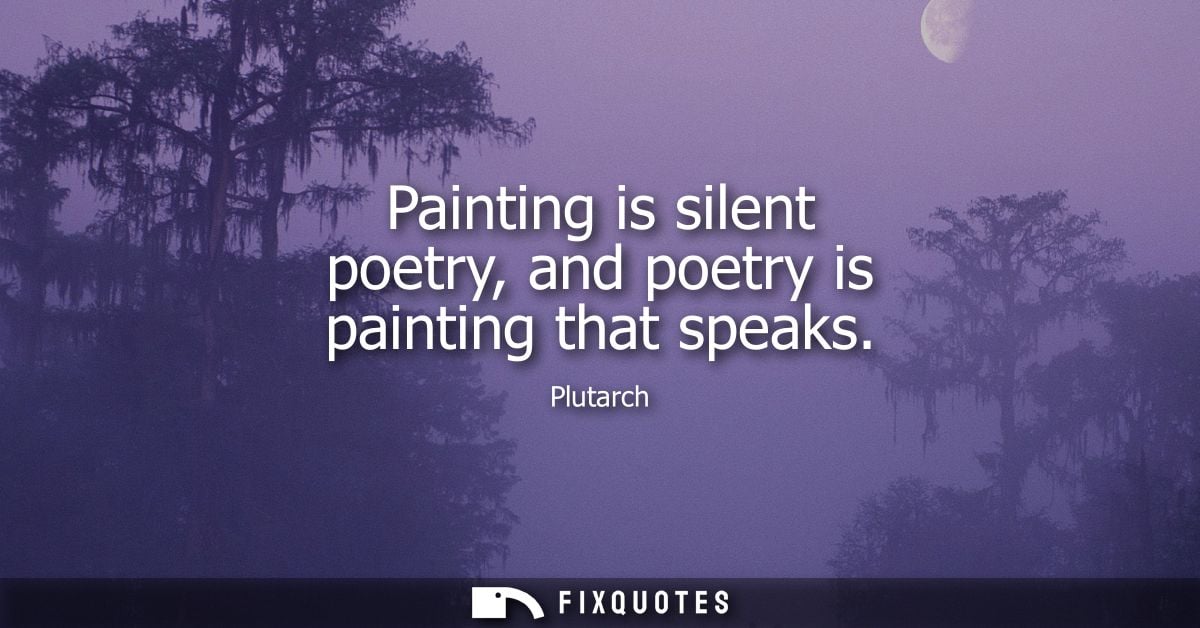
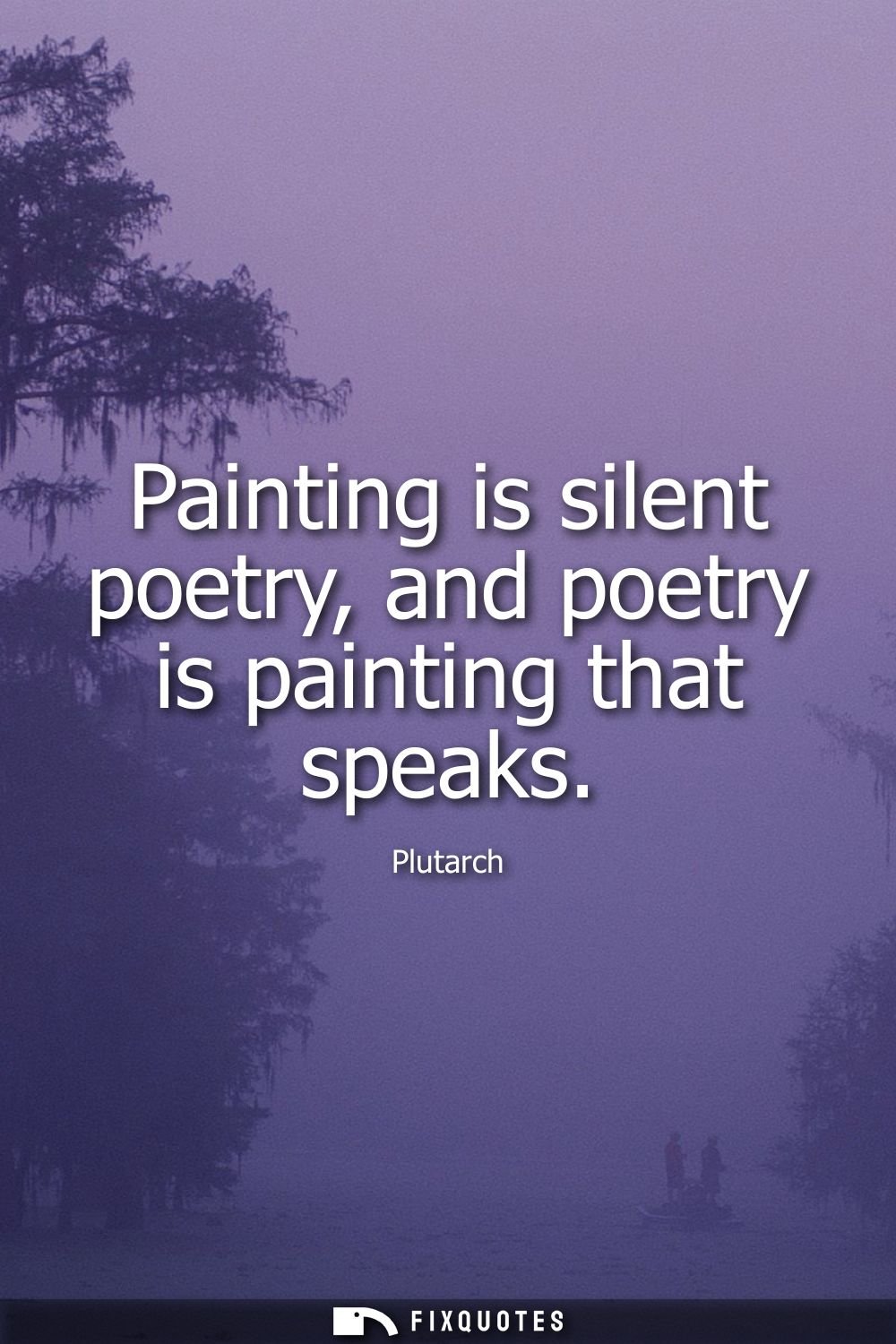
"Painting is silent poetry, and poetry is painting that speaks"
About this Quote
Plutarch’s line is a neat little bridge between two art forms that, in his world, carried real civic weight. Painting and poetry weren’t just “creative expression”; they were tools for shaping memory, character, and public taste. By calling painting “silent poetry,” he grants images a narrative and moral intelligence usually reserved for words. By calling poetry “painting that speaks,” he returns the compliment, arguing that language can be just as sensuous and immediate as a fresco or statue.
The intent isn’t to flatten the differences, though. The subtext is a hierarchy problem: in Greco-Roman culture, verbal arts often claimed higher status because they could argue, persuade, and instruct explicitly. Plutarch quietly refuses that bias. He suggests that an image can do what rhetoric does, only through implication: gesture, composition, the charged pause before action. Silence becomes a feature, not a lack. Painting “poetizes” by compressing a story into a single frame the viewer must complete.
Context matters: Plutarch wrote amid a Roman Empire obsessed with Greek cultural authority, when education revolved around rhetoric and the classics, and elite homes were galleries of mythological scenes meant to signal virtue and lineage. This aphorism defends the visual as a serious moral technology. It also flatters the cultivated reader-viewer: the best audience is bilingual in mediums, able to “hear” a painting and “see” a poem. In a culture anxious about imitation versus originality, Plutarch’s pairing legitimizes both as parallel ways of making meaning feel inevitable.
The intent isn’t to flatten the differences, though. The subtext is a hierarchy problem: in Greco-Roman culture, verbal arts often claimed higher status because they could argue, persuade, and instruct explicitly. Plutarch quietly refuses that bias. He suggests that an image can do what rhetoric does, only through implication: gesture, composition, the charged pause before action. Silence becomes a feature, not a lack. Painting “poetizes” by compressing a story into a single frame the viewer must complete.
Context matters: Plutarch wrote amid a Roman Empire obsessed with Greek cultural authority, when education revolved around rhetoric and the classics, and elite homes were galleries of mythological scenes meant to signal virtue and lineage. This aphorism defends the visual as a serious moral technology. It also flatters the cultivated reader-viewer: the best audience is bilingual in mediums, able to “hear” a painting and “see” a poem. In a culture anxious about imitation versus originality, Plutarch’s pairing legitimizes both as parallel ways of making meaning feel inevitable.
Quote Details
| Topic | Art |
|---|---|
| Source | Help us find the source |
| Cite |
Citation Formats
APA Style (7th ed.)
Plutarch. (2026, January 14). Painting is silent poetry, and poetry is painting that speaks. FixQuotes. https://fixquotes.com/quotes/painting-is-silent-poetry-and-poetry-is-painting-29343/
Chicago Style
Plutarch. "Painting is silent poetry, and poetry is painting that speaks." FixQuotes. January 14, 2026. https://fixquotes.com/quotes/painting-is-silent-poetry-and-poetry-is-painting-29343/.
MLA Style (9th ed.)
"Painting is silent poetry, and poetry is painting that speaks." FixQuotes, 14 Jan. 2026, https://fixquotes.com/quotes/painting-is-silent-poetry-and-poetry-is-painting-29343/. Accessed 12 Feb. 2026.
More Quotes by Plutarch
Add to List