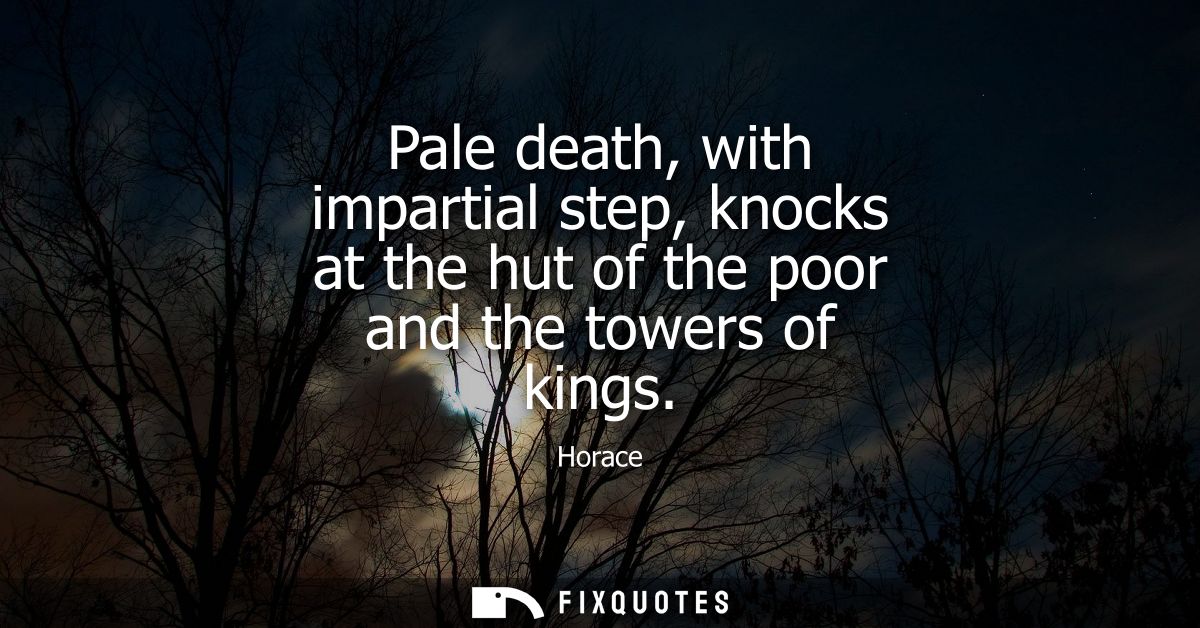
"Pale death, with impartial step, knocks at the hut of the poor, and the towers of kings"
About this Quote
The line’s architecture does the work. “Hut of the poor” and “towers of kings” are stacked as stark visual opposites: cramped survival versus vertical power. Horace doesn’t moralize about inequality; he stages it, then punctures it with a single knock. That knock is key: death isn’t a war or a storm but a visitor you can’t refuse - intimate, domestic, arriving at your door.
Context matters. Horace writes in an Augustan world obsessed with order, status, and the performance of permanence: monuments, lineage, the grandeur of Rome. Against that spectacle, he offers a stoic, almost Epicurean corrective: your social rank is real, but it’s not ultimate. The subtext isn’t just “everyone dies.” It’s “act accordingly.” If kings can’t buy an exemption, why should anyone waste a life chasing the illusion that they can?
Quote Details
| Topic | Mortality |
|---|---|
| Source | Horace, Odes (Carmina), Book 1, Ode 4 — Latin: 'Pallida mors aequo pulsat pede pauperum tabernas regumque turres'. |
| Cite |
Citation Formats
APA Style (7th ed.)
Horace. (2026, February 20). Pale death, with impartial step, knocks at the hut of the poor, and the towers of kings. FixQuotes. https://fixquotes.com/quotes/pale-death-with-impartial-step-knocks-at-the-hut-24562/
Chicago Style
Horace. "Pale death, with impartial step, knocks at the hut of the poor, and the towers of kings." FixQuotes. February 20, 2026. https://fixquotes.com/quotes/pale-death-with-impartial-step-knocks-at-the-hut-24562/.
MLA Style (9th ed.)
"Pale death, with impartial step, knocks at the hut of the poor, and the towers of kings." FixQuotes, 20 Feb. 2026, https://fixquotes.com/quotes/pale-death-with-impartial-step-knocks-at-the-hut-24562/. Accessed 7 Apr. 2026.