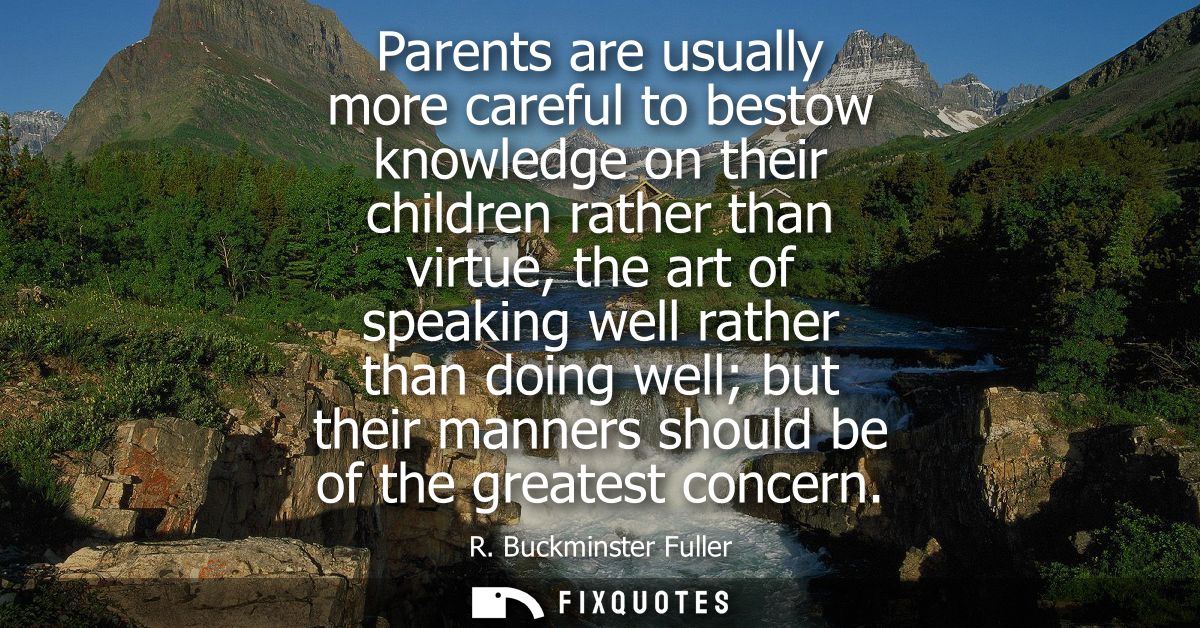
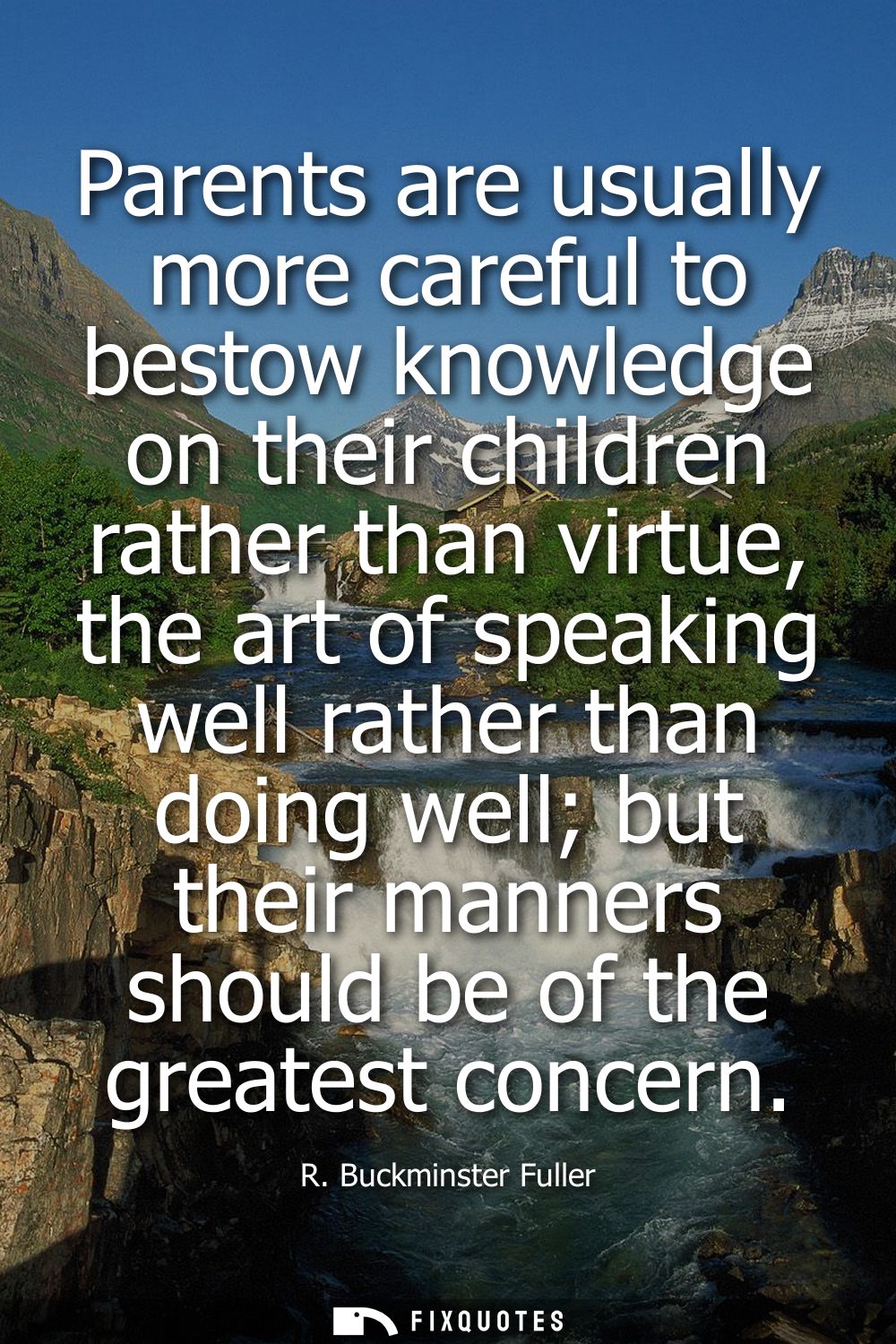
"Parents are usually more careful to bestow knowledge on their children rather than virtue, the art of speaking well rather than doing well; but their manners should be of the greatest concern"
About this Quote
The phrasing matters. “Bestow knowledge” sounds like a gift handed down from above, a credentialed transfer. “Virtue,” by contrast, can’t really be bestowed; it’s cultivated, modeled, rehearsed under pressure. Fuller’s syntax makes that imbalance feel structural, not accidental: parents default to what can be taught, measured, recited. “The art of speaking well” is the perfect stand-in for the social economy of appearances - the kid who interviews well, presents well, wins rooms. “Doing well” is messier, harder to stage, less rewarded in the short term.
Then he lands on “manners,” a word that can read quaint until you realize he’s using it as an everyday proxy for ethics: how you move through the world when no one is grading you. Coming from an inventor obsessed with systems, design, and long-term survival, the subtext is pragmatic: a society optimized for cleverness but indifferent to decency will eventually break. Fuller isn’t moralizing from a pulpit; he’s diagnosing a cultural misallocation of attention - raising rhetoricians when we need responsible actors.
Quote Details
| Topic | Parenting |
|---|---|
| Source | Help us find the source |
| Cite |
Citation Formats
APA Style (7th ed.)
Fuller, R. Buckminster. (2026, January 18). Parents are usually more careful to bestow knowledge on their children rather than virtue, the art of speaking well rather than doing well; but their manners should be of the greatest concern. FixQuotes. https://fixquotes.com/quotes/parents-are-usually-more-careful-to-bestow-9660/
Chicago Style
Fuller, R. Buckminster. "Parents are usually more careful to bestow knowledge on their children rather than virtue, the art of speaking well rather than doing well; but their manners should be of the greatest concern." FixQuotes. January 18, 2026. https://fixquotes.com/quotes/parents-are-usually-more-careful-to-bestow-9660/.
MLA Style (9th ed.)
"Parents are usually more careful to bestow knowledge on their children rather than virtue, the art of speaking well rather than doing well; but their manners should be of the greatest concern." FixQuotes, 18 Jan. 2026, https://fixquotes.com/quotes/parents-are-usually-more-careful-to-bestow-9660/. Accessed 10 Feb. 2026.